| Specification | Detail |
|---|---|
| Dimensions | 255 × 90 × 190 mm (L × W × H) |
| Weight | 1,316.4 g |
| Structure | Suitcase-style flip-top lid with push-button clasp |
| Outer Material | 180 gsm lychee-texture specialty paper |
| Lid Top | 5 mm transparent acrylic window (full-surface) — products visible through closed lid |
| Lid Frame | Lychee-texture paper over greyboard border around acrylic |
| Interior | Red velvet lining (all walls + lid interior) + EVA foam insert |
| Upper EVA Tray | 6 parallel slots for lipsticks (removable) |
| Lower Compartment | 2 large sections for eyeshadow palette + 2 powder compacts |
| Hardware — Structural | 1 × push-button twist clasp (front centre, gold) + 2 × side rotary release knobs (gold) + 2 × hinges (back, gold) |
| Hardware — Decorative | 4 × gold corner guards + 1 × gold brand name plate (rectangular, on acrylic) |
| Handle | 1 × U-shape gold carry handle (front, screwed into base) |
| Process | Partial front emboss + hardware assembly |
| Post-Use | Reusable as jewellery box after cosmetics are used |
Six lipstick slots in the upper removable EVA tray, two large compartments below for an eyeshadow palette and two powder compacts.
Gold hardware on all structural points. A 5 mm transparent acrylic lid that lets you see the entire product arrangement through the closed case.
When the makeup is finished, the case stays. The red velvet lining, the gold corner guards, the carry handle — none of this reads as disposable.
It reads as a jewellery box. A vanity case. Something kept on a dressing table rather than put in a recycling bin.
That is the sustainable packaging argument that actually works at retail: not a certification label on the side of a box that still ends up in landfill, but a structure so useful the customer cannot bring themselves to discard it.
Topvisio is a sustainable packaging manufacturer based in Dongguan, Guangdong, China, supplying this structure with FSC certification, ISO 9001 and ISO 14001 documentation, and for brands shipping into the EU, material composition and packaging-weight data compliant with the PPWR.
Weight: 1,316.4 g. MOQ 1,000 units, sample lead time 7 days, production 30–45 business days after sample approval.
Drawer and book-style boxes have a monthly production capacity of up to 800,000 units.
Under direct light, the texture creates a pattern of microhighlights across the surface. Under sidelight, it deepens.
The 180 gsm weight is chosen for this application because the paper must wrap around the box frame, navigate the corner guards, and lie flat around the acrylic window without lifting or bubbling.
The lid is the defining element of this sustainable packaging. A 5 mm acrylic sheet sits flush in the lid frame, bordered by the lychee-texture paper.
The acrylic is optically clear — not tinted, not frosted. Looking down at the closed case, you see the six lipstick slots and the brand name plate in gold.
The product is on display before the case is opened. That is a retail and unboxing advantage that no opaque lid provides.
The interior is red velvet on all walls, the lid lining, and the base. The velvet is bonded to the EVA foam substrate before assembly.
The upper EVA tray — the six-slot lipstick holder — is removable. Lifting it reveals the lower compartment, sized for one eyeshadow palette and two powder compacts in standard formats.
Hardware on this sustainable packaging: four gold corner guards protect the edges and give the case its suitcase visual language. A push-button twist clasp on the front — press the button and turn the lever to open.
Two rotary release knobs on the sides add secondary security for transit. One U-shape gold carry handle is screwed into the front base.
Two gold hinges on the back allow the lid of this sustainable packaging to open 120 degrees and stay open without a support strut.
This sustainable packaging carries nine separate hardware components: clasp, two rotary knobs, handle, four corner guards, and two hinges.
Each is installed through the lychee-texture paper and greyboard into the box frame. Every installation point requires a precise hole — too small and the hardware cannot be seated; too large and the hardware sits loosely and shifts under use.
The clasp is the most critical. The twist mechanism requires the lid and base clasp components to align within 0.5 mm on all three axes when the lid is closed.
A misalignment of more than this means the clasp either does not engage fully or requires excessive force to open. We use a positioning jig for the clasp installation and test the fit on every 25th unit during the production run.
The corner guards are installed last and must sit flush to the paper surface with no visible gap at any edge. A gap of more than 0.3 mm is visible under normal lighting.
We use a press fixture that applies uniform pressure across all four guard edges simultaneously during bonding.
The lychee-texture paper wraps the full exterior of this sustainable packaging — top, sides, base, and the narrow border strips around the acrylic window.
Where the paper meets the acrylic frame, it must lie perfectly flat with no lifting at the edge. Any gap between paper and acrylic border allows moisture ingress and creates a visual defect that is immediately apparent.
The paper is bonded under controlled tension with a low-moisture adhesive to prevent the dimpled surface from absorbing moisture unevenly and developing micro-wrinkles.
After bonding, the full exterior is held in a formed jig for 30 minutes before any hardware is installed.
The stitching on the lid frame and base edges is a decorative element that also reinforces the paper-to-frame bond at the corners.
Stitch line deviation of more than 2 mm from the intended position is visible against the regular dimple pattern of the lychee texture.
We use a guide rail on the stitching machine and check stitch alignment on the first 10 units of each batch.
Black with red interior is the standard colourway for this sustainable packaging format. The lychee-texture paper is available in champagne, ivory, burgundy,
forest green, navy, and blush, with matching interior velvet colours. The gold hardware works across all colourways.
Gold is the standard hardware finish. Silver, gunmetal, and rose gold are available for all structural and decorative hardware components.
Mixed hardware — gold corner guards with a silver clasp, for example — is possible but adds coordination complexity during assembly.
The 5 mm clear acrylic is the standard specification for this sustainable packaging. A smoked or lightly tinted acrylic can be used if the brand prefers to obscure product details while maintaining the suggestion of depth.
Frosted acrylic is available but eliminates the visibility advantage that makes this case distinctive in gifting contexts.
The six-slot upper tray is calibrated for standard lipstick tube diameters of 12–16 mm.
For brands whose lipstick formats are larger — oversized tubes, lip liner pencils, or chunky lip glosses — we adjust the slot dimensions during sampling.
The lower compartment can be divided into more sections with EVA dividers, or left open for a single large palette.
Two adjustments reduce unit cost meaningfully. First, remove the eight corner guards and the gold brand name plate on the acrylic — these are the decorative hardware components that add both cost and assembly time without affecting structural function.
The clasp, rotary knobs, hinges, and handle remain. The case retains its functional integrity and its suitcase visual identity, with a simpler hardware profile. Removing the eight corner guards alone eliminates eight separate installation steps per unit, since each guard requires its own alignment check and bonding cycle — this is typically the single largest labour saving available on this structure without altering the core mechanism.
Second, replace the 5 mm acrylic window with a PET film sheet — PET is lighter, thinner, and less expensive than acrylic, and still provides full visibility.
The tactile difference between 5 mm acrylic and PET film is significant in hand, but for a budget-sensitive production run, PET delivers the same visual function at meaningfully lower cost. A third lever worth considering for higher-volume orders is standardising on a single hardware finish across the full run rather than offering mixed finishes — this simplifies incoming component inspection and reduces the risk of finish mismatches during assembly, which is a common source of rework on hardware-heavy structures like this one.
These adjustments can be applied individually or combined. Brands running a first production order sometimes start with the full specification to establish the retail positioning, then introduce cost reductions on repeat orders once the format has proven itself at the intended price point — this sequencing lets the brand test market response before committing to a leaner build.
The paper and board components of this sustainable packaging can be sourced as FSC-certified materials, with full chain-of-custody documentation for certified orders.
This structure can also be supplied with ISO 9001 and ISO 14001 documentation, and for brands shipping into the EU, material composition and packaging-weight data compliant with the PPWR.
that cannot actually be recycled in the collection systems of the markets they are sold in.
It appears alongside imagery of forests and leaves on products that generate significant material waste.
The case for calling this sustainable packaging rests on a different premise entirely.
A 1,316.4 g case with gold hardware, velvet lining, and an acrylic window is not something a customer throws away.
The materials communicate permanence. The hardware communicates value. The velvet communicates care.
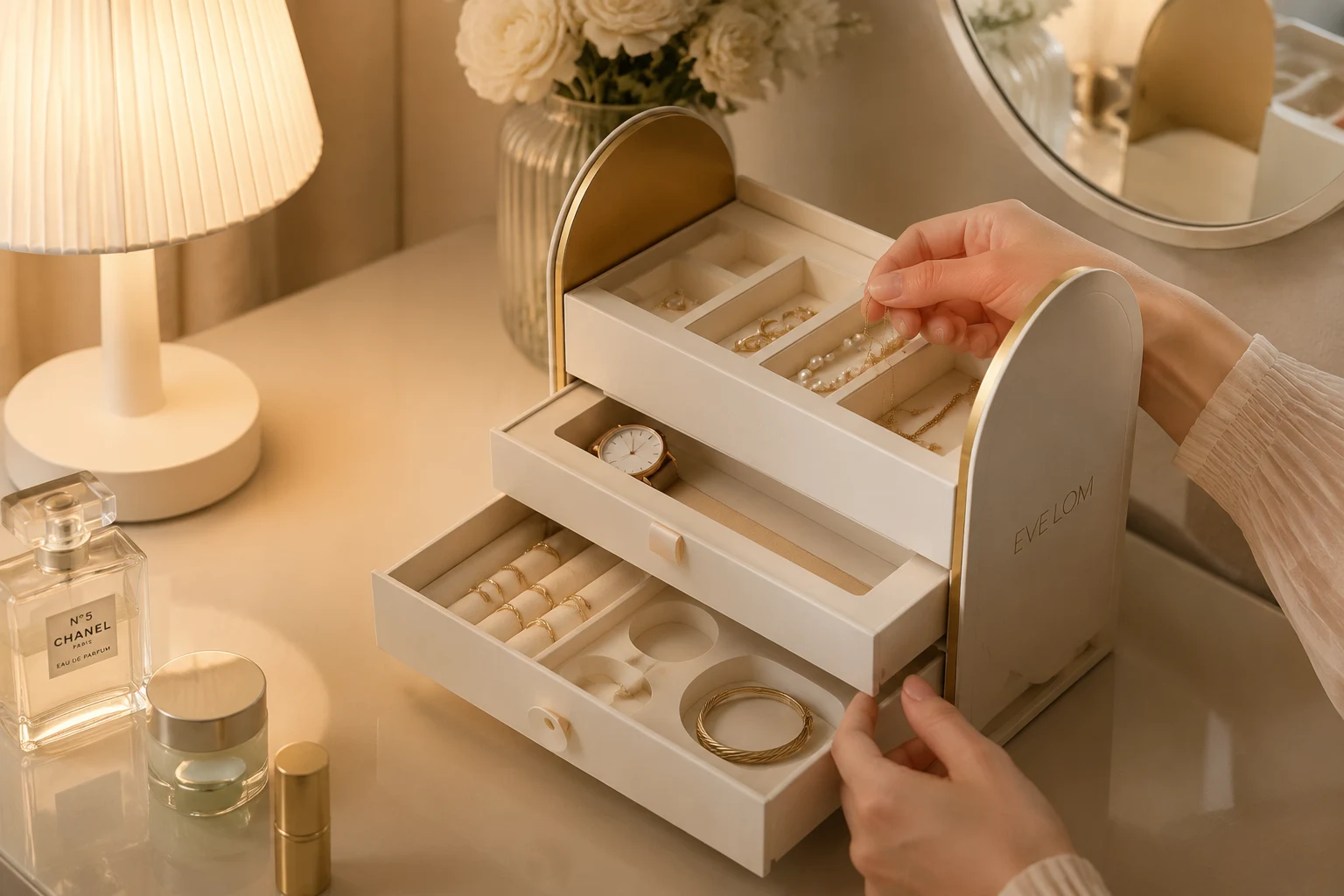
Post-product, the six lipstick slots become ring slots. The lower compartment becomes a storage space for earrings, small accessories, or folded jewellery.
The carry handle makes it portable. The clasp keeps it secure.
That is not marketing language. That is a physical reality of how customers interact with cases built to this specification.
The packaging becomes a possession.
The primary buyer. A brand launching a full-range lipstick collection — six shades, a coordinating eyeshadow palette, two face powder formats — needs a gift presentation format that positions the set as a considered, investable purchase.
This case does that. The acrylic lid puts the products on display before the case is opened. The velvet and gold hardware communicate the same value language as jewellery packaging.
Buyers sourcing exclusive or limited-edition makeup gift sets for seasonal retail often specify packaging at this level when the set needs to justify a price point above £80 or equivalent.
The case format photographs well from multiple angles, which matters for both e-commerce listing images and editorial coverage.
When a cosmetics brand collaborates with a fashion house, an artist, or a cultural institution, the packaging is as much the product as the cosmetics inside.
This case format supports that positioning. The acrylic window can carry an engraved or printed design element.
The corner guards can carry a co-brand logo. The velvet colour can be matched to a specific brand palette.
Companies that supply premium gift sets for client relationship programmes, employee recognition, or event gifting use this format when the gift needs to be memorable and reusable.
The carry handle makes it practical. The jewellery-box post-use function extends the brand’s presence in the recipient’s daily environment.
The upper removable EVA tray holds 6 lipsticks in slots calibrated for 12–16 mm diameter tubes.
The lower compartment — accessible by lifting the upper tray — accommodates one eyeshadow palette up to approximately 220 × 80 mm and two standard powder compacts up to 90 mm diameter.
Send us your specific product dimensions and we will confirm fit or propose an adjusted insert layout before sampling.
5 mm acrylic is significantly more impact-resistant than standard packaging materials. It will not crack under normal parcel handling.
However, this sustainable packaging should be shipped inside an outer carton with void fill to prevent the acrylic surface from being scratched by other items.
The acrylic frame is bonded into the lid structure and will not separate under normal transit forces.
Yes. The gold brand name plate on the acrylic is the standard location for engraved or printed branding.
The corner guards can also carry a small embossed logo. The clasp face is too small for legible engraving in most cases, but the rotary knobs can carry a simple monogram or symbol.
Branding placement is confirmed during the sampling phase.
The sustainable packaging case for this format rests on longevity and reusability rather than material composition.
The Ellen MacArthur Foundation's framework for sustainable packaging identifies reusability and extended product life as core principles of circular packaging design.
A case kept and reused for 2–3 years has a significantly lower environmental impact per use than a single-use carton that is discarded immediately, regardless of material composition.
For brands that additionally require material-level credentials, this sustainable packaging can be supplied with FSC certification, ISO 9001 and ISO 14001 documentation, and for brands shipping into the EU, material composition and packaging-weight data compliant with the PPWR.
MOQ is 1,000 units. Sample lead time is 7 days after design confirmation and covers all hardware, acrylic window fit, velvet lining, EVA insert slot dimensions, and exterior paper wrap flatness. Production lead time is 30–45 business days after sample approval.
No charge for standard sampling on orders that proceed to production.
Topvisio is a sustainable packaging manufacturer based in Dongguan, Guangdong, China. This structure can be supplied with FSC certification, ISO 9001 and ISO 14001 documentation, and for brands shipping into the EU, material composition and packaging-weight data compliant with the PPWR.
GET STARTED
Sample in 7 Days
Tell us your products, the box size, colour, and quantity.
We’ll respond within 24 hours.
Secondary Subheadings
Secondary Subheadings
Secondary Subheadings