| Label | Value |
|---|---|
| Product Name | Beveled-Edge Two Piece Box |
| Structure | Telescoping lid + base (beveled lid edge, no hinge, no magnet) |
| Size — Mini | 160 × 160 × 102 mm / 200 g |
| Size — Small | 190 × 190 × 105 mm / 259.4 g |
| Size — Medium | 210 × 210 × 115 mm / 322.6 g |
| Size — Large | 245 × 245 × 111 mm / 407.9 g |
| Lid Board | 157 gsm coated duplex + 1,200 gsm double-grey |
| Base Board | 182 gsm gold card + 1,200 gsm double-grey |
| Lid Finish | CMYK + 1 spot colour (base) / soft-touch matte lamination / partial emboss + foil stamp (logo badge) / partial semi-gloss matte UV / V-score / die-cut / assembly |
| Base Finish | 182 gsm gold card / laminated / plain gold exterior |
| Certifications | FSC on request, PPWR compliant documentation available |
| Application | Skincare sets (toner, lotion, cream), cosmetic gift sets |
| MOQ | 1000 pcs per size |
| Sample Lead Time | One week after design confirmation |
| Production Lead Time | 30-45 working days after sample approval |
mechanism. It is the oldest and most structurally reliable format in premium gift packaging, and it remains the most widely used for cosmetic sets, skincare gift ranges, and seasonal limited editions.
This two piece box uses a beveled-edge lid — the lid walls angle outward slightly rather than running straight down. This is not purely decorative. The bevel creates a wider contact surface between lid and base, which reduces the friction force needed to remove the lid and eliminates the tight-pull failure common in straight-walled telescoping boxes. It also gives the box a more architectural silhouette on the shelf.
Topvisio produces this two piece box in four sizes — 160 mm, 190 mm, 210 mm, and 245 mm square — sharing the same print artwork and surface finish. The lid is wrapped in 157 gsm coated duplex over 1,200 gsm double-grey structural board, printed in CMYK plus one spot-colour base and finished in soft-touch matte lamination. The base uses 182 gsm gold card over 1,200 gsm double-grey, laminated, presenting as a clean champagne gold exterior.
Topvisio is a two piece box manufacturer based in Dongguan, Guangdong, China, supplying this structure with FSC certification, ISO 9001 and ISO 14001 documentation, and for brands shipping into the EU, material composition and packaging-weight data compliant with the PPWR. MOQ is 1,000 units, sample lead time is 7 days, and production lead time is 30–45 business days after sample approval.
Two-piece lid-and-base boxes have a monthly production capacity of up to 1,500,000 units.
This one does not. The lid and base carry different materials on purpose.
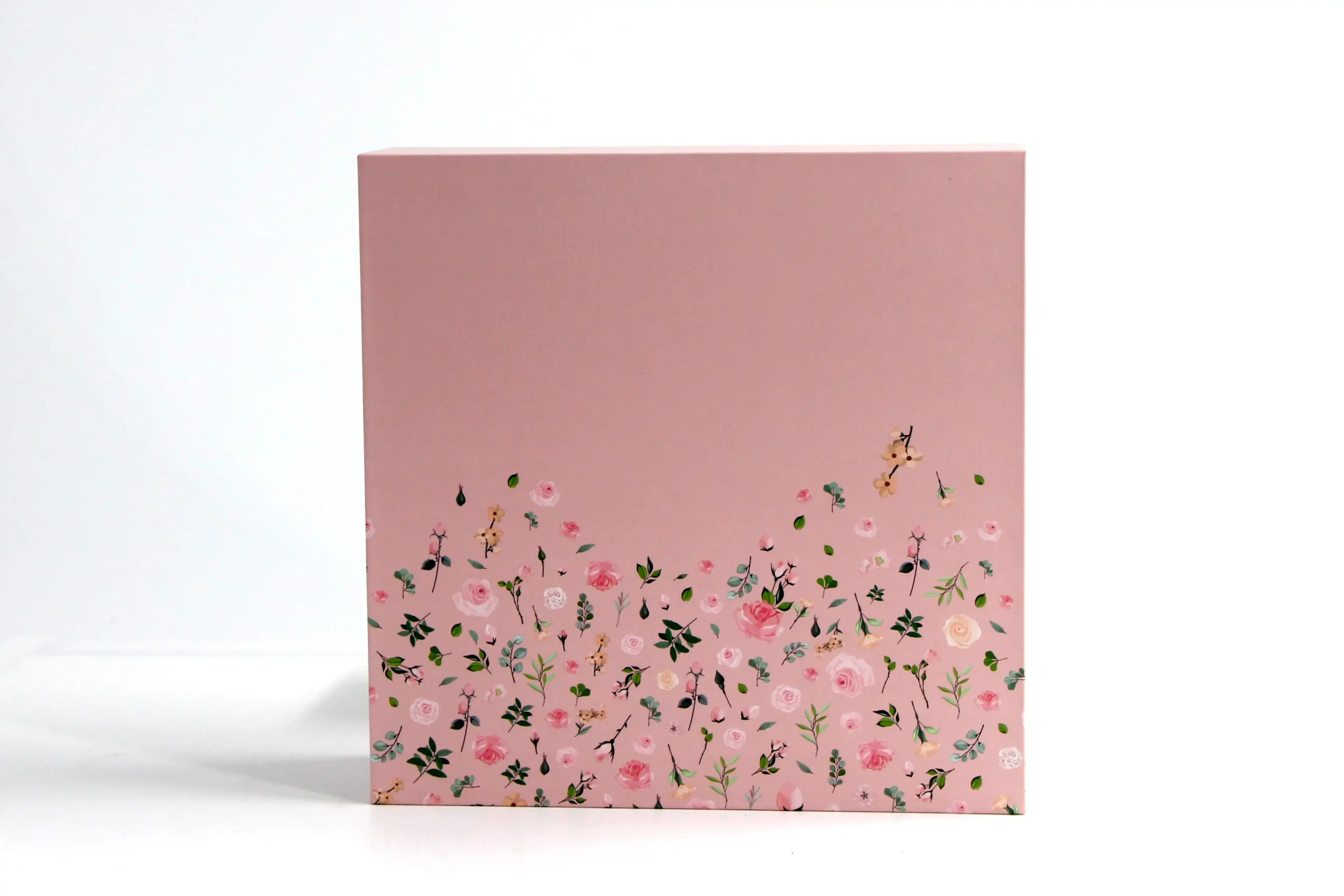
The lid is the face of the packaging. It gets the full print treatment: CMYK full-colour artwork across the front panel, one spot colour used for the pink background to maintain Pantone consistency across all four sizes, soft-touch lamination for the velvet hand-feel, partial semi-gloss matte UV to make the dragon and floral illustration lift off the surface, and a logo badge with foil stamp plus emboss at the centre.
The base is deliberately restrained. 182 gsm gold card, laminated, no print. The contrast between the illustrated red lid and the plain gold base is what makes the two piece box read as premium rather than busy. When the lid comes off, the gold base walls frame the product inside.
The four-size range uses the same print file.
Artwork scales proportionally across Mini (160 mm), Small (190 mm), Medium (210 mm), and Large (245 mm). A brand ordering all four sizes pays one artwork fee and one set of plates.
Each size has its own die, but the surface finish specification remains identical across the entire range.
cockling — a problem that appears on 128 gsm duplex when the lamination adhesive introduces heat during the bonding process, particularly on panels wider than 200 mm. The 157 gsm weight also gives the emboss on the logo badge enough paper body to hold a sharp edge without the surrounding area distorting.
The structural board under the lid is 1,200 gsm double-grey. This controls how the lid behaves when removed and replaced repeatedly. A lid with 1,000 gsm board compresses slightly at the top edge after 15–20 open-close cycles — the bevel angle distorts and the fit loosens. At 1,200 gsm this does not happen within normal retail and gifting use.
The base uses 182 gsm gold card rather than printed duplex for a specific reason: gold card carries the metallic substrate in the paper itself. The gold is not printed — it is the paper. Lamination over gold card preserves the base colour across every production run without the colour drift that occurs when gold ink is printed on white stock across multiple batches.
The semi-gloss matte UV on the lid deserves a specific explanation. It is not a full-surface gloss coat. It is applied only to the illustration zone — the dragon, the flowers, and the lanterns — leaving the background and the logo badge in matte.
The UV zone catches light differently from the matte surround, which creates a depth effect without any emboss or foil on the illustration itself.
Registration tolerance on the UV is ±0.4 mm.
Reduce lid and base from 1,200 gsm to 1,000 gsm double-grey.
The fit tolerance remains within specification. The risk appears after 15–20 open-close cycles on the beveled lid — the edge compresses slightly and the fit loosens.
Acceptable for single-use gifting; less suitable for sets the recipient keeps and reopens. Brands running a first-time order sometimes request both weights sampled side by side so the difference in hand-feel is visible before the production decision is locked in.
Reduce the lid wrapping paper from 157 gsm to 128 gsm coated duplex.
Cost saving is modest. The risk is edge cockling under soft-touch lamination on the Large size (245 mm panel). The emboss depth on the logo badge also reduces slightly because the thinner paper has less body to push against the die.
Test on the Large size before committing. If cockling appears at 128 gsm, we typically recommend stepping back up to 140 gsm as a middle ground rather than reverting fully to 157 gsm.
Removes the velvet hand-feel.
The box looks the same; it does not feel the same. For a two piece box in this price tier, the lamination is the first signal of quality the buyer receives.
The saving is typically under USD 0.06 per unit — small enough that most brands at this positioning choose to keep soft-touch and look elsewhere in the specification for savings.
Replace 182 gsm gold card with 157 gsm gold card, or with 157 gsm white duplex printed gold.
The 157 gsm gold card holds colour well and the weight reduction has minimal visual impact.
Printed gold on white duplex is a visible downgrade — the metallic effect is flatter and shows greater batch variation across production runs, particularly under mixed lighting at retail counters where the inconsistency becomes more noticeable.
Removes the metallic edge from the brand mark.
On a soft-touch matte surface, printed gold reads darker and flatter than foil. The badge loses the contrast that makes it stand out against the illustrated background.
The badge becomes flat while the foil stamp remains.
Without the raised surface, the badge sits at the same plane as the surrounding lamination.
The difference is felt more than seen — the logo no longer has a tactile presence.
Eliminating the Mini or the Large size reduces die costs and simplifies inventory management.
The Mini (160 mm) suits single-product sets, while the Large (245 mm) suits premium multi-product ranges.
If the brand primarily sells mid-range sets, the Small and Medium sizes cover most configurations efficiently. Combining two or more of these seven levers usually delivers a larger cumulative saving than pursuing any single option in isolation, and we're happy to model out a few combinations against your target unit cost before you commit to a specification.
A magnetic box has a hinged lid with embedded magnets at the front edge. It opens with one hand and stays open without assistance.
A two piece box requires both hands — one holds the base and one lifts the lid.
For retail environments where staff are opening and closing the box repeatedly to show customers, a magnetic box is more convenient. For gifting, where the box is opened once by the recipient, the two piece box format creates more ceremony — the lid-lift is a deliberate action.
A magnetic box in an equivalent board specification costs approximately 20–30% more per unit than a two piece box.
The hinge, magnets, and additional assembly operations account for the difference.
At an MOQ of 500 pieces, this becomes a meaningful cost consideration.
The two piece box provides a large, uninterrupted front panel that is ideal for full-illustration artwork such as the dragon design shown here.
A magnetic box divides the front face with a vertical lid edge, which interrupts artwork that crosses the centre line.
For brands using complex illustrated packaging, the two piece box provides the better canvas.
A brand selling a three-product toner-lotion-cream set typically uses the Medium size, while a five-product range fits comfortably in the Large size.
The same artwork runs across both formats, simplifying seasonal campaign production and reducing artwork management costs.
Cosmetic brands entering department store gifting floors in Europe and the Middle East use the two piece box because the gold base reads as premium without requiring metallised print on the artwork itself.
The base provides the luxury signal while the illustrated lid delivers the brand story. This separation creates a cleaner presentation than applying metallic effects across the entire package.
White-label brands that want to differentiate by feel rather than by price often choose the combination of a soft-touch matte lid and a gold-card base.
The material combination is straightforward in appearance but difficult to replicate at lower cost because the final result depends on correct production sequencing, lamination control, and material matching.
Individually, the materials are not unusually expensive. The value comes from how they are combined and executed in production.
A two piece box is a rigid packaging format with a separate lid and base. The lid slides vertically off the base — there is no hinge, no magnet, and no internal locking mechanism.
It is also called a telescoping box, a set-up box, or a lid-and-base box.
In cosmetic packaging, it is the standard format for gift sets where presentation and structural strength are both priorities.
MOQ is 1,000 units per size.
A brand ordering all four sizes places four separate orders of 1,000 units minimum — one per size.
If the artwork is shared across sizes, the plate cost is paid once and applied to all four runs.
Yes. Each size is available independently.
The four sizes shown here — 160 mm, 190 mm, 210 mm, and 245 mm — were produced as a coordinated set for a single client, but there is no requirement to order more than one.
Request a sample of the specific size you need; sample lead time is 7 days after design confirmation, with production following at 30–45 business days after sample approval.
The bevel is the angled profile on the lid walls. Instead of the lid walls running straight down parallel to the base walls, they angle slightly outward toward the top.
This increases the contact area between lid and base at the point where the two surfaces meet, which reduces the force required to remove the lid and eliminates the tight-grip failure that occurs in straight-walled two piece boxes after the board compresses slightly over time. The effect is most noticeable on the larger sizes in this range, where the greater panel surface area gives the lid more leverage against the base if the fit is too tight.
The semi-gloss matte UV is a partial coating applied only to the illustrated areas of the lid. The rest of the surface stays in soft-touch matte.
The UV-coated areas reflect light differently from the matte surround, creating a visible depth difference between the illustration and the background without any emboss or additional print pass on the illustration itself.
It is one of the more cost-effective ways to add visual dimension to a full-illustration two piece box.
The paperboard lid and base are recyclable through standard paper collection once separated from any interior insert.
The gold card base is paper-based and enters the same recycling stream.
This two piece box can be supplied with FSC certification, ISO 9001 and ISO 14001 documentation, and for brands shipping into the EU, material composition and packaging-weight data compliant with the PPWR.
Topvisio is a two piece box manufacturer based in Dongguan, Guangdong, China. This structure can be supplied with the same FSC, ISO 9001, ISO 14001, and PPWR documentation described above.
GET STARTED
Sample in 7 Days
Tell us your products, the box size, colour, and quantity.
We’ll respond within 24 hours.
Secondary Subheadings
Secondary Subheadings
Secondary Subheadings