| Specification | Detail |
|---|---|
| Box Dimensions | 174 × 154 × 32.5 mm (L × W × H) |
| Net Weight | 158.1 g per unit |
| Box Structure | Lid and base (separate lid and tray) |
| Lid Material | 150gsm coated board + 1,200gsm single-sided white greyboard |
| Base Material | 150gsm coated board + 1,200gsm single-sided black greyboard |
| Insert | Black PP vacuum-formed tray + PET transparent cover |
| Insert Configuration | Single large slot (whole chocolate block) + fork slot; or multi-slot for individual pieces |
| Lid Surface Treatment | Gold hot stamping + emboss relief + matte lamination + die-cut |
| Base Surface Treatment | Die-cut + assembly |
| Accessories | Gold fork (individually wrapped, included) |
| MOQ | 1,000 units |
| Sample Lead Time | One week after design confirmation |
| Production Lead Time | Approx. 30 business days (confirmed per order) |
| Certification Available | FSC, upon request, for all board and paper materials |
surface. The coating gives the gold foil a stable adhesion base, and the surface smoothness lets the emboss die produce clean relief without the grain interference of uncoated stock. The greyboard core of this chocolate box is 1,200gsm — single-sided white for the lid, single-sided black for the base. The white inner face of the lid greyboard keeps the interior of the closed box clean. The black inner face of the base greyboard is not visible in normal use — it is covered by the PP insert tray — but it contributes to the weight and rigidity of the base, and the black-on-white exterior edge at the seam line when lid meets base is a small detail that reads as intentional rather than accidental.
Topvisio is a chocolate box manufacturer based in Dongguan, Guangdong, China, with 15 years of experience producing chocolate boxes and premium food packaging. These chocolate boxes can be supplied with FSC certification, ISO 9001 and ISO 14001 documentation, and for brands shipping into the EU, material composition and packaging-weight data required under the EU Packaging and Packaging Waste Regulation (PPWR).
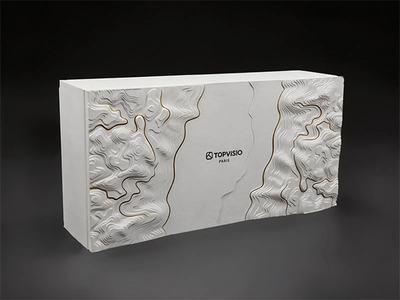
The lid surface of this chocolate box goes through four processes in sequence: gold hot stamping for the foil label, emboss relief pressing for the botanical pattern, matte lamination applied over the full surface, and die-cutting to final shape. The order matters. Stamping before embossing allows the foil to be positioned precisely on a flat surface. The matte lamination is applied last, over both the foil and the embossed surface, which unifies the finish and protects the foil edges from lifting during handling.
The black PP insert tray of this chocolate box is vacuum-formed to the interior dimensions of the base. The standard configuration has one large slot sized for a whole chocolate block, with a side slot for the included gold fork. The tray format can be changed to a multi-slot configuration for individual chocolate pieces — slot count and dimensions are designed around your product. The PET transparent cover clips onto the tray, keeping the chocolate secure and visible without requiring the lid to be closed.
Two-piece lid-and-base boxes have a monthly production capacity of up to 1,500,000 units.
The coating gives the gold foil a stable adhesion base, and the surface smoothness lets the emboss die produce clean relief without the grain interference of uncoated stock.
The greyboard core is 1,200gsm — single-sided white for the lid, single-sided black for the base. The white inner face of the lid greyboard keeps the interior of the closed box clean. The black inner face of the base greyboard is not visible in normal use — it is covered by the PP insert tray — but it contributes to the weight and rigidity of the base, and the black-on-white exterior edge at the seam line when lid meets base is a small detail that reads as intentional rather than accidental.
The lid surface goes through four processes in sequence: gold hot stamping for the foil label, emboss relief pressing for the botanical pattern, matte lamination applied over the full surface, and die-cutting to final shape. The order matters. Stamping before embossing allows the foil to be positioned precisely on a flat surface. The matte lamination is applied last, over both the foil and the embossed surface, which unifies the finish and protects the foil edges from lifting during handling.
The black PP insert tray is vacuum-formed to the interior dimensions of the base. The standard configuration has one large slot sized for a whole chocolate block, with a side slot for the included gold fork. The tray format can be changed to a multi-slot configuration for individual chocolate pieces — slot count and dimensions are designed around your product. The PET transparent cover clips onto the tray, keeping the chocolate secure and visible without requiring the lid to be closed.
The emboss is the most visible quality indicator on this chocolate box. If the relief is shallow, the surface looks flat and the premium coated board is wasted. We check emboss depth on the first sample batch before approving production. If depth is insufficient, we adjust press parameters and re-run. A flat emboss at a premium price point is not acceptable.
The lid-to-base fit is the other common issue on this chocolate box. Too tight and the lid requires force to remove. Too loose and it shifts during transport. We calibrate the fit tolerance during sampling and hold it across the production run.
For cost reduction: greyboard from 1,200gsm to 1,000gsm (lower impact resistance), or PP insert to PS (same food safety, slightly more brittle). We explain the trade-off before you decide.
Full-surface embossing is more demanding than partial embossing because the die must maintain consistent depth across the full panel.
The botanical pattern is the standard design. It can be replaced with any brand-specific pattern. If your brand has an established surface pattern used elsewhere in your packaging, we engineer it into the die.
The matte lamination protects the surface and creates the tactile contrast between the matte field and the gold foil label. The foil sits slightly proud of the laminated plane, catching light differently from the surrounding area — a physical effect, not a print effect.
The botanical pattern is the standard option. The die can carry any surface pattern — geometric, floral, brand monogram, or abstract. Custom die production happens during sampling, credited against the production order.
Standard: centred rectangular cartouche in gold foil. Shape, dimensions, text, and foil colour adjustable. Silver, rose gold, and holographic foil available. Brand logo and typographic system applied to label artwork.
Standard: one large slot for a whole chocolate block plus fork slot. For individual pieces, PP tray is redesigned with multiple slots to your dimensions. PET cover included in either configuration.
Standard: 1,200gsm greyboard + 150gsm coated board. Cost reduction: 1,000gsm greyboard or PS insert. We recommend standard spec for international shipping and retail. Lower-cost option suitable for direct-to-consumer gifting.
FSC-certified production is available for this chocolate box. Topvisio manages the full chain-of-custody documentation. The paper materials in this box — coated board and greyboard — are eligible for FSC certification. For more information on FSC certification for paper packaging, see the Forest Stewardship Council website.
A well-made chocolate deserves a chocolate box that says so before it’s opened. White and gold is a consistent performer in premium confectionery retail — it doesn’t date, doesn’t require seasonal re-tooling, works standalone or in a gift set. Brands at the premium tier use this box because the visual matches the price.
White and gold reads across Christmas, Valentine’s Day, Mother’s Day, and Eid without seasonal re-tooling. The emboss adds visual complexity without colour. One die investment covers the full year.
Gold is the dominant finish in premium confectionery gifting across Gulf markets. This chocolate box — gold foil label, white base, gold fork included — creates a presentation that reads as complete. It has been used for premium gifting in UAE, Saudi Arabia, and Kuwait, where packaging weight and accessory quality are evaluated alongside the product.
White and gold fits naturally into European premium food retail. The PET cover allows the chocolate to be seen without opening — important for retail display. This chocolate box holds its shape through a multi-week retail run.
The white exterior gives the gold foil label maximum contrast, useful for corporate gifting where brand identity needs to read at a glance. The included gold fork makes this chocolate box self-contained. At 32.5mm depth, boxes stack efficiently on display tables.
Q1: Can the insert hold individual chocolate pieces instead of one whole block?
Yes. The standard PP tray has one large slot for a whole chocolate block. For individual pieces, the tray is redesigned with multiple smaller slots sized to your chocolate dimensions.
Provide the piece size and the number of pieces, and we propose a tray layout. The PET transparent cover is included in either configuration.
Q2: Who is Topvisio and what makes them a chocolate box manufacturer?
Topvisio is a rigid packaging manufacturer based in Dongguan, Guangdong, China, with 15 years of experience producing chocolate boxes and premium food packaging. These chocolate boxes can be supplied with FSC chain-of-custody certification, ISO 9001 quality management documentation, and ISO 14001 environmental management documentation, along with compliance documentation such as EU PPWR for brands selling into regulated European markets.
Q3: Can the emboss pattern be replaced with our brand design?
Yes. The botanical pattern is the standard option, not a fixed feature. A brand-specific emboss pattern — monogram, geometric, product-specific illustration, or any other design — can be engineered into the die. The custom die is produced during sampling and the cost is credited against the production order when you place it.
Q4: What is the difference between the lid and base greyboard?
The lid uses 1,200gsm single-sided white greyboard — the inner face is white, keeping the interior of the box clean when the lid is in place. The base uses 1,200gsm single-sided black greyboard — the black face is the inner wall of the base, visible at the edges when the lid is removed. The black-on-white edge at the seam is a deliberate detail. It also means the base interior reads as darker and more contained, which frames the black PP tray cleanly.
Q5: Is the PP insert food safe?
Yes. The black PP vacuum-formed insert is food-grade. PP (polypropylene) is one of the most widely used food-contact plastics and meets the safety standards of the FDA in the United States and EU Regulation (EC) No 1935/2004 on food contact materials in Europe.
Q6: What is the MOQ?
1,000 units. Custom emboss dies or insert reconfigurations may affect MOQ. Contact us with your brief for a project-specific number.
Q7: How long does sampling and production take?
Sample lead time is 7 days from design confirmation. The sample includes the full assembly — emboss depth, foil placement, lid-to-base fit, insert configuration. You approve the sample before production starts, and the sampling fee is credited against your production order. Standard production lead time is 30 to 45 business days after sample approval.
Q8: Can this chocolate box be FSC certified?
Yes. The coated board and greyboard are eligible for FSC chain-of-custody certification. Topvisio manages the full documentation process. FSC certification is available on request at the quoting stage.
Q9: Does Topvisio handle export?
Yes. Export customs clearance on the China side for all orders. Topvisio has been exporting to Europe, the US, and the Middle East for 15 years. We know what each market requires for food-contact packaging compliance and export documentation. Door-to-door logistics available for qualifying destinations.
Read More >>
GET STARTED
Sample in 7 Days
Tell us your products, the box size, colour, and quantity.
We’ll respond within 24 hours.
Secondary Subheadings
Secondary Subheadings
Secondary Subheadings