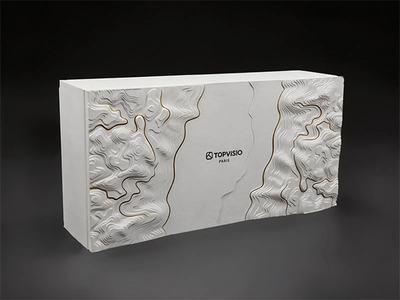
| Label | Value |
|---|---|
| Product Name | Bespoke Collector Set with Telescoping Lid Box |
| Structure | Telescoping lid + base, shallow tray format (vertical lift) |
| Size | 325 × 325 × 38.9 mm (lid drop included) |
| Lid & Base Board | 180 gsm black textured specialty paper + 1,500 gsm single-sided black grey board (lid and base identical) |
| Interior Finish | Same 180 gsm black wrap, mitred corners, no exposed grey board |
| FSC Certified | Yes — available on request |
| PPWR Compliance | Compliance document available on request |
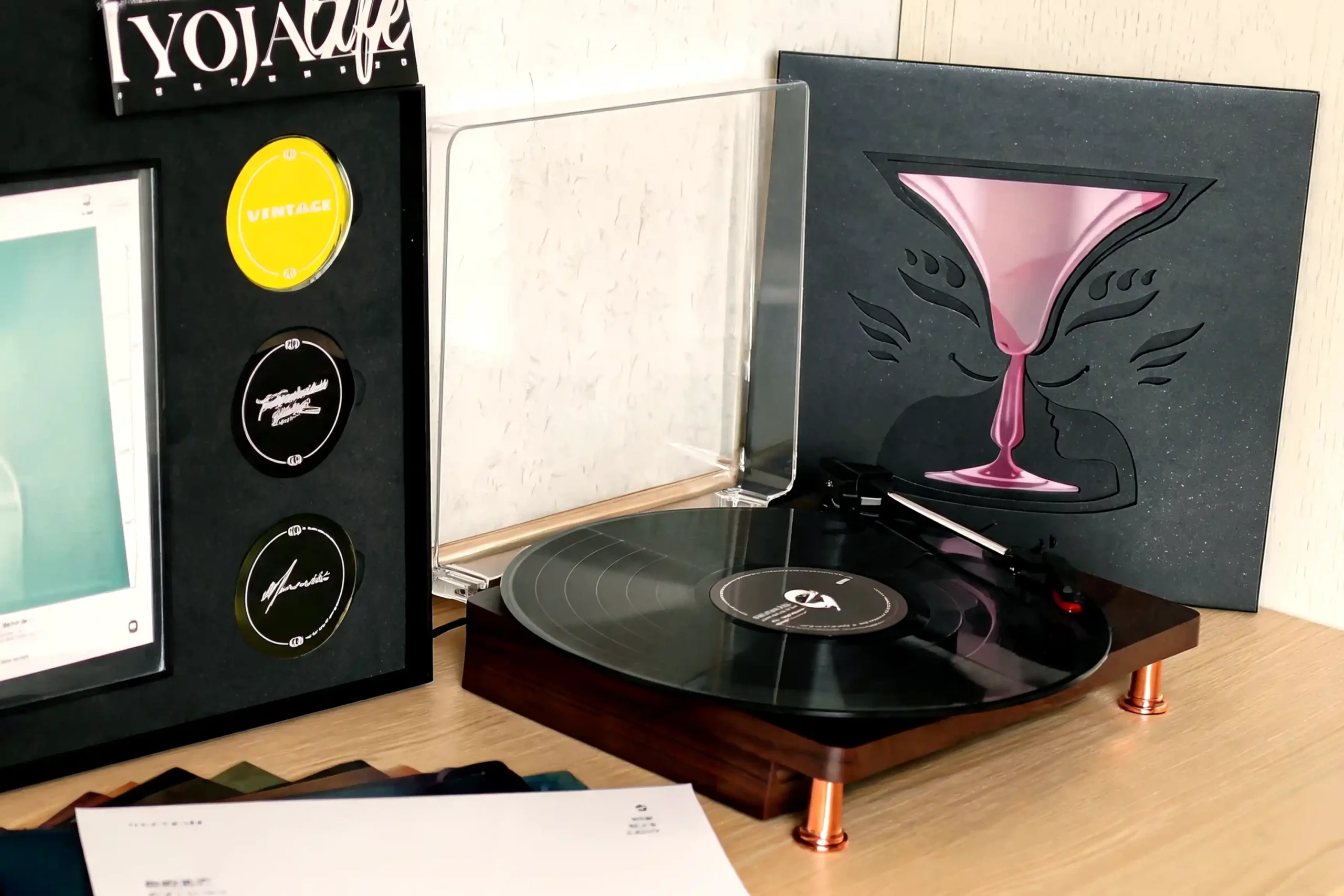
| Internal Piece 1 | APET transparent cocktail-effect card (UV print, multi-layer) |
| Internal Piece 2 | Cup-shaped illustrated booklet (die-cut black specialty paper) |
| Internal Piece 3 | Circular music timer (printed white specialty paper, die-cut rotating dial) |
| Internal Piece 4 | Acrylic coaster, 2.5 mm cast acrylic (printed + back-laminated) |
| Internal Piece 5 | Layered menu (thermal receipt paper + 1 mm acrylic + textured paper) |
| Internal Piece 6 | Vinyl-record-style sleeve (silver metallised printing paper, full-bleed) |
| Certifications | FSC on request, PPWR compliant documentation available |
Topvisio is a bespoke packaging manufacturer based in Dongguan, Guangdong, China, running 14+ automated production lines across a 20,000 m² facility, with a monthly capacity of 200,000 units for irregular, hand-assembled structures like this one. We supply FSC, ISO 9001 and ISO 14001 documentation, plus EU PPWR compliance data for EU-bound orders.
This bespoke packaging build measures 325 by 325 by 38.9 mm — a shallow telescoping lid-and-base format only 38.9 mm tall — and inside it sits a black A-grade EVA cradle shaped to hold six separate items: a transparent cocktail-effect card, an illustrated booklet die-cut in the shape of a cup, a printed music timer, a 2.5 mm acrylic coaster, a layered menu, and a vinyl-record-style sleeve.
The exterior of this bespoke packaging reads as one continuous matte black surface. We use a 180 gsm black textured specialty paper across both lid and base, with a tone-on-tone deboss of the brand mark on the lid centre. Inside that debossed recess we apply a black-on-black hot foil — black metallic foil stamped onto black textured paper.
From a metre away it disappears. Under raking light at arm's length the brand mark on this bespoke packaging catches and shows a slightly deeper, more polished black against the suede-finish paper. This is the effect the design brief asked for, and it is the part of the build that takes the longest to get right. It's a detail few bespoke packaging projects bother to get this precise.
The lid and base are identical in construction. Both use the same wrap stock — 180 gsm black textured paper — laminated over a 1,500 gsm single-sided black-coated grey board.
The 1,500 gsm thickness is heavier than the 1,200 gsm we use on most rigid boxes. At 325 by 325 mm with only a 38.9 mm rim, the lid panel is large and shallow, and at 1,200 gsm the centre of the panel sags under its own weight. 1,500 gsm holds the panel flat.
The interior of both the lid and the base is finished in the same black wrap, mitred at the corners and tucked under the rim. No exposed grey board edges.
The cradle that holds the merchandise pieces is A-grade black EVA foam, milled with individual recesses for each of the six items. A-grade EVA holds sharper edges on the milled cavities than standard EVA and resists compression from the weight of the contents during shipping.
The black-foil deboss on the lid is a two-step process and the most demanding finishing step in the whole bespoke packaging build. The deboss die strikes first, creating the recess in the paper surface. The foil stamp follows, registered to the recess by ±0.2 mm, depositing the black metallic foil only inside the debossed area. Any drift in registration and the foil overlaps the un-debossed paper around the brand mark, which kills the tone-on-tone effect.
Most bespoke packaging projects we run start from a standard rigid box format and add custom artwork. This one started from a list of six oddly-shaped contents and worked backwards into a box that could hold them all at the right thickness. The order of the brief was inverted, and that changes which decisions get made first.
The first decision was depth. A 38.9 mm interior depth had to accommodate the thickest item — the 2.5 mm acrylic coaster sits in its EVA recess at 5 mm, but with the EVA wall above it adding clearance the total stack must clear 35 mm. The remaining 3.9 mm goes to the lid rim drop.
The second decision was the cradle layout. Six items, two of them irregular shapes (the cup-shaped booklet and the vinyl-record sleeve), had to sit on a 325 by 325 mm plane without any overlap and with enough margin between them that the lid closes without pressing on any single piece. The cradle layout drawing went through eleven revisions before everyone signed off.
The third was the foil deboss. A standard foil stamp on coated paper takes about three seconds per impression. Black foil on textured paper takes longer — the foil needs higher temperature and more dwell time to bond into the texture without leaving the foil floating on top of the paper grain. We slowed the foil press down by roughly 40 percent for this job.
The transparent cocktail card is APET sheet, 0.3 mm thick, UV-printed with a multi-layer artwork that gives the impression of a cocktail glass when held up to light. The print is a CMYK pass with a white underbase for the opaque elements.
The illustrated booklet is die-cut in the silhouette of a cup, eight pages stitched along the curved spine, printed on the inside of the booklet with character illustrations and on the outside cover with the cup outline in spot black. The cover stock is the same 180 gsm black textured paper as the box exterior, which gives the booklet the same hand-feel as the box.
The music timer is a circular printed disc on 200 gsm white specialty paper, die-cut around its outer edge and through the centre, with a rotating dial that lines up with printed time markers. It functions as a small mechanical paper toy.
The acrylic coaster is 2.5 mm cast acrylic, edge-polished, printed on the underside with the artwork, then back-laminated with a protective film so the print does not lift if a wet glass sits on the upper face.
The menu is a three-layer build: a strip of thermal receipt paper on top with printed text, a 1 mm clear acrylic plate behind it for rigidity, and a layer of textured specialty paper as the backing.
The vinyl-record sleeve is a 12-inch square envelope made from silver metallised printing paper, printed full-bleed with the artwork on the outer face and a plain silver interior.
Exterior stock — the 180 gsm textured paper is the default; we can substitute soft-touch laminated coated paper, leatherette, or paper with embedded fibres. Each stock has a different ink and foil response, which affects the deboss-plus-foil sequence.
Deboss and foil — the brand mark is debossed at a depth of 0.4 mm and foiled with black metallic. Alternative finishes include silver foil, gold foil, holographic foil, blind deboss with no foil, or a colour foil in any Pantone matching reference.
EVA cradle — A-grade black is our default for bespoke packaging projects where contents shift during shipping is a concern. Lower-grade EVA cuts cost but the cavity edges round off after a few stack cycles.
Box dimensions — 325 mm square is the dimension this project required. Bespoke packaging is dimensional by definition; for other contents we run anywhere from 100 mm cube up to 600 by 400 mm.
Internal contents — every item inside this build was custom-made. For a different drop the cradle layout and merchandise items will all be different.
Limited-edition merchandise drops are the most common reason brands commission bespoke packaging at this level of detail. The buyer is usually a brand marketing team, an entertainment IP licensee, a collaboration product manager, or a corporate gift programme planner with budget for a low-volume premium build.
Game studios and entertainment IPs order this format for collectors' editions, anniversary boxes, and influencer seeding kits. The shallow telescoping design photographs well for unboxing video content because the entire contents are visible the moment the lid lifts.
Beauty brands and spirits brands commission similar bespoke packaging builds for limited-edition gifting at end-of-year and major regional holidays. The depth changes — beauty kits run deeper to hold bottles upright; spirits kits run deeper still — but the structural approach is the same.
The full spec is expensive. These are the levers we offer on a bespoke packaging brief when the landed price needs to come down. Each one carries a visible trade-off we walk through with the client before sign-off.
Switch the 180 gsm black textured paper to 157 gsm matte black coated paper. The tactile suede surface is lost and the paper becomes a flat smooth matte. The deboss-plus-foil effect still works but the contrast between debossed area and surrounding texture is reduced.
Drop the 1,500 gsm black grey board to 1,200 gsm. The lid panel sags slightly at the centre on a 325 mm span — visible as a 1 to 2 mm dip when the box is photographed straight-on. Acceptable for boxes that ship in outer cartons and are not displayed on shelf.
Replace the black-foil deboss with a matte black spot UV on a debossed area. The tone-on-tone effect is similar but the spot UV is glossier and lacks the metallic depth of the foil. Cost saving is meaningful since the foil press setup is the most expensive step.
Switch A-grade EVA to standard EVA. The milled cavity edges are slightly softer and the contents have looser fit. Fine for short ship cycles, not ideal for international air freight where boxes get shaken.
Reduce acrylic coaster from 2.5 mm to 1.5 mm. The coaster feels lighter in hand and is more flexible, which buyers notice immediately when they pick it up. The print and laminate process is identical.
Bespoke packaging is packaging custom-built from scratch to fit a specific product, brand, or merchandise set rather than chosen from a stock catalogue.
The structure, materials, finishes, internal cradle, and any included merchandise pieces are all designed and tooled for one project.
Bespoke packaging is most often commissioned for limited-edition releases, collectors' editions, brand anniversaries, IP collaborations, and high-value corporate gifting.
A typical project runs eight to twelve weeks: two weeks for structural design and material sourcing, one week to build the first physical sample, two to three weeks for revisions and client approval, then four to six weeks for production.
Tighter timelines are possible but the first sample becomes the production sample, which limits revision room.
MOQ for bespoke packaging at this complexity is 500 pieces.
Below that, the per-unit tooling cost — for the foil die, deboss die, EVA mould, and any custom contents — becomes hard to absorb.
For brands testing a concept we can build a single hand-assembled prototype in one week.
Yes. For most bespoke packaging projects we assemble the full set in our facility, drop the EVA cradle and all contents into the base, close the lid, and ship the complete unit.
The customer receives a sealed product ready for retail or gifting. This is the default workflow.
The black textured paper, black grey board, and EVA foam used in this bespoke packaging build are not food-contact rated.
They are designed for merchandise and gifting use, not direct food contact.
If the contents include food items, those items must be in their own primary food-contact packaging before being placed in the cradle.
This bespoke packaging is produced by Topvisio, a Dongguan-based manufacturer running 14+ automated production lines across a 20,000 m² facility, with a monthly capacity of 200,000 units for irregular, hand-assembled structures like this one.
On request we can supply FSC chain-of-custody documentation, EU PPWR compliance data, and certification records covering ISO 9001 (quality management) and ISO 14001 (environmental management).
For the box exterior we need vector files for any brand marks that will be foil-stamped or debossed, plus full-resolution CMYK artwork for any printed surfaces.
For internal merchandise we need separate artwork files for each piece, sized to the cradle layout drawing we provide after the first design round.
GET STARTED
Sample in 7 Days
Tell us your products, the box size, colour, and quantity.
We’ll respond within 24 hours.