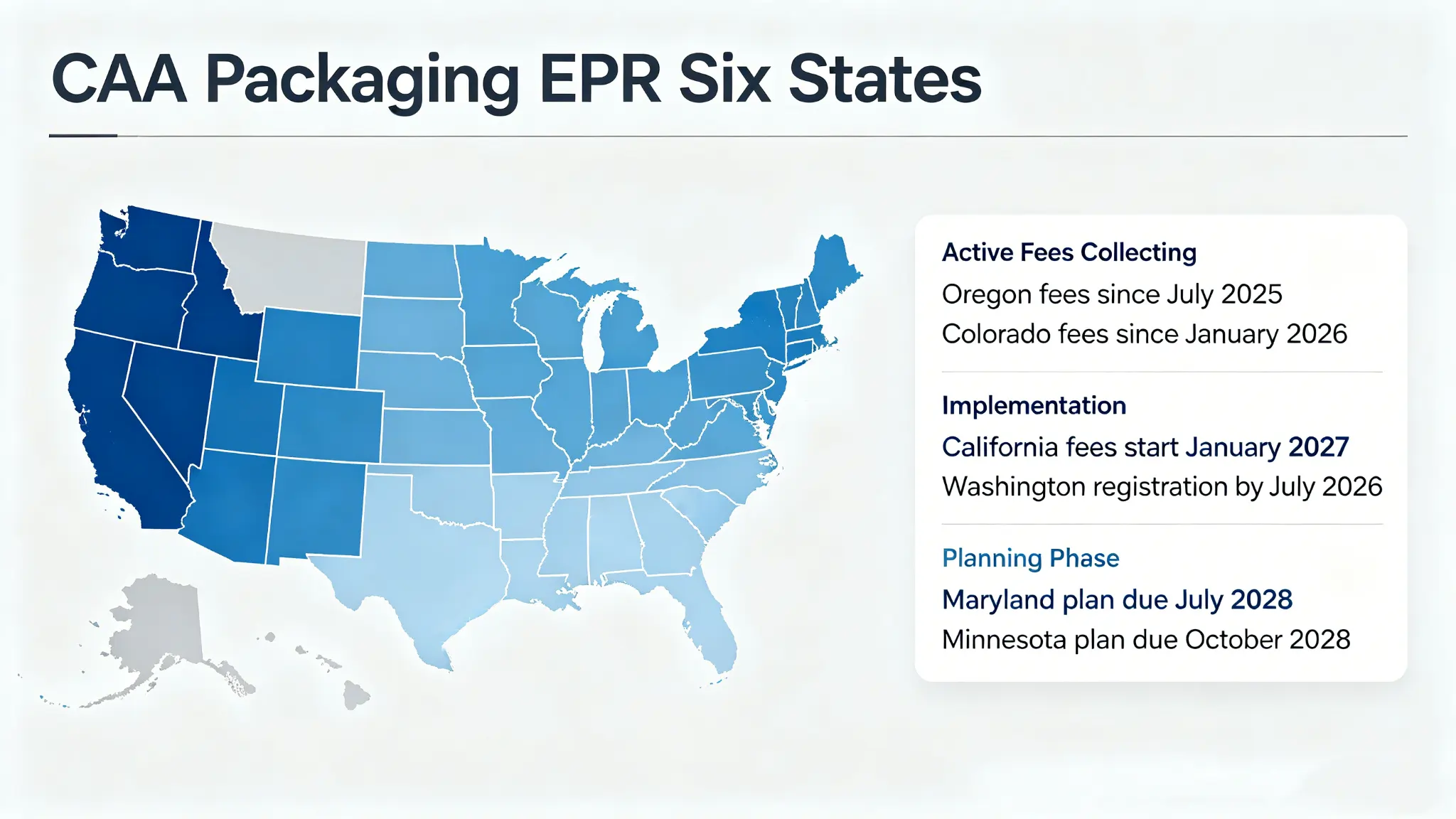
Circular Action Alliance (CAA) is the only organization currently approved to implement extended producer responsibility laws for paper and packaging in the United States. Founded in 2022 by 20 producers spanning the food, beverage, consumer goods, and retail industries, the nonprofit now operates as the designated Producer Responsibility Organization in six states — California, Colorado, Maryland, Minnesota, Oregon, and Washington — with a seventh, Maine, still working through its own process.
For any brand selling packaged goods into more than one of these states, Circular Action Alliance isn’t a single compliance relationship. It’s six separate ones, each running on its own timeline. Understanding how Circular Action Alliance operates state by state matters more than treating it as one national program.
Oregon: The First State Where the Program Is Actually Running
Oregon holds the distinction of being the first state where a CAA program is fully operational rather than still in planning. The state’s Recycling Modernization Act launched producer fee obligations on July 1, 2025, making Oregon the earliest of the six states to reach that stage. Most recently, Oregon’s Department of Environmental Quality approved a Responsible End Markets amendment in May 2026, strengthening how collected materials are verified as responsibly managed downstream.
Oregon is also the one state in this group currently tangled in litigation. On February 6, 2026, a federal court dismissed most claims in a lawsuit brought by the National Association of Wholesaler-Distributors against Oregon’s DEQ, but issued a narrow preliminary injunction pausing enforcement against NAW members specifically, with a full hearing scheduled for July 2026. Circular Action Alliance isn’t a party to the suit and has stated that registration, reporting, and fee obligations continue unchanged for the vast majority of producers in the meantime.
Colorado: Furthest Along on Measurable Results
Colorado’s program plan was approved by the state’s Department of Public Health and Environment in December 2025, with producer fees beginning in January 2026. The state is projecting its paper and packaging recycling rate to climb from 25% to 58% by 2035, and expects the program to bring no-cost recycling access to roughly 700,000 additional households.
California: The Largest Program, Still in Early Implementation
California’s SB 54 is the broadest of the six laws in scope, and also the slowest to reach implementation. Regulations weren’t finalized until May 1, 2026, and CAA submitted its California program plan on June 15, 2026, opening a public comment period through August 14, 2026.
Producer fees in California don’t begin until January 2027, roughly a year and a half after Oregon’s program was already collecting money. California is also the state where the law reaches beyond fee collection into packaging design itself, including SB 343 restrictions on recyclability labeling.
Washington, Maryland, and Minnesota: The Later-Timeline Group
Washington, Maryland, and Minnesota all designated Circular Action Alliance as their producer responsibility organization, but each sits earlier in its rollout than Oregon, Colorado, or California. Washington’s Department of Ecology named CAA as PRO on March 4, 2026, with producer registration required by July 1, 2026, and full implementation not expected until 2030.
Maryland selected CAA in October 2023, but its own producer responsibility plan isn’t due until July 1, 2028. Minnesota confirmed CAA’s registration in February 2025, with a stewardship plan due by October 1, 2028.
The practical read for producers: registration and data-reporting obligations in this group generally arrive years before any fee obligation does, which makes it easy to underestimate how much lead time a compliance team actually has — right up until a registration deadline passes unnoticed.
Why Six States Add Up to Six Different Compliance Calendars
None of these six programs share a single registration date, a single fee schedule, or a single reporting cycle. Oregon started collecting producer fees in mid-2025; Colorado followed in January 2026; California won’t start until 2027; Washington, Maryland, and Minnesota are further out still. A brand selling into all six states isn’t managing one relationship with Circular Action Alliance — it’s tracking six separate compliance calendars under one umbrella organization.
There’s no federal packaging EPR law consolidating these programs, so the number of states is likely to keep growing rather than settle. Seven states have now enacted comprehensive packaging EPR legislation, and industry trackers expect more to follow.
What This Means for Packaging Buyers
If your rigid boxes, cartons, or retail packaging ship into any of these six states, the practical task is building a compliance calendar by state rather than treating Circular Action Alliance as a single line item. Registration deadlines, fee start dates, and reporting cycles differ enough that a calendar built for Oregon’s timeline won’t tell you anything useful about Maryland’s.
For material and recyclability data specifically — the numbers a producer needs to hand CAA for registration and reporting — the responsibility for accuracy sits with whoever is registering as the producer, but that data has to originate somewhere in the supply chain. A packaging supplier that can’t produce basic material composition and weight data on request adds friction to every one of these six reporting cycles.
There’s also a classification question worth sorting out early: whether a given business counts as the “producer” in each Circular Action Alliance state at all. Several of these laws define producer status around whose brand appears on the packaging, similar to the manufacturer-versus-supplier distinction that shows up in EU packaging law, and a company can be an obligated producer in one state while a different party in its supply chain holds that role in another.
How Topvisio Supports Producers Navigating This
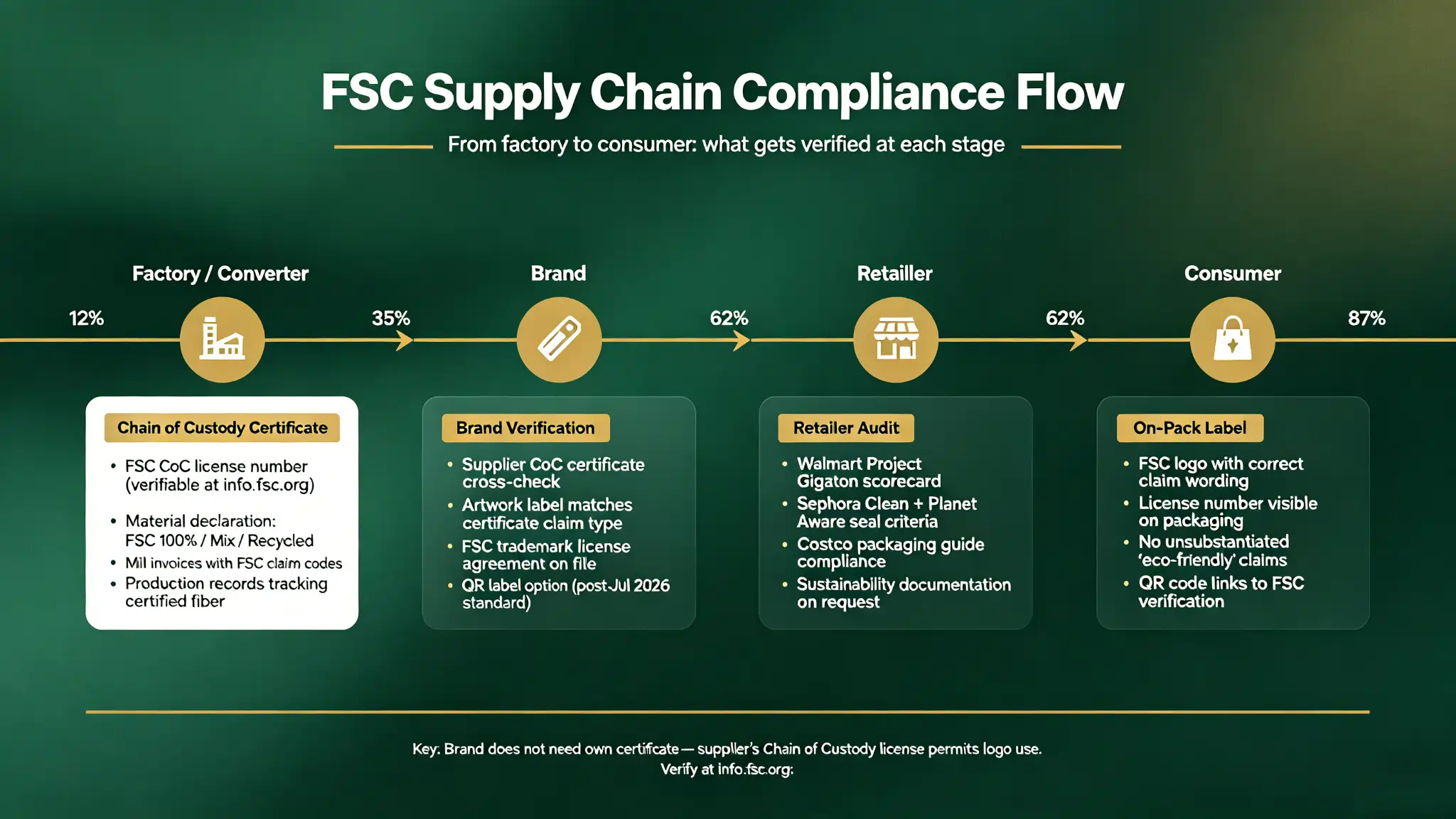
Topvisio doesn’t register with Circular Action Alliance or file reports on a customer’s behalf — that obligation belongs to the producer placing packaging on the market in each state. As a rigid gift box manufacturer supplying brands across the US, EU, Middle East, and APAC, Topvisio maintains material composition and weight data organized so it can be handed to a compliance team without a multi-week records search, and can provide FSC-linked sourcing documentation on request for orders where certified material matters.
FAQ
Is Circular Action Alliance a government agency?
No. It’s a nonprofit, producer-led Producer Responsibility Organization. Each state’s environmental agency — CalRecycle in California, Colorado’s CDPHE, Washington’s Department of Ecology — retains oversight and enforcement authority.
Do all six states have the same requirements?
No. Each state’s law was passed separately, with different covered materials, different fee structures, and different timelines. Oregon’s program has been collecting fees since 2025; California’s won’t start until 2027.
What happens if a producer misses a registration deadline?
Consequences vary by state and are enforced by the state agency rather than Circular Action Alliance directly. In several states, producers that aren’t registered or participating in an approved plan may be barred from selling covered materials in that state.
Is Circular Action Alliance the only PRO option in every state?
Not always. Maryland’s law permits multiple PROs to operate concurrently, while California, Colorado, Oregon, Washington, and Minnesota currently rely on CAA as the sole designated PRO for packaging and paper.
Will more states join this list?
Very likely. Seven states have now enacted comprehensive packaging EPR legislation, and more state legislatures are considering similar bills. With no federal law consolidating these programs, producers should expect the list of states, and the number of separate compliance calendars, to keep growing.