Most packaging buyers track tariffs and material costs closely, but far fewer track the USD to CNY rate that quietly moves alongside them. In 2026, that’s been the more consistently moving number. The yuan has strengthened meaningfully against both the dollar and the euro this year, and that shift changes what a “stable” quote actually means in practice.
This USD to CNY discussion is informational, not financial advice, we’re not forecasting currency markets. But if you’re sourcing rigid gift boxes from China and your supplier quotes in USD or EUR, understanding the direction this number has moved is worth five minutes.
What Actually Happened to USD to CNY in 2026
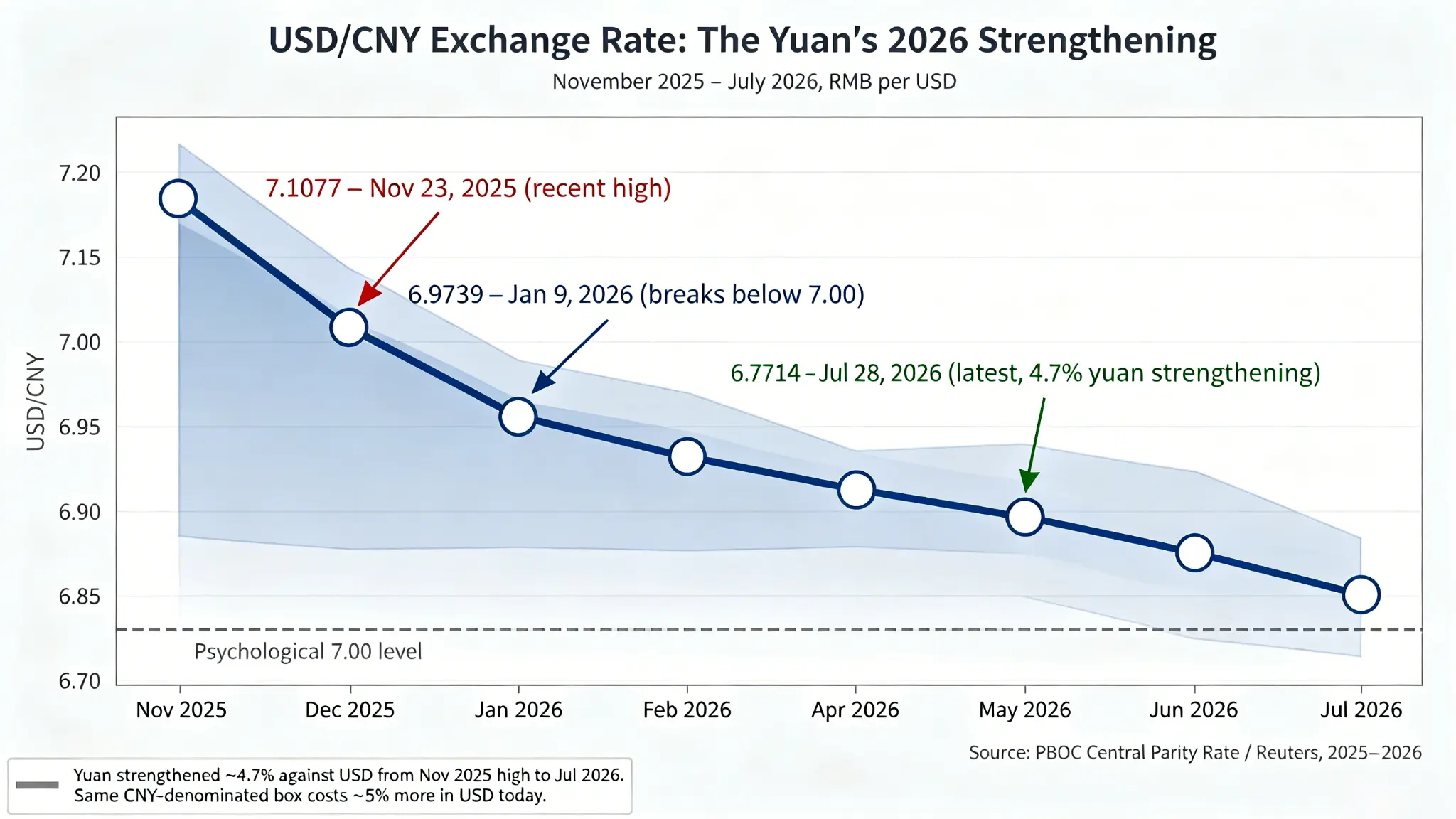
USD to CNY sat at 7.1077 on November 23, 2025, the recent high point before this year’s strengthening trend began. By January 9, 2026, it had broken below the psychological 7.00 level to 6.9739. As of late July 2026, the rate sits around 6.7714, a roughly 4.7% strengthening of the yuan since that November high.
The euro side moved too, though less dramatically. EUR/CNY traded around 8.36 at a January 2026 peak and had eased to roughly 7.87 by early June, meaning a euro buys fewer yuan than it did at the start of the year.
In plain terms: the same finished rigid gift box, priced in Chinese yuan by your manufacturer, costs a US or EU buyer more dollars or euros today than it did in late 2025, purely from the currency shift, before any change in material or labor cost. A box quoted at ¥13 in November 2025 cost roughly $1.83 at the time; the same ¥13 box costs roughly $1.92 today, a swing of nearly 5% with the underlying yuan price completely unchanged.
Why the Yuan Strengthened Against the Dollar
A few forces converged. Anticipated US Federal Reserve rate cuts have weakened the dollar broadly, making the yuan relatively stronger by comparison. Thawing US-China trade tensions through late 2025 and into 2026 supported sentiment. China’s policy stance has also played a role: the People’s Bank of China has been actively managing the pace of appreciation through its daily reference rate mechanism, while the country’s persistent trade surplus continues to create underlying upward pressure on the currency.
Major banks have published broadly similar projections for where USD to CNY settles: Bank of America forecasts the yuan strengthening toward approximately 6.80 per dollar, and Huatai Securities projects around 6.82 by year-end 2026, both already close to where the rate is trading as of this writing.
How This Plays Out Depending on How Your Quote Is Priced
Quote Currency | What’s Happening to Your Cost | What to Watch For |
Quoted in CNY (RMB) | Your USD or EUR cost moves with the exchange rate even if the CNY price never changes — most common, least tracked. | Ask your supplier for the conversion rate they’re using and how often it’s updated. |
Quoted in USD, fixed | Your dollar cost is locked, but your supplier absorbs currency risk — a stronger yuan erodes their margin. | Fixed-currency quotes may face repricing pressure at renewal if the trend continues. |
Quoted in USD, revisited per order | Each new quote reflects the current exchange rate at the time it’s issued. | Compare quotes against the FX rate at quote date, not just your last order. |
What to Actually Do About It
Ask which USD to CNY rate your supplier is using, and when it was last updated. A quote based on a November 2025 rate and one based on a July 2026 rate can differ by nearly 5% on the same underlying yuan price, worth knowing before you compare two supplier quotes against each other.
If you’re quoted in CNY, build a buffer into your budget, not just your unit price. The yuan has trended in one direction for most of 2026; if that continues into Q3 and Q4, the dollar or euro cost of a CNY-denominated order can drift upward between sampling and final payment even with zero change to the agreed yuan price.
For large or recurring orders, ask about rate-lock options. Some suppliers and freight forwarders can lock a USD to CNY conversion rate at deposit time for the full order, which removes this variable from your cost planning entirely.
Don’t confuse FX movement with a real cost increase, or vice versa. If a quote moves and you’re not sure why, ask your supplier to separate the FX component from any material or labor cost change. The two get bundled together more often than they should.
A Practical Example
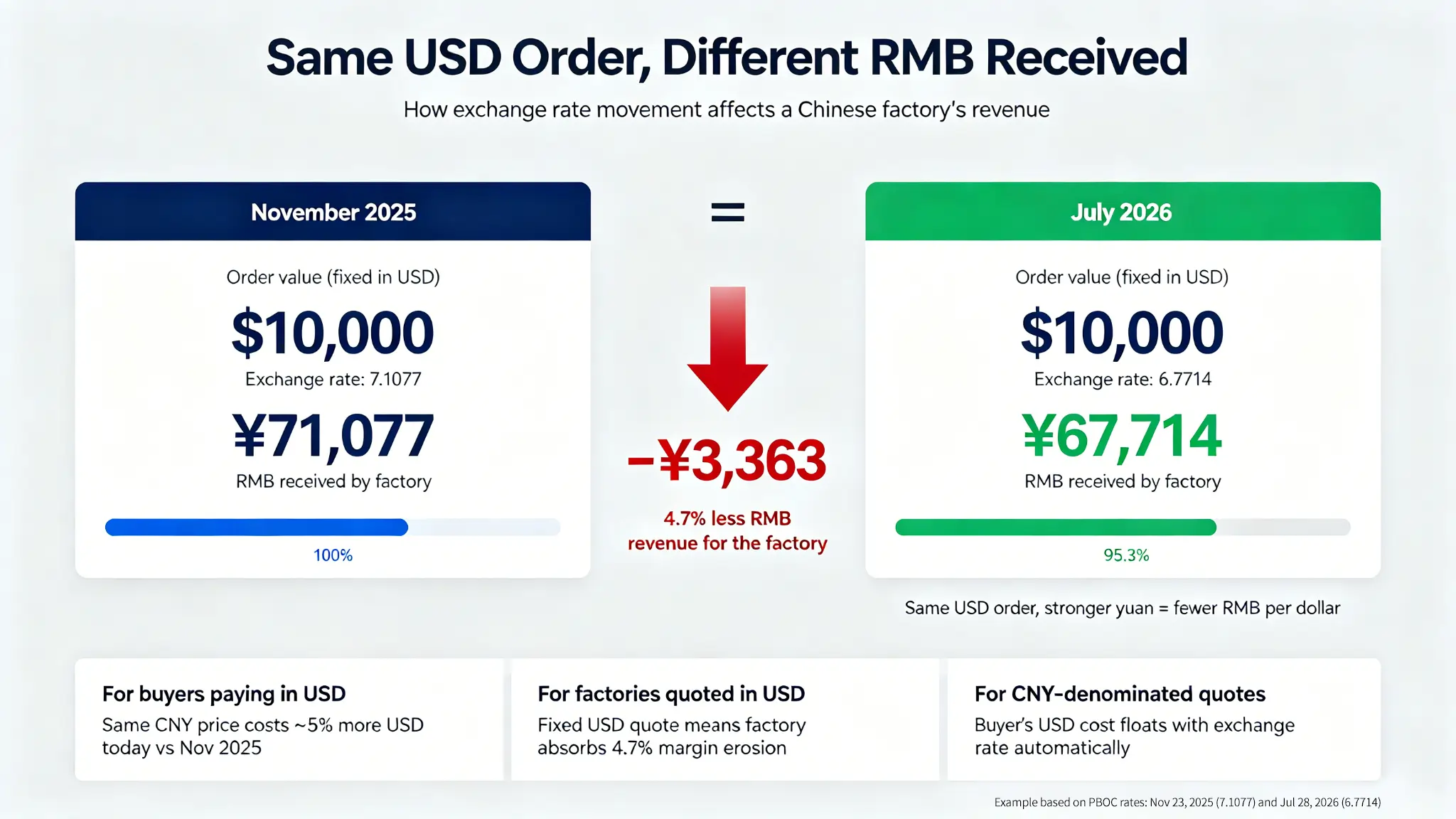
Say you ordered a magnetic gift box at ¥13.50 per unit in November 2025, when USD to CNY sat around 7.11, that’s roughly $1.90 per unit. If you reorder the identical box in late July 2026 at the same ¥13.50, with USD to CNY now around 6.77, your dollar cost is roughly $1.99 per unit. Nothing about the box changed. The yuan simply buys more dollars than it did eight months ago, and that difference shows up directly in your landed cost. At 5,000 units, that’s an unplanned $470 swing from currency movement alone, separate from any material, freight, or tariff change covered elsewhere in our 2026 cost coverage.
Where Topvisio Stands on This
We quote primarily in USD for US clients and can discuss rate-lock arrangements for larger or recurring orders, so USD to CNY movement doesn’t become a surprise line item between sampling and final payment. If you’re unsure how your current quote was priced, ask, we’ll tell you plainly. See our Custom Gift Boxes and Rigid Box lines for current USD-quoted pricing.
FAQ
Has USD to CNY moved a lot in 2026?
Yes, the yuan has strengthened against both the US dollar and the euro for most of 2026. USD to CNY moved from 7.1077 in late November 2025 to roughly 6.7714 by late July 2026, a roughly 4.7% strengthening of the yuan. EUR/CNY similarly eased from a January 2026 peak near 8.36 to around 7.87 by early June.
Does a stronger yuan make Chinese exports more expensive?
For buyers paying in USD or EUR against a yuan-denominated price, yes, the same CNY price converts to a higher dollar or euro amount when the yuan strengthens. This is independent of any change in material, labor, or production cost.
Should I lock in a USD price to avoid currency risk?
It depends on your order size and timeline. A fixed-USD quote shifts currency risk to your supplier rather than you, which may come under repricing pressure if the trend continues. For large or recurring orders, asking about a formal rate-lock arrangement is often more reliable than an informal fixed-price understanding.
Do freight and customs costs move with USD to CNY the same way product cost does?
Freight quoted in USD is largely insulated from yuan movement since carriers price in dollars directly. Customs duty, however, is calculated on the declared value of the goods, so if that value is set in yuan and converted at time of entry, duty payments carry the same currency exposure as the product cost itself.
Is USD to CNY expected to keep strengthening through 2027?
Major bank forecasts reviewed for this piece project continued yuan strength into late 2026, with the currency already trading close to their year-end targets as of this writing. Treat the USD to CNY direction as a planning input, not a guarantee, and revisit your assumptions each quarter.