The question arrives in different forms: “Should we shift sourcing to a Vietnam gift box manufacturer?” “Is India realistic for luxury rigid boxes?” “Can we get the same quality without the China tariff?” Usually there’s a customs invoice attached.
We’re going to answer this directly. We are a Chinese manufacturer, so we have an obvious interest in saying “no, you can’t.” We’re going to resist that. Whether a Vietnam gift box manufacturer or an Indian one actually delivers the savings and speed brands expect depends heavily on the specific product category, and the tariff math itself shifted at the end of July, which changes some of the numbers brands have been working from.
The Three-Country Picture at a Glance
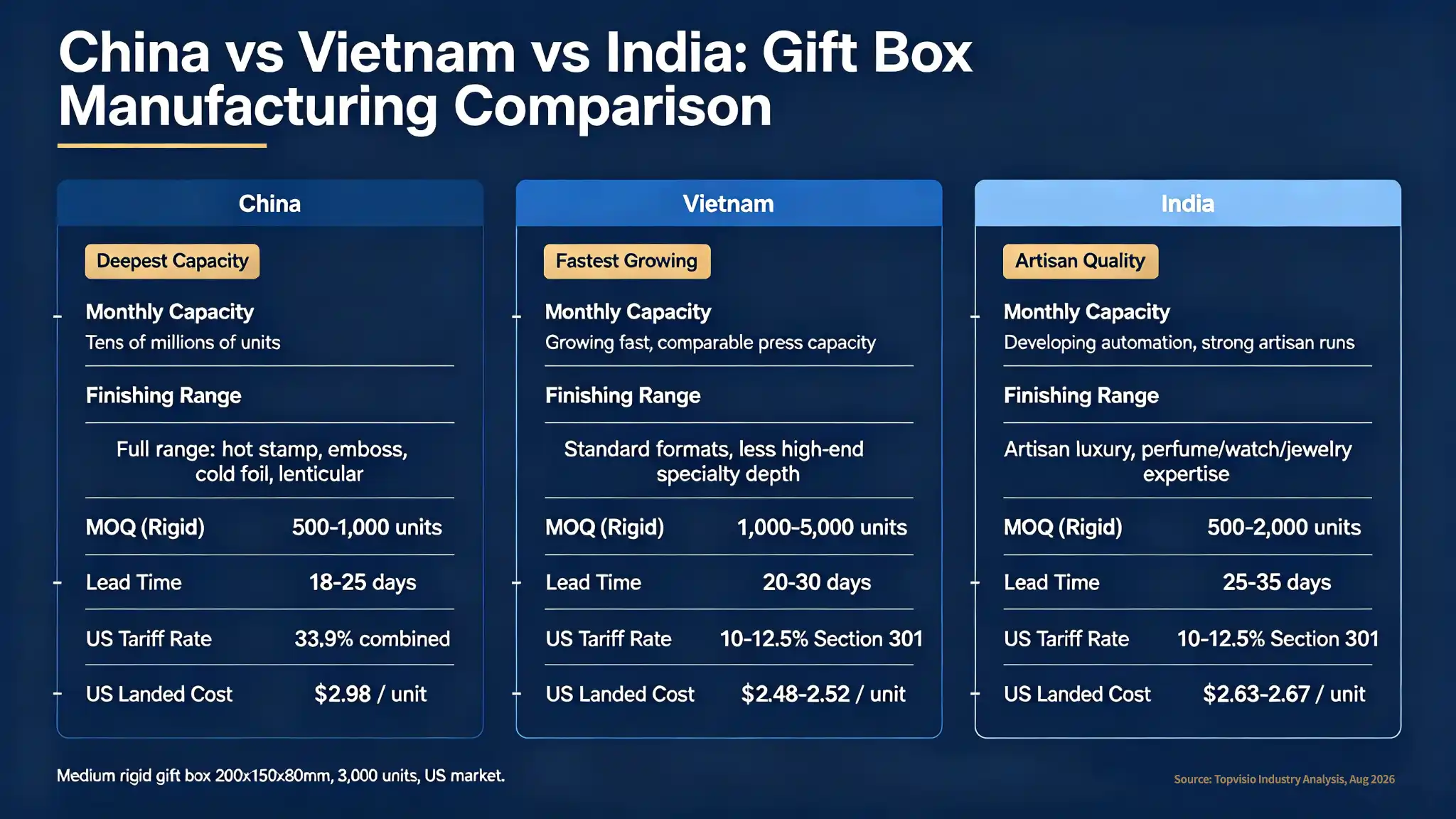
China remains the deepest capacity, most mature supply chain, and widest finishing range of the three, with Dongguan, Guangzhou, and Shenzhen clusters serving the EU, US, and Middle East at scale. The US tariff, now roughly 33.9% combined, is the primary cost disadvantage. A typical Vietnam gift box manufacturer has real and growing capability in folding cartons and mid-tier rigid boxes, with a meaningfully lower US duty burden, though raw material is still partially imported from China, adding lead time. India’s Sivakasi cluster produces genuine award-winning luxury rigid boxes for niche categories, strong for smaller runs and artisan-quality work, but with lower automation for large volumes and a less uniform certification ecosystem.
What Changed in the Tariff Math This Summer
The Section 122 surcharge that Vietnamese and Indian shipments paid at roughly 10% expired on July 24, 2026, on its statutory 150-day limit. It wasn’t simply removed. New Section 301 duties, in the same 10-12.5% range depending on the country, took effect the same minute on imports from roughly 80 countries, including Vietnam and India. China’s rate moved from 35% under the old Section 122 stack to roughly 33.9% under the new one, since its existing 25% Section 301 duty was untouched by any of this litigation. See our full China tariff update for the complete picture.
The practical result: the gap between China and a Vietnam gift box manufacturer didn’t close or open significantly, it’s still roughly a 20-24 percentage point spread, but the specific legal mechanism brands were quoting from is no longer accurate. Anyone still citing “10% Section 122” for Vietnam or India sourcing is working from a superseded figure.
Detailed Comparison: What Actually Matters for Gift Box Buyers
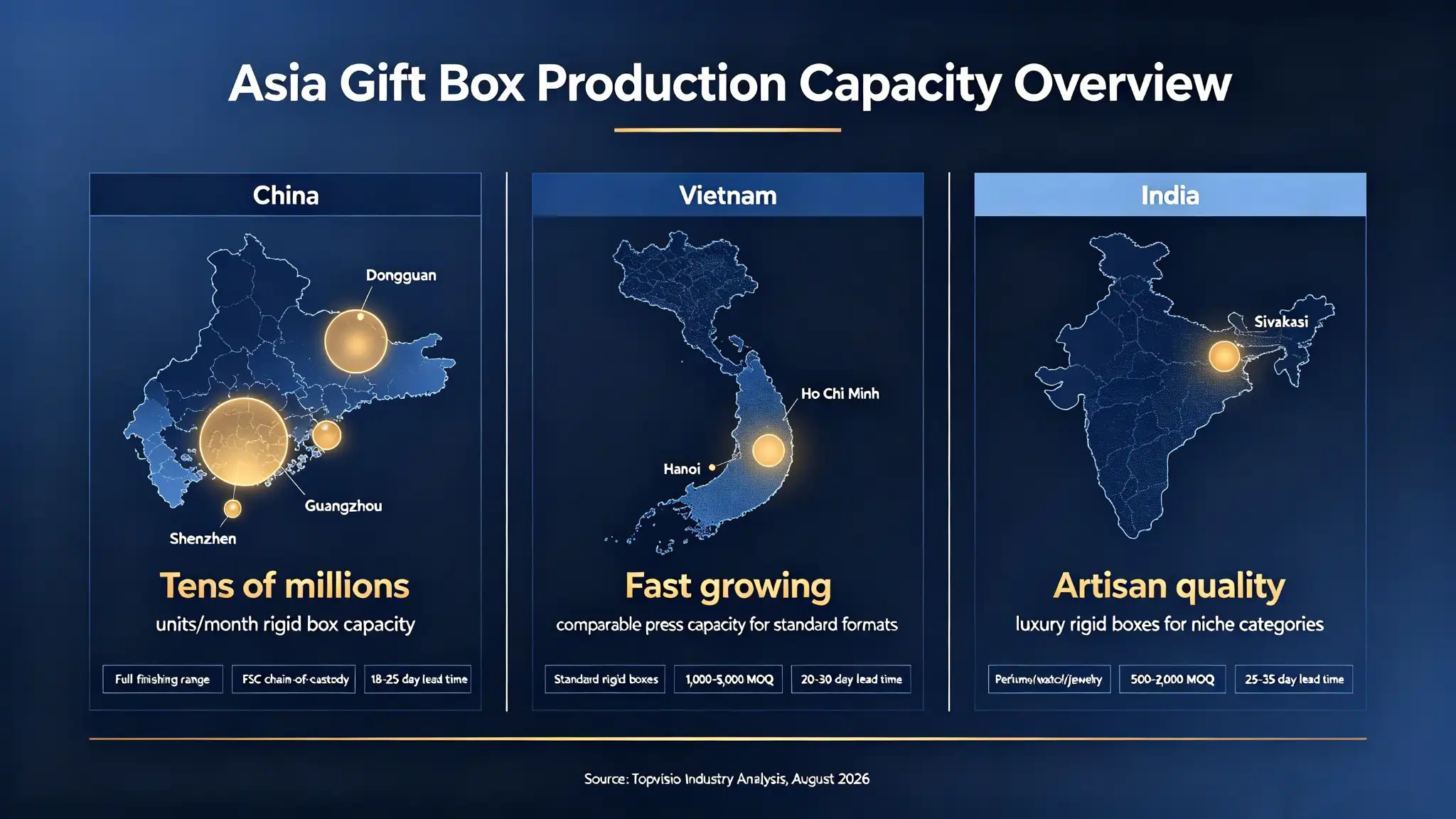
Before deciding whether a Vietnam gift box manufacturer makes sense for your product line, here’s how the three origins actually compare on the factors that matter for gift box buyers specifically, not general manufacturing capability.
China offers global-scale rigid box capacity, tens of millions of units monthly in Guangdong alone, with the full range of specialty finishing, hot stamp, emboss, cold foil, across hundreds of factories. Domestic greyboard, white card, and specialty paper are vertically integrated, and FSC chain-of-custody is well established in major hubs. MOQ for rigid boxes typically runs 500-1,000 units, with production lead times of 18-25 days.
A typical Vietnam gift box manufacturer’s rigid box capacity is growing fast, with large exporters now at comparable press capacity for standard formats, though highest-end specialty finishes still have less depth than China. High-grade board is partially imported from China or Korea, adding 5-10 days lead time. MOQ for rigid boxes runs 1,000-5,000 units, lower for digital-print premium runs, with production lead times of 20-30 days for comparable complexity. FSC and ISO certification is available but the supply chain is thinner, requiring more due diligence.
India offers strong artisan finishing and developing automation for high-volume specialty runs. Domestic chipboard is available, though specialty papers are often imported from 14-plus countries. MOQ typically runs 500-2,000 units, varying by factory, with production lead times of 25-35 days, slower for international client sample iteration. Certification is growing, with major exporters holding ISO 9001, though FSC chain-of-custody is less universal than in Chinese hubs.
The Tariff Math: Where the Numbers Actually Go Now
For a medium rigid gift box (200x150x80mm) at 3,000 units into the US market: China’s ex-factory price runs roughly $1.85, with the current 33.9% combined duty adding about $0.63 on CIF, plus $0.50 sea freight, landing around $2.98 per unit. A Vietnam gift box manufacturer’s ex-factory price runs roughly $1.75, with the new Section 301 duty (10-12.5% depending on classification) adding $0.18-0.22, plus $0.55 sea freight, landing around $2.48-2.52. India runs similarly, roughly $1.80 ex-factory, comparable new duty exposure, plus $0.65 sea freight, landing around $2.63-2.67.
The saving versus China is still real, roughly $0.45-0.50 per unit for Vietnam, somewhat less for India, but it’s noticeably smaller than the $0.58 figure that circulated when Vietnam and India were paying only the flat 10% Section 122 rate and nothing else.
The Switching Cost the Math Ignores
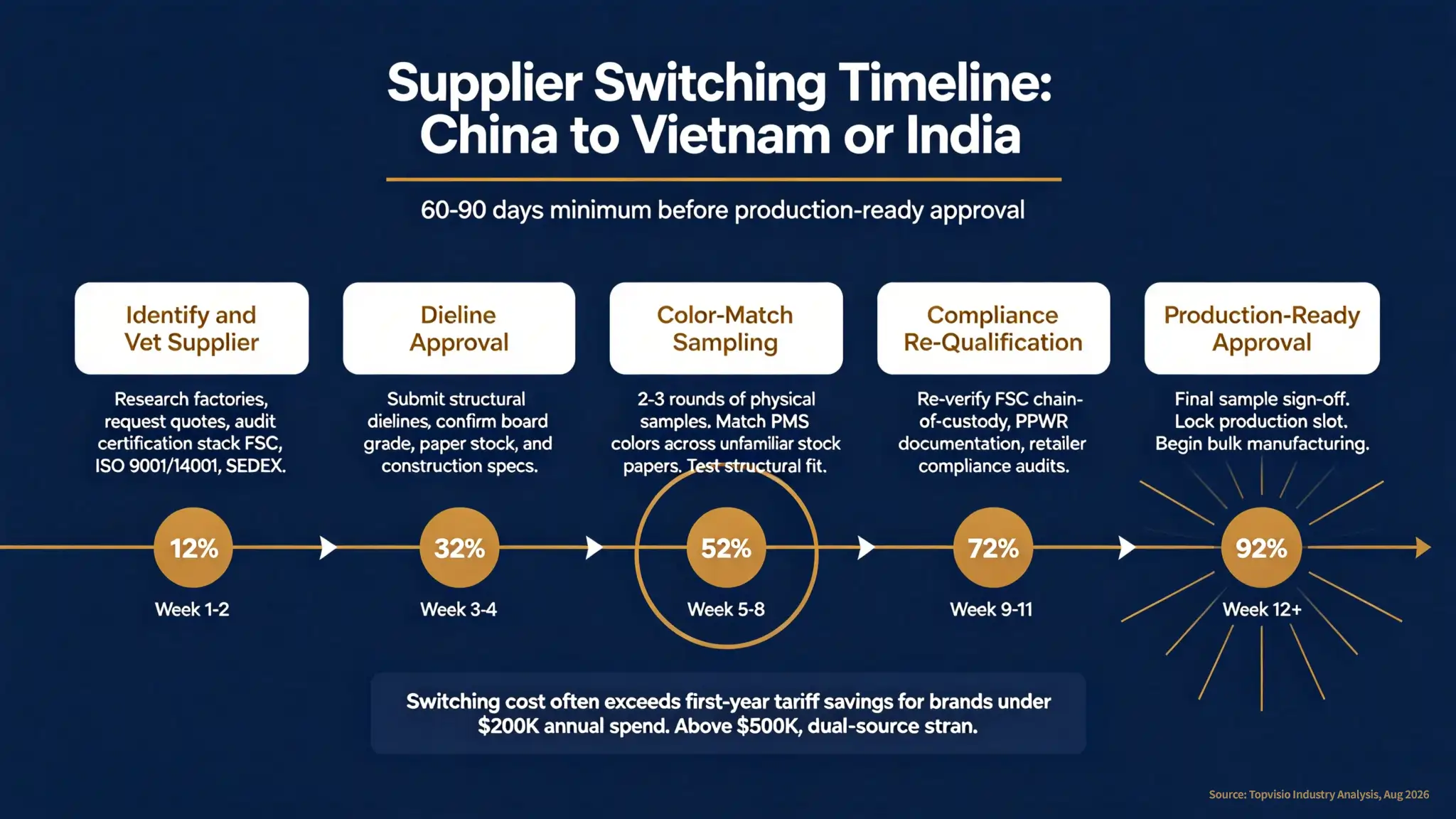
Moving from an established China supplier to a Vietnam gift box manufacturer or an Indian one involves new dieline approvals, color-match sampling across potentially unfamiliar stock papers, re-qualification of the supplier’s FSC and compliance documentation, and typically 2-3 rounds of sampling, 60-90 days minimum, before production-ready approval. Anyone comparing these origins against China on landed cost alone is missing this variable. For brands spending under $200K per year on packaging, this switching cost often exceeds the first year of tariff savings. Above $500K annually, the math starts to favor a genuine dual-source strategy.
Where a Vietnam Gift Box Manufacturer Genuinely Wins, and Where It Doesn't Yet
A Vietnam gift box manufacturer wins clearly for corrugated mailers and e-commerce shipping boxes, standard folding cartons, mid-tier rigid gift boxes with standard finishes, and brands with US annual packaging spend above $200K where the tariff saving still justifies switching friction after the July rate changes. Vietnam is not yet at China’s level for the highest-end specialty finishes at scale, deep cold-foil, lenticular, certain holographic effects at 50,000-plus units. One China-based industry analysis put it plainly: for roughly 90% of B2B packaging specifications, a good Vietnam gift box manufacturer’s output is indistinguishable from a comparable Chinese facility. The remaining 10% matters if your product sits in it, luxury cosmetics with 8-color print and deep embossing, complex multi-component gift sets, or packaging requiring full FSC chain-of-custody to major retailer compliance standards.
Where India Genuinely Wins, and Its Real Limitations
India wins for artisan-quality luxury rigid boxes where handcraft precision matters more than throughput, smaller runs where per-unit quality is paramount, and specific niche categories, Sivakasi has genuine expertise in perfume, watch, and jewelry rigid boxes. India’s real limitations for export-scale sourcing: automation for high-volume production generally trails China or Vietnam’s leading factories, lead times run longer, and the certification ecosystem is present in major exporters but less uniformly available across the industry.
Recommended Approach by Scenario
Situation | Recommended Approach |
US brand, under $150K packaging spend/year | Stay with China. Switching friction exceeds tariff saving in year one. |
US brand, $200K–500K spend/year, standard rigid specs | Worth piloting a Vietnam gift box manufacturer for corrugated and standard rigid. Retain China for premium finishes. |
US brand, $500K+ packaging spend/year | Genuine case for a Vietnam gift box manufacturer as primary source for standard runs; China for highest-spec luxury. |
EU / GCC / UK / AU brand | Tariff advantage is minimal either way — choose based on quality and lead time. |
Topvisio's Position
We’re a Chinese manufacturer with 15 years of production in Dongguan. We’re not going to pretend the tariff situation doesn’t affect US clients weighing a Vietnam gift box manufacturer or Indian alternative, it does, and it’s real, even after the July changes narrowed the gap slightly. What we offer that Vietnam or India alternatives typically can’t match at the same scale: the full finishing range, cold foil, lenticular, multi-layer embossing, hot stamp on metallic board, on orders from 1,000 units upward; sampling turnaround fast enough that your physical sample often arrives before a competing quote from an alternate origin; and an FSC, ISO 9001, ISO 14001, ISO 45001, and SEDEX certification stack that major retailers require, fully documented and audit-ready.
For EU, GCC, UK, and Australian clients, the tariff conversation doesn’t really apply. For US clients evaluating the numbers, we’ll quote honestly and show the landed cost clearly, including current duty, so you can make the right call for your brand.
FAQ
What is the current US tariff rate on packaging from a Vietnam gift box manufacturer?
Roughly 10-12.5%, under the new Section 301 duties that replaced the expired Section 122 surcharge on July 24, 2026, varying by product classification. This is close to, but not identical to, the flat 10% Section 122 rate that applied earlier in the year.
How long does switching suppliers from China to Vietnam or India actually take?
Typically 60-90 days minimum for dieline approval, color-match sampling, and compliance re-qualification, not counting the time to identify and vet a new supplier in the first place.
Is a Vietnam gift box manufacturer actually cheaper than China now that Section 122 expired?
Yes, but by a smaller margin than earlier in 2026. China’s combined rate sits around 33.9%, while Vietnam and India now fall under the new Section 301 duty range of roughly 10-12.5%, a real gap but narrower than the earlier Section 122 comparison suggested.
Should every brand switch some production to Vietnam or India?
No, not every brand should move production to a Vietnam gift box manufacturer or an Indian one. The switching cost, new dielines, sampling, compliance re-qualification, often exceeds the tariff saving for brands under roughly $200K in annual packaging spend. Above $500K, a dual-source strategy generally makes more sense.
Does the China-Vietnam-India tariff comparison matter for EU or UK brands?
Not much. EU MFN duty on Chinese paperboard is 0%, so the sourcing decision for non-US markets should be based on quality, lead time, and supplier relationship rather than tariff arbitrage.