In short: Middle East gift packaging tends to favor rich, saturated colors — deep reds, golds, and jewel tones — alongside structural formats built for seasonal occasions like Eid, which drive a significant share of annual gifting volume in the region. Metallic foil finishing is used more heavily and more often in multiple colors than is typical in Western markets.
Middle East gift packaging design draws on different visual conventions than European or North American markets, and brands entering the region for the first time benefit from understanding these preferences before finalizing artwork, rather than adapting a Western design after the fact and hoping it translates.
Topvisio Packaging produces Middle East market packaging out of Dongguan, Guangdong, running 14+ automated production lines, with FSC certification available on request, PPWR compliance, ISO 9001, ISO 14001, and SEDEX audit standing. Our Eid gift box line is built specifically around the region’s most significant seasonal gifting occasion.
Color Preferences in Middle East Gift Packaging
Gold, deep red, and rich jewel tones — emerald, sapphire, burgundy — feature heavily in Middle East gift packaging, often combined with black or deep navy as a grounding color. These choices reflect broader regional aesthetic preferences around luxury and celebration, and they tend to read as more festive and higher-value in this market than the more muted, pastel-leaning palettes common in some Western gift packaging trends. Brands adapting an existing product line for the region often find that a straightforward color palette swap — shifting from a pastel or muted exterior to gold and jewel tones — does more to signal regional relevance than a full structural redesign.
Metallic Finishing and Foil Work
Foil stamping is used more heavily in Middle East gift packaging than in many other markets, often in multiple colors — gold, silver, and copper foil combined on a single box is more common here than in markets where a single accent foil color is the norm. This reflects a broader regional preference for visibly premium, ornate finishing over minimalist restraint, though this varies by product category and specific brand positioning rather than applying uniformly across every gift category.
Seasonal Occasions That Drive Demand
Eid al-Fitr and Eid al-Adha represent the most significant gifting occasions in much of the Middle East, comparable in scale to how Christmas drives seasonal gifting volume in many Western markets. Ramadan more broadly, alongside these two Eid celebrations, drives a substantial share of annual gift packaging demand across cosmetics, confectionery, and general gifting categories. Brands planning a Middle East market entry should treat these occasions as primary planning anchors for seasonal production, similar to how a Western brand plans around the year-end holiday period.
Structural Formats Common in the Region
Rigid boxes with elaborate exterior finishing are common across confectionery, cosmetics, and general gifting categories in the Middle East, often with more structural complexity — multi-tier boxes, hinged compartments, decorative window cutouts — than equivalent Western gift packaging. This reflects both the cultural significance placed on gift presentation and, in many markets within the region, retail price points that support more elaborate packaging investment relative to the product’s own cost.
Language and Text Considerations
Packaging destined for Middle East markets often needs to accommodate both Arabic and English text, with layout considerations for right-to-left Arabic script alongside left-to-right English. This affects logo placement, text block sizing, and overall layout planning in ways that a purely English-language design doesn’t need to account for, and it’s worth involving a design team experienced with bilingual Arabic-English packaging layout rather than retrofitting Arabic text onto a design built for English alone.
Certifications and Compliance for Middle East Shipments
FSC chain-of-custody certification is available on request — see FSC International for how that documentation works — alongside PPWR compliance for any component of a shipment also destined for EU markets, and ISO 9001, ISO 14001, and SEDEX audit standing for retail buyers running formal supplier reviews. Certification expectations in Middle East retail vary more by individual retailer and market than in the EU, so confirming specific requirements with a destination retail partner is worth doing directly rather than assuming a single certification stack covers every buyer in the region.
Real-World Scenarios: Different Product Categories in the Region
A cosmetics brand entering the Middle East market often finds that its existing product formulations translate well, but its packaging needs meaningful visual adaptation — a muted, minimalist European packaging design frequently gets refreshed with richer color and more elaborate finishing for regional launch, even when the product formula itself remains unchanged. A confectionery brand selling into the region during Ramadan needs to plan packaging production well ahead of the lunar calendar date, since Ramadan and Eid timing shifts roughly ten to eleven days earlier each year relative to the Gregorian calendar, making a fixed annual production schedule based on previous years’ dates a common planning mistake.
A jewelry or luxury goods brand entering Gulf markets specifically often finds that packaging elaborateness expectations run higher than in many other regions — multi-tier boxes, hinged compartments, and heavier structural weight are more standard here than in markets where minimalist luxury packaging has become more common, reflecting different regional conventions around what signals genuine luxury.
Material and Finishing Choices for the Region
Beyond color and foil work, Middle East gift packaging often favors heavier greyboard cores and more substantial overall weight than equivalent packaging in some other markets, since perceived value in this region correlates strongly with physical heft. PU leather wraps and textured specialty papers see more frequent use here than plain coated paper, particularly for gifting categories tied to significant cultural occasions rather than everyday retail purchases.
Working With Local Retail Partners
Retail requirements and certification expectations vary more by individual country and retailer within the broader Middle East region than in more standardized markets like the EU. A packaging specification that satisfies a retail partner in the UAE doesn’t automatically meet requirements in Saudi Arabia or other Gulf markets, and brands expanding across multiple countries within the region should confirm requirements per market rather than assuming a single specification covers the entire region uniformly.
Certification Documentation for Middle East Retail
While certification requirements vary by specific retailer, FSC chain-of-custody documentation and general quality certifications like ISO 9001 increasingly come up in supplier conversations across the region’s larger retail chains, following a pattern seen in other developed retail markets. Brands with this documentation already in place tend to move through supplier onboarding more quickly than those needing to source it reactively once a retail partner requests it.
Packaging Structures for Ramadan and Eid Gifting
Date boxes represent a distinct and culturally significant packaging category during Ramadan, given the tradition of breaking fast with dates — these structures often combine elaborate exterior finishing with a food-safe interior tray, similar in structural logic to a confectionery box but adapted to the specific dimensions and presentation conventions dates require. Larger family or corporate Eid gift sets combining multiple items — dates, sweets, a small keepsake — need the same kind of divided interior structure that multi-item hampers require in other markets, adapted to regional aesthetic conventions.
Perfume Packaging for Regional Preferences
Perfume holds particular cultural significance in much of the Middle East, and packaging for this category often warrants special attention beyond general gift packaging conventions. Structures designed for the region’s perfume market frequently favor taller, more architectural box shapes with elaborate window cutouts to display the bottle, along with the heavier finishing and richer color conventions common across the broader Middle East gift packaging category. Brands adapting an existing perfume box design for regional launch should treat this category as warranting more design attention than a general product-line color adaptation might otherwise receive.
Lead Times for Regional Market Launches
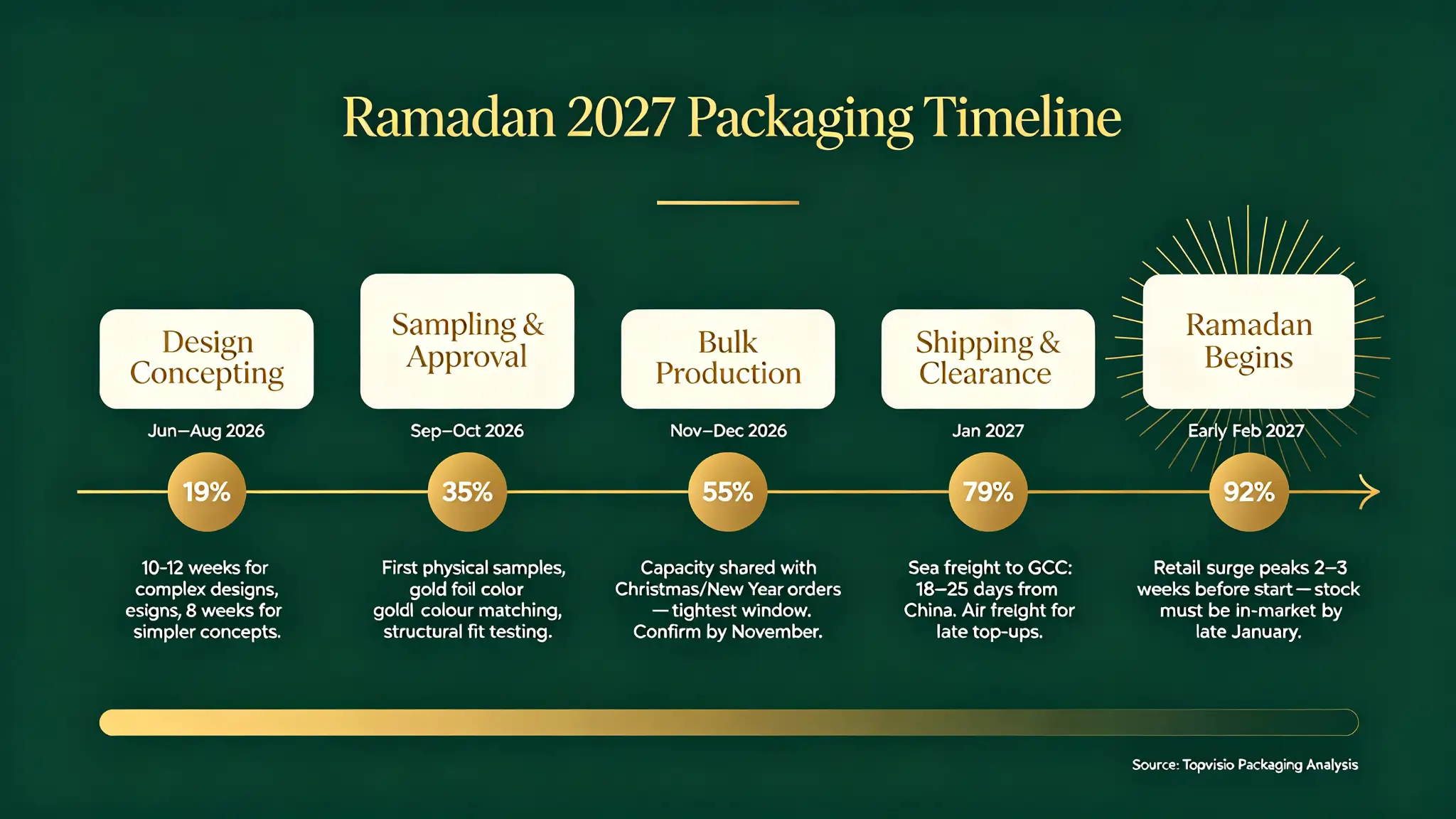
Brands planning a packaging launch tied to Ramadan or Eid need to work backward from the lunar calendar date, building in production lead time — typically 5-10 business days for an initial sample and 25-45 business days for bulk production depending on structural complexity — well ahead of the actual gifting season, since demand across the entire regional packaging supply chain tightens as these occasions approach, similar to how Western holiday seasons compress capacity industry-wide.
Because Ramadan’s Gregorian calendar date shifts earlier each year, brands relying on a fixed annual production calendar based on the previous year’s timing risk missing the actual seasonal window, which is a more common planning error for this market than for holidays tied to a fixed Gregorian date.
Sourcing Middle East Gift Packaging From a Single Manufacturer
Brands selling across multiple markets, including the Middle East alongside Western regions, often find value in sourcing packaging from a single manufacturer capable of producing region-specific variants rather than working with separate suppliers per market. This consolidation simplifies quality control and allows a manufacturer’s design team to apply consistent underlying structural quality while adapting color, finish, and language layout per region — a more efficient approach than managing entirely independent supplier relationships for what is ultimately variations on related packaging needs.
Balancing Regional Adaptation With Global Brand Identity
Brands entering the Middle East market face a genuine tension between adapting packaging for regional resonance and maintaining consistent global brand identity across markets. A completely region-specific redesign risks diluting brand recognition for customers who encounter the brand across multiple markets, while a completely unadapted global design risks underperforming against local competitors who’ve invested in genuinely regional presentation. Most successful approaches preserve core brand elements — logo, primary brand color, typography — while adapting secondary elements like accent colors, finishing intensity, and structural elaborateness to regional expectations.
Working With a Design Team on Regional Adaptation
Brands unfamiliar with Middle East gift packaging conventions benefit from working with a design team that has direct experience in the region, rather than attempting to guess at appropriate color and finish choices from general market research alone. Many manufacturers, including Topvisio Packaging, can advise on which structural and finishing choices have performed well for other brands entering the same market, which shortcuts the trial-and-error a brand would otherwise go through on its own first regional launch.
Common Mistakes When Entering the Middle East Market
The most common mistake is adapting a Western color palette and finish level for the region without genuinely reconsidering the visual approach — a muted, minimalist design that reads as premium in a European market can read as underwhelming or incomplete in a market where richer color and more elaborate finishing signal value. The second common mistake is treating Ramadan and Eid as a single generic ‘holiday season’ rather than planning specifically around these occasions’ actual timing and cultural significance, which shift on the lunar calendar and don’t align with a fixed Western seasonal production schedule.
Common Mistakes in Middle East Market Packaging
The most common mistake is treating the Middle East as a single uniform market when it actually spans multiple countries with distinct retail requirements, aesthetic nuances, and gifting calendars — a design and compliance approach validated for one country doesn’t automatically transfer cleanly to another within the region. The second common mistake is underestimating how much color and finish adaptation matters here compared with a simple language translation of packaging text; brands that translate copy into Arabic while keeping an unchanged Western color palette and finish level often underperform brands that genuinely adapt the visual approach alongside the language.
Manufacturing and Certifications
You can browse our full product range or check FSC-certified packaging options for available material grades.
Approaching Middle East gift packaging with the same level of dedicated attention given to any other major market — rather than treating it as a secondary adaptation of an existing Western design — tends to produce results that resonate more genuinely with regional customers and perform better against local competitors who have made that investment.
That investment shows up in the details customers notice without necessarily articulating — color richness, finishing weight, structural presence — and it’s a meaningful part of why some international brands succeed in the region while others, despite strong products, struggle to gain the same traction.
For any brand weighing whether the investment in genuine Middle East gift packaging adaptation is worth it, the practical answer tends to be yes wherever the region represents a meaningful share of target revenue, since packaging is one of the more visible and controllable levers a brand has for signaling cultural fluency to customers before a single word of marketing copy is read. That signal matters before a purchase decision is even consciously made.
Frequently Asked Questions
Frequently Asked Questions
What colors work best for Middle East gift packaging?
Gold, deep red, and rich jewel tones like emerald and sapphire feature heavily, often combined with black or navy as a grounding color, reflecting regional preferences around luxury and celebration.
Is multi-color foil stamping common in Middle East gift packaging?
Yes. Combining gold, silver, and copper foil on a single box is more common in this market than in regions where a single accent foil color is the norm.
What are the main seasonal occasions for gift packaging in the Middle East?
Eid al-Fitr and Eid al-Adha are the most significant gifting occasions, comparable in scale to how Christmas drives seasonal demand in many Western markets, alongside broader Ramadan gifting.
Does Middle East gift packaging need bilingual text layout?
Often, yes. Packaging frequently needs to accommodate both Arabic and English text, with layout planning for right-to-left Arabic script alongside left-to-right English.
Is FSC certification recognized in Middle East retail markets?
FSC certification is available on request, though certification expectations vary more by individual retailer in this region than in the EU, so confirming specific requirements with a destination partner is worth doing.
Can an existing Western gift box design be adapted for the Middle East market?
Sometimes, though a straightforward color palette shift toward gold and jewel tones often does more to signal regional relevance than attempting a full structural redesign.
How does Ramadan’s shifting calendar date affect packaging production planning?
Since Ramadan shifts roughly ten to eleven days earlier each year on the Gregorian calendar, brands should plan production around the actual upcoming date rather than assuming the previous year’s timing, to avoid missing the seasonal window.
Should perfume packaging receive special design attention for Middle East markets?
Given perfume’s particular cultural significance in the region, many brands invest more design attention in this category specifically, often favoring architectural box shapes with window cutouts and heavier finishing than general product-line adaptations.