A rigid gift box looks simple from the outside. But behind every magnetic cosmetic set box, every premium wine carry case, every luxury chocolate presentation box, lies a material supply chain that has been under sustained cost pressure for most of 2026, and the greyboard price is the single biggest reason why.
The two materials that matter most are greyboard, the structural inner board that makes a rigid box rigid, and white card paper, the outer layer you see and touch. Both have risen, and the greyboard price move is the larger of the two for most rigid box structures. The causes are different. The effect on your packaging budget is the same.
What's Actually Happened Since January 2026
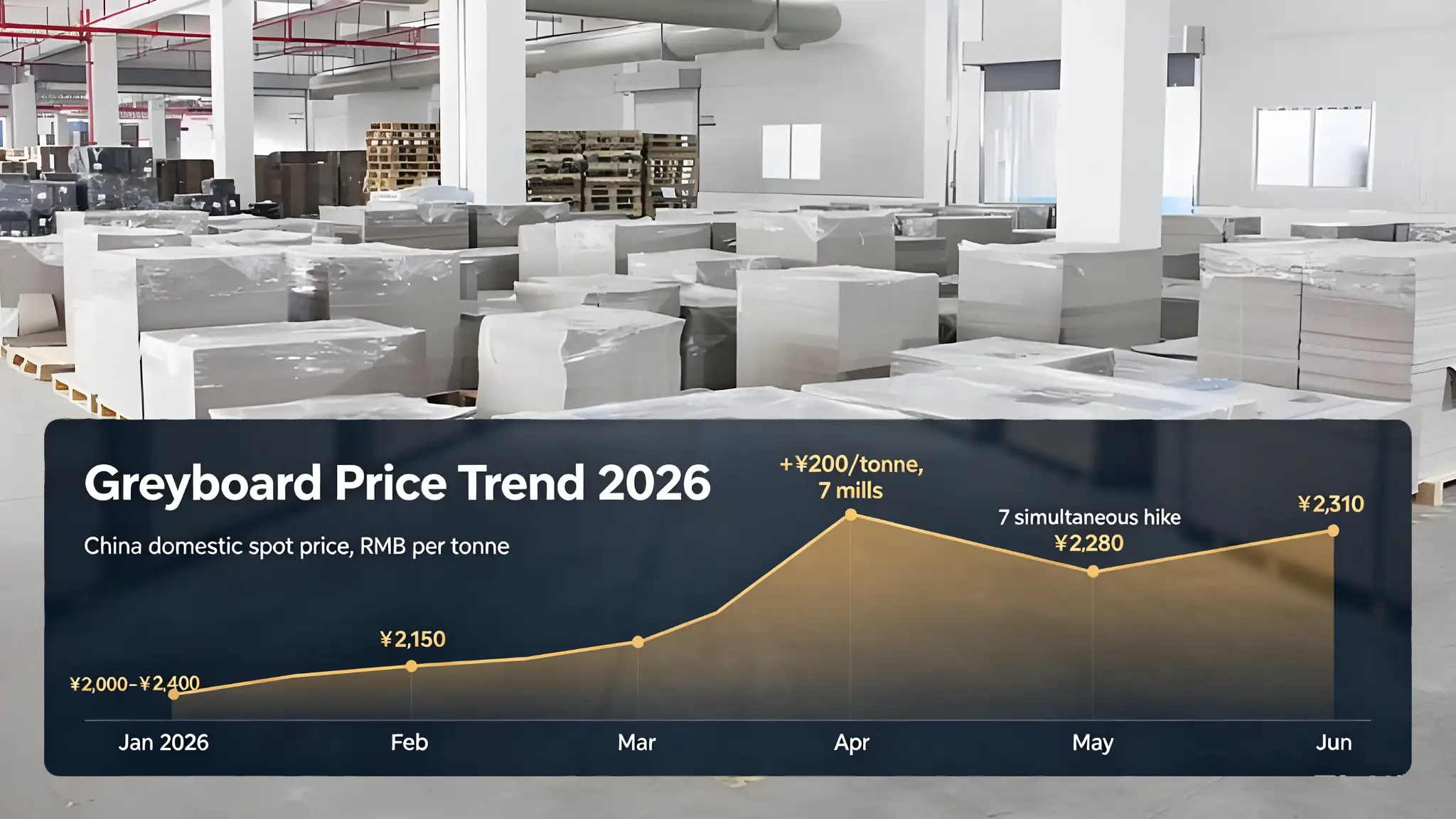
Greyboard spot pricing sat around ¥2,100-2,200 per tonne in January, held through a Chinese New Year lull, then jumped roughly ¥200 per tonne in March when seven mills across Zhejiang, Hebei, Shandong, and Henan raised prices simultaneously. By late May, greyboard spot pricing had settled at ¥2,260-2,310 per tonne, and June brought a further directional increase as major producers adjusted linerboard and corrugating pricing upward.
White card paper followed a steeper early-year climb, from roughly ¥3,700 per tonne in January to a peak near ¥4,000 in March, before easing to roughly ¥3,800-3,930 through the traditional spring slack season. The pattern across both materials is the same: a sharp early-year jump driven by coordinated mill price increases, followed by a partial, not full, retreat.
The Real Engine Underneath Both: Waste Paper
Unlike wood pulp, a global commodity, greyboard is made primarily from recycled fibre, domestic waste yellow board paper in China’s case. That makes the greyboard price highly sensitive to domestic collection conditions rather than international pulp markets. Since Q1 2026, domestic waste paper prices have risen roughly ¥300-400 per tonne cumulatively, driven by tighter environmental regulation on sorting facilities, collection disruptions including rainfall, and a structural shortfall in recoverable fibre as lighter-weight packaging replaces some corrugated formats.
This isn’t an isolated Chinese phenomenon confined to trade-press reporting. Independent industry tracking from Procurement Resource confirms the same wastepaper-driven pattern showing up in China’s broader corrugated packaging costs through Q2 2026, citing tightness in old corrugated container collection, rain-disrupted logistics, and stronger pre-festival procurement all pushing input costs upward at the same time mills faced their own margin pressure.
Three Forces Are Converging at Once
Waste paper cost pressure is the base layer, but two additional forces compound it. China’s paperboard industry is concentrated enough that when major producers move, the market follows: one leading manufacturer’s early-2026 price increases across multiple production bases triggered a cascade of matching hikes from smaller mills within weeks, a pattern Packaging Dive’s coverage of the broader containerboard market describes as a shift toward a sustained upward pricing cycle. Separately, chemical auxiliaries, starch, sizing agents, environmental processing chemicals, have risen 10-20% year on year, representing 8-12% of total mill production cost, a cost-push from below that reduces mills’ tolerance for spot price negotiation.
None of these three forces are temporary operating spikes. 2026 is the opening year of China’s next Five-Year Plan cycle, and environmental compliance standards for mills, water treatment, energy, emissions, have tightened further as part of that policy direction. These are structural additions to the cost of making paperboard, not a cyclical blip that reverses on its own.
Which Gift Box Categories Feel It Most
The greyboard price increase doesn’t hit every structure equally, since board weight per unit varies significantly across box categories. Here’s how it maps across common categories.
Box Category | Impact Level | Reason |
Magnetic closure boxes | Highest | Most greyboard per unit; magnet cost also rising separately |
Luxury wine boxes | High | Bottle protection needs 2–3mm board — more greyboard by weight |
Cosmetic / beauty gift sets | Moderate–High | Specialty outer paper tracks white card price directly |
Two-piece lid-and-base | Moderate | Simpler structure; greyboard is a smaller share of total cost |
What Smaller Brands Should Actually Expect
The 2026 cost environment is asymmetric. Brands with confirmed volume commitments and established supplier relationships are partially insulated from spot-rate volatility. Brands ordering at spot rates, particularly smaller runs, are absorbing more of the increase with less buffer. A 200x200x80mm magnetic closure box that quoted at $1.40-1.80 per unit at 3,000 units in early 2025 is more likely to quote at $1.60-2.10 today, a real 14-17% increase on the ex-factory price, not negotiation padding.
Five Things to Do Right Now
Given how the greyboard price has moved this year, a few concrete steps make sense before your next order.
Get your Q4 quote before August. The July-August window is historically when paperboard pricing eases slightly ahead of pre-holiday demand. If you have confirmed holiday volumes, request and lock pricing now rather than waiting into September’s firmer market.
Specify greyboard weight in your purchase order. Under cost pressure, some manufacturers substitute a lighter board without disclosure. If your PO just says “rigid box” without specifying gsm, typically 1,200-1,500 g/m² for a premium structure, you have no contractual basis to reject a lighter board that technically meets a vague spec.
Audit foil coverage alongside board costs. Hot-stamping foil pricing has also moved this year, covered in our foil and magnet price report. Reviewing surface treatment and structural material together often reveals more savings than looking at the greyboard price in isolation.
Consolidate SKU structures where possible. A range using three or four box sizes with minimal functional difference gives a manufacturer worse material yield than two standardized formats. This remains one of the most underused cost levers in gift packaging.
Ask your supplier directly about their greyboard supply arrangement. Manufacturers with strategic supplier relationships or upstream integration tend to hold pricing better through a cost environment like this one. A supplier who can’t answer clearly is more likely a trading company than a manufacturer, and that gap shows up in both cost and quality control.
Where Topvisio Stands on This
Topvisio itemizes greyboard specification separately in every quote, so the greyboard price component is visible rather than buried in a single all-in number. For customers with confirmed Q4 volume, requesting current pricing now, before the seasonal firming typically seen from September onward, is worth doing directly with your account contact. See our Rigid Gift Box, Magnetic Gift Box, and Luxury Wine Box lines for current specification and pricing.
FAQ
Why have packaging costs gone up in 2026 specifically?
The main driver behind the greyboard price move is waste paper rising roughly 300-400 yuan per tonne in Q1 2026, combined with chemical auxiliary cost increases and coordinated price leadership from major producers, several structural shifts converging at once rather than a single disruption.
How much more should I budget for the same rigid box in 2026?
Budget roughly 10-15% higher than a 2024 or early-2025 baseline for equivalent specifications, driven mainly by the greyboard price increase. Larger orders and advance volume commitments generally compress that increase.
What is greyboard and why does it matter so much to cost?
Greyboard is the heavy structural board, typically 1,200-1,500 g/m², that forms the inner skeleton of a rigid box. It’s predominantly made from recycled fibre in China and typically represents 30-40% of total material cost in a rigid box, making the greyboard price the single largest cost variable in most builds.
Which box types are most affected by rising greyboard prices?
Magnetic closure boxes see the highest combined pressure, from greyboard plus separately rising magnet costs. Wine boxes and other thick-wall luxury structures follow due to heavier board requirements per unit.
Will greyboard prices come down later in 2026?
A moderate July-August softening is plausible, but the underlying pressure, waste paper cost, environmental compliance, chemical auxiliaries, is structural rather than cyclical. Q4 is generally projected as the year’s price high point as holiday demand accelerates.