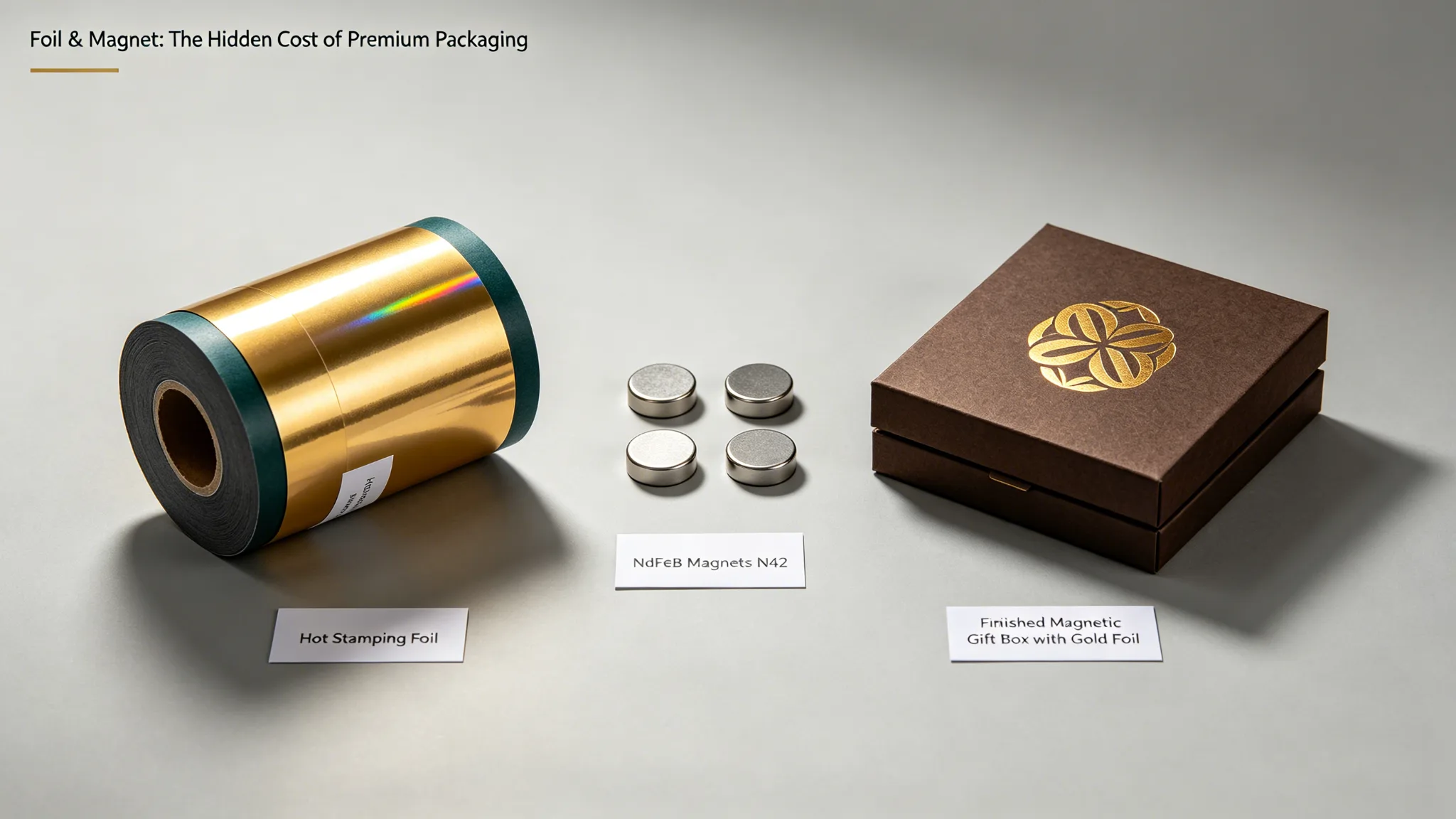
Two materials most brands never think about have moved sharply in 2026, and both are still moving. Hot-stamping foil, the gold or silver layer on your logo, tracks aluminium, which tightened after a shipping disruption in the Strait of Hormuz. Neodymium magnets, the ones inside every magnetic-closure box, moved on a completely different driver, and as of July, prices are back near their highs rather than settled where a June update would have suggested.
This piece covers what actually happened to hot-stamping foil and magnet pricing, with verifiable data through early July 2026, and what it means in dollars on a typical order.
Aluminium: A Shipping Disruption Moved the Price
Hot-stamping foil starts as a thin layer of electrolytic aluminium bonded to a carrier film. When aluminium tightens, foil costs follow with a short lag.
In Q1 2026, roughly 150 vessels were stranded near the Strait of Hormuz, disrupting metal and raw-material shipping routes through one of the world’s busiest chokepoints. Middle Eastern smelters account for close to 9% of global aluminium supply, so the disruption reached Chinese foil producers directly, both through higher export costs and shipping uncertainty. US aluminium foil spot pricing reached roughly $5,620 per metric ton in March 2026, up from typical pre-disruption levels.
What That Means for Foil Pricing
A recent planning guide for hot-stamping foil puts factory-export pricing at $9-28 per kg, landed cost through ordinary import channels at $14-35 per kg, and US-stocked inventory at $25-60 per kg, the range widening with carrier thickness, coating type, and whether the order needs security or custom-color features. There’s no single commodity index for foil because it’s an engineered transfer coating rather than aluminium sold by weight, so two suppliers quoting different specs can both be telling the truth.
For a luxury gift box with substantial gold-foil coverage, the practical effect of this year’s aluminium tightness is a mid-single-digit percentage increase on the hot-stamping foil line item, smaller in isolation than the rare-earth story below, but it stacks with everything else moving at once.
Worth knowing before you request a quote: ask for net foil weight, not roll or carton weight. Hot-stamping foil pricing is calculated per kilogram of actual coating, and a supplier quoting against gross shipping weight will look artificially cheap until the real spec comes out in the sample.
Rare Earths: A Spike, a Correction, and Then a Full Retrace
The bigger story this year sits with the magnets, not the hot-stamping foil, though both remain part of the same cost conversation for any magnetic-closure gift box. Every magnetic-closure gift box uses neodymium-iron-boron (NdFeB) magnets, and the core input, praseodymium-neodymium (NdPr) alloy, had one of the most volatile years on record for this material, and the volatility hasn’t finished.
NdPr oxide opened 2026 at roughly $53 per kg. By late April it had climbed to $136.70-139.60 per kg, a rally of about 160% in four months. By June 1 it had corrected to roughly $90 per kg, a pullback that looked like the story settling down. It wasn’t. By July 1, the NdPr alloy benchmark had climbed back to approximately $133 per kg, up over 21% in a single month and a new high for the year, essentially retracing the entire June correction in four weeks.
Why This Happened
Two forces drove the original spike, and both are still in play. Chinese supply discipline through production quotas tightened available NdPr through the first half of the year, and export licensing restrictions on rare-earth processing technology fed continued uncertainty into pricing. On the demand side, global EV sales rose sharply in 2025 and were forecast to grow another 28% year-on-year in 2026. Every EV with a permanent-magnet traction motor needs 1-3 kg of NdFeB magnet material.
The June correction reflected a partial unwind of speculative positioning and some softening in Chinese domestic demand, but the structural issue underneath never went away, which is exactly why prices climbed back so quickly. China controls roughly 85% of global rare-earth refining capacity, per Critical Minerals News. Mining the ore is the easier part; separating neodymium from the surrounding mix of elements requires processing infrastructure that took China three decades to build, and that Western projects are still years from replicating at scale.
What It Costs on a Magnetic Closure Box
Between hot-stamping foil and magnet costs, the magnet side moves the needle more on a typical order. A standard magnetic closure on a 200x150mm gift box uses roughly 15-25 grams of NdFeB magnet material per unit. At the early-July NdPr benchmark near $133/kg, the raw material cost for that magnet content sits well above where it was even in April’s supposed peak, let alone January. Add the manufacturing, plating, and assembly cost layered onto raw NdFeB blanks, and a magnetic box ordered today carries a meaningfully different cost base than the same box quoted at any earlier point in 2026.
If your supplier quoted magnetic-closure pricing back in Q1 or even in June and hasn’t revisited it, that number is stale twice over. Rare-earth swings of this size move fast enough that a quote older than 30-60 days is worth re-confirming before you commit to a production run.
What to Do About It
Get a current quote on hot-stamping foil, not an old one. Both materials moved enough this year that a quote from earlier in 2026, even from a few weeks ago, doesn’t reflect today’s cost. Ask your supplier when the hot-stamping foil and magnet pricing in your quote was last refreshed.
Specify foil coverage precisely. Spot-foil on a logo costs meaningfully less than full-surface treatment. If your design allows it, reducing coverage by even 30-40% can offset most of this year’s per-kg increase without losing the visual effect.
Reserve magnets for SKUs where they earn their cost. Not every box in a range needs a magnetic closure. A ribbon-pull or friction-fit lid achieves a premium feel at a fraction of the rare-earth exposure, save the magnet for hero products.
Lock pricing before Q4 if volumes are confirmed. Holiday-season demand typically firms up both hot-stamping foil and magnet pricing further. If you have committed Q4 volume, Q3 is the window to secure it.
Where Topvisio Stands on This
We itemize hot-stamping foil and magnet costs separately in every quote, so you can see exactly what’s driving the number rather than receiving one opaque line item. If a spec change, reduced foil coverage, an alternative closure mechanism, can hold your design intent while cutting cost, we’ll flag it before you ask. See our Magnetic Gift Box, Rigid Box, and Bespoke Packaging lines for itemized pricing.
FAQ
Why has hot-stamping foil gotten more expensive in 2026?
Roughly 150 vessels were stranded near the Strait of Hormuz in Q1 2026, disrupting shipping for Middle Eastern smelters that supply close to 9% of global aluminium — the raw material behind hot-stamping foil. Foil pricing tracks aluminium with a short lag, so the disruption fed through to foil costs over the following months.
How much do NdFeB magnet prices affect a standard gift box?
A typical magnetic closure uses 15-25 grams of NdFeB material. With the core input trading back near $133/kg as of early July 2026, essentially retracing its earlier correction, the raw material line on a magnetic box costs meaningfully more than it did at any point earlier in the year.
Will rare earth prices keep rising?
Uncertain, but the pattern so far in 2026 has been sharp moves in both directions rather than a settled trend. China’s control of roughly 85% of global rare-earth refining capacity is a structural constraint, not a temporary one, and demand from EV motors and wind turbines continues to grow.
Can I avoid the magnet cost increase entirely?
Only by switching closure types. A ribbon-pull or friction-fit lid avoids rare-earth exposure entirely. For SKUs where the magnetic click is part of the brand experience, the cost increase is largely unavoidable this year, the lever is reducing where else you spend, not eliminating the magnet.
Where can I learn more about specifying the right magnet grade?
See our companion piece on neodymium magnet grades, covering how N35, N42, and N52 differ in cost and performance, and how to verify you’re getting the grade you paid for.