If you’ve been bracing for another packaging material to get more expensive in 2026, the EVA foam insert story will surprise you. The resin is structurally oversupplied, and even after a volatile year, prices remain well below where they sat during the 2021-2024 boom. But if your EVA foam insert quote hasn’t moved, that’s not your supplier overcharging you, it’s because the resin was never the expensive part.
This piece covers what’s actually happening to EVA pricing, why the EVA foam insert in your box doesn’t track the resin chart, and where the real cost in a foam-and-flocking insert actually sits.
The Resin Story: Oversupply, Not Scarcity
China built EVA capacity aggressively during the 2021-2024 photovoltaic boom, when EVA prices for solar-encapsulant grades soared past 30,000 RMB per tonne. That margin attracted heavy investment from producers including Sinopec, Lianhong New Technology, Zhejiang Petrochemical, and Zhongke Guangdong Refining. By the end of 2025, China’s EVA production capacity had reached roughly 3.8 million tonnes per year, a 35.7% jump from 2024, with another 1.69 million tonnes per year of new capacity planned for 2026, against demand estimated around 3.6 million tonnes. That’s a structural surplus, not a temporary dip.
What Actually Happened to Price This Year
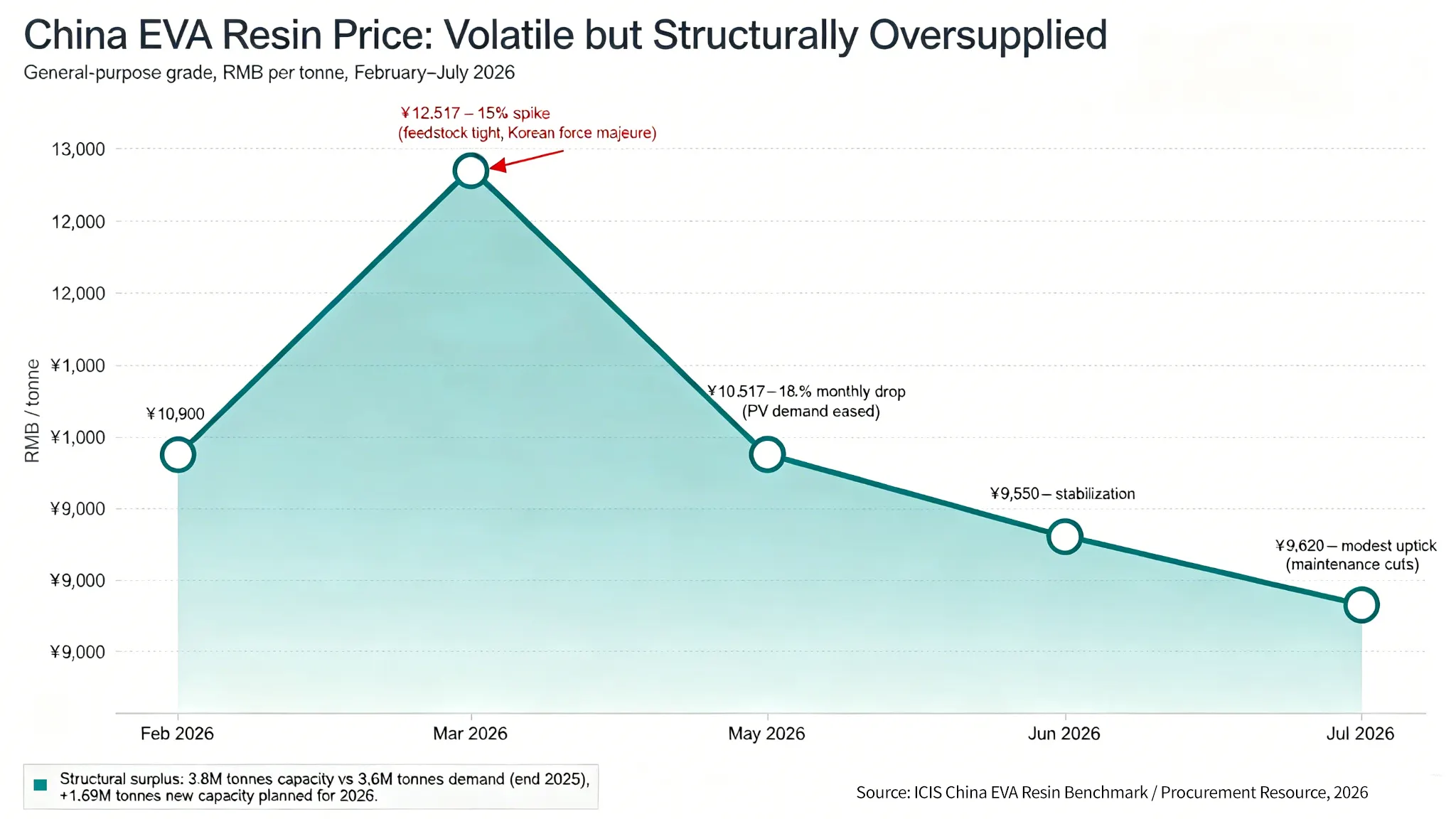
2026 hasn’t been a smooth decline. March saw a sharp roughly 15% spike after feedstock tightened when a major South Korean supplier declared force majeure and domestic producers cut ethylene output. That reversed hard by late May, when the benchmark price fell to roughly ¥10,517 per tonne, an 18.8% single-month drop as the photovoltaic installation rush ended and downstream demand pulled back. June brought stabilization around ¥9,550 per tonne as producers controlled output and inventory destocked. By July, mainstream spot quotes had ticked back up to roughly ¥9,600-9,700 per tonne as several producers ran maintenance and production cuts, tightening near-term supply, though industry reporting describes this latest uptick as unlikely to hold given continued weak downstream demand.
Even at July’s slightly firmer price, EVA remains far below where it traded through most of the 2021-2024 boom, and structurally oversupplied capacity means the ceiling on any rebound stays low.
Why This Happened, and Why It's Not Reversing Soon
The structural driver is a demand mismatch, not a temporary dip. Photovoltaic-grade EVA still dominates new capacity decisions because solar module production scaled faster than anyone modeled, but general-purpose and foam-grade EVA, the kind used in packaging inserts, footwear, and foam sheets, didn’t see comparable demand growth. Industry reporting from Procurement Resource and Mordor Intelligence describes this pattern plainly as photovoltaic dominance and weak traditional demand, with foam-grade producers competing for a shrinking share of overall capacity utilization.
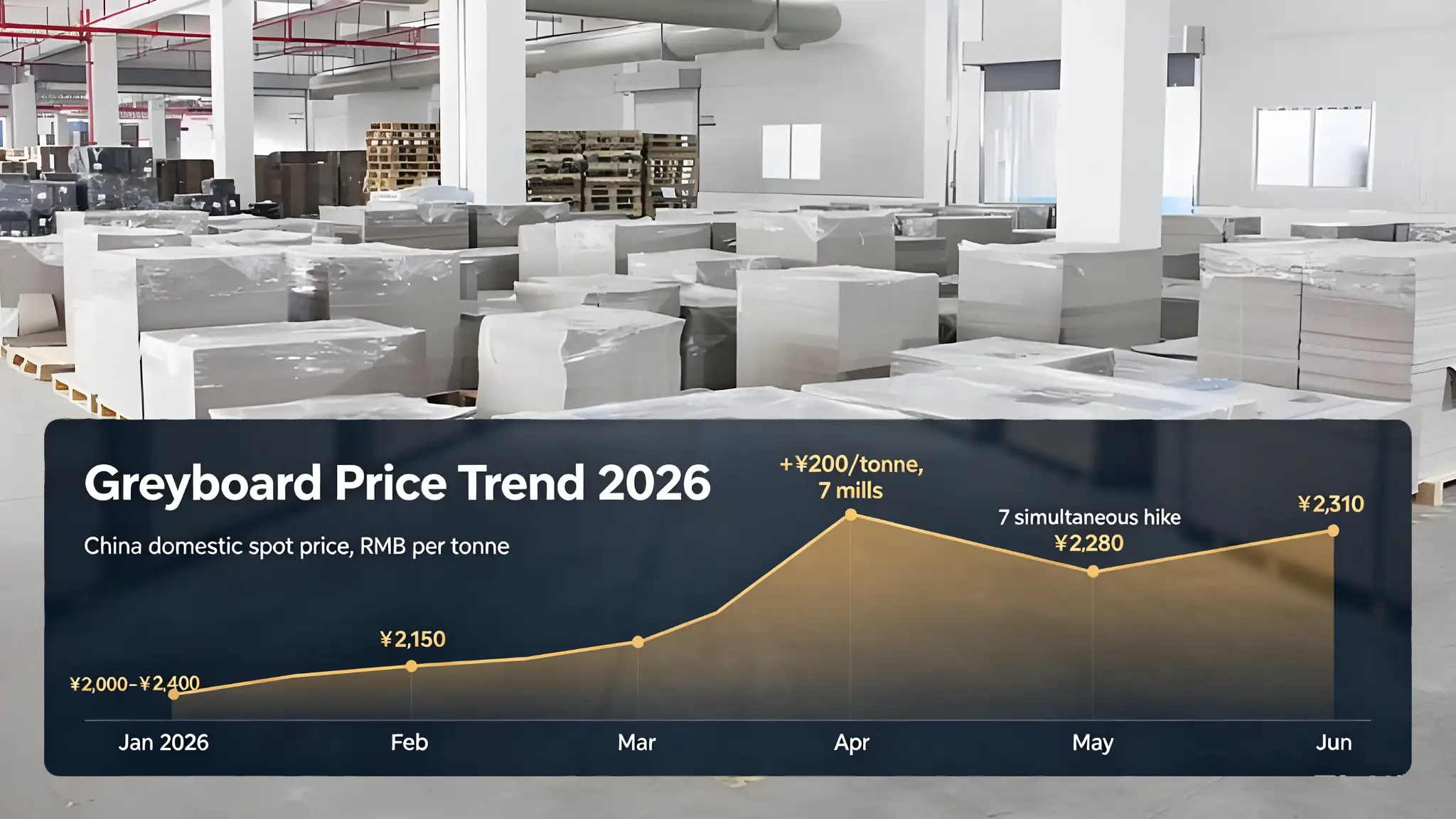
The practical read for packaging buyers: unlike greyboard, hot-stamping foil, or rare-earth magnets, all of which we’ve covered moving sharply higher in 2026, EVA resin is one of the few packaging-adjacent materials currently working in your favor, per ICIS market analysis. If your supplier quoted you a higher foam price citing general material cost pressure, ask which material specifically. EVA resin isn’t the one driving it.
So Why Doesn't Your EVA Foam Insert Quote Reflect This?
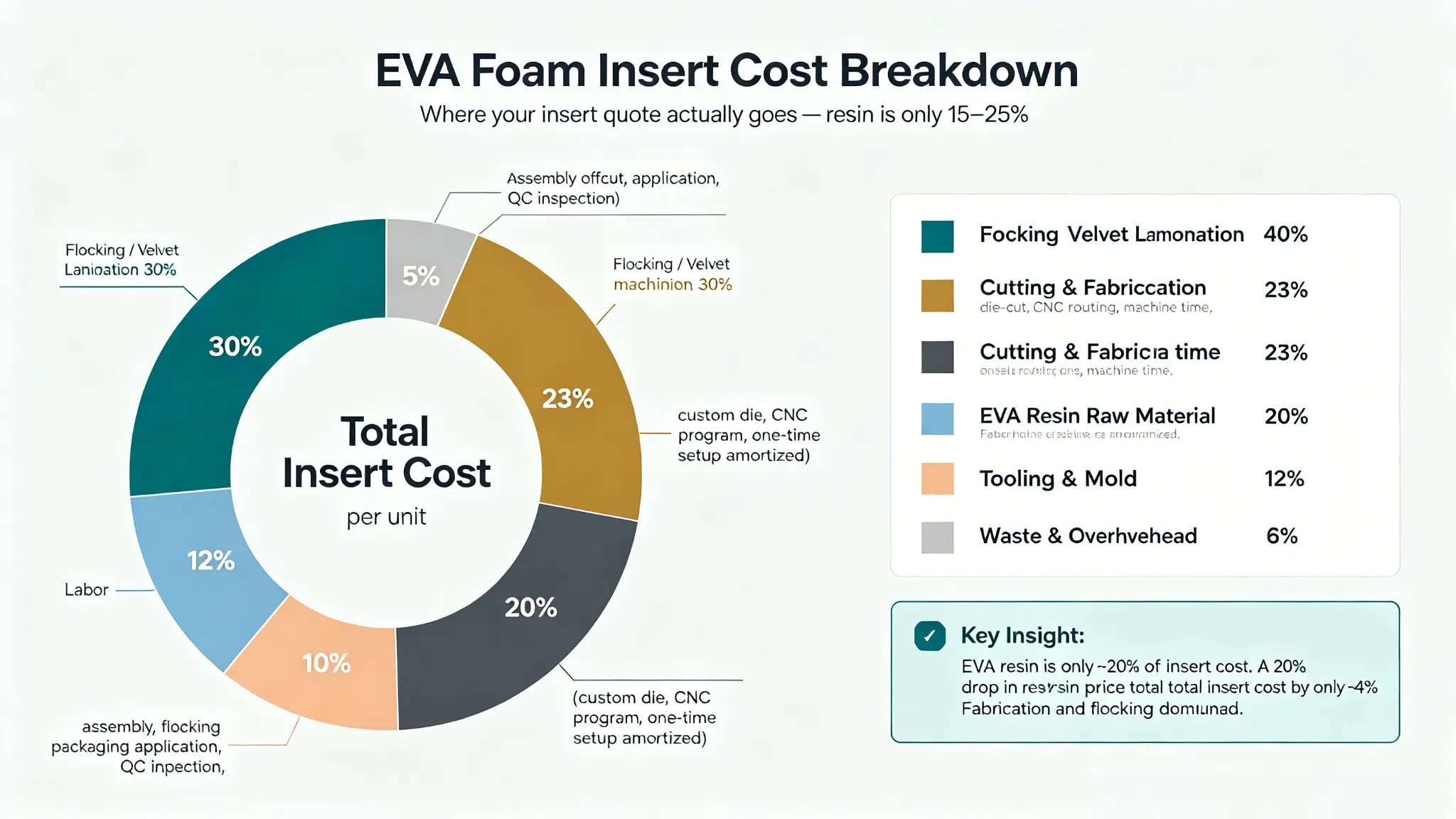
Because the resin is rarely the majority of what you’re paying for. A finished EVA foam insert, die-cut or CNC-routed to fit a specific product, then flocked or velvet-laminated for a premium feel, is a manufactured component, not a commodity material. The cost stack looks roughly like this:
Cost Component | Share of Insert Price | 2026 Trend |
EVA resin (raw material) | 15–25% | Falling / soft — structural oversupply, even after July uptick |
Fabrication (die-cut, CNC, tooling) | 30–40% | Stable to slightly higher — labor and machine time, not resin-linked |
Flocking or velvet lamination | 25–35% | Stable — fabric, adhesive, and labor cost, independent of EVA pricing |
Finishing, packing, QC | 10–15% | Stable |
This is why a 2026 quote citing “material cost increases” for an EVA foam insert deserves a follow-up question. If the resin is genuinely soft, and your quote went up, the increase is coming from labor, tooling, or the flocking layer, not the foam itself.
What Actually Drives EVA Foam Insert Cost in 2026
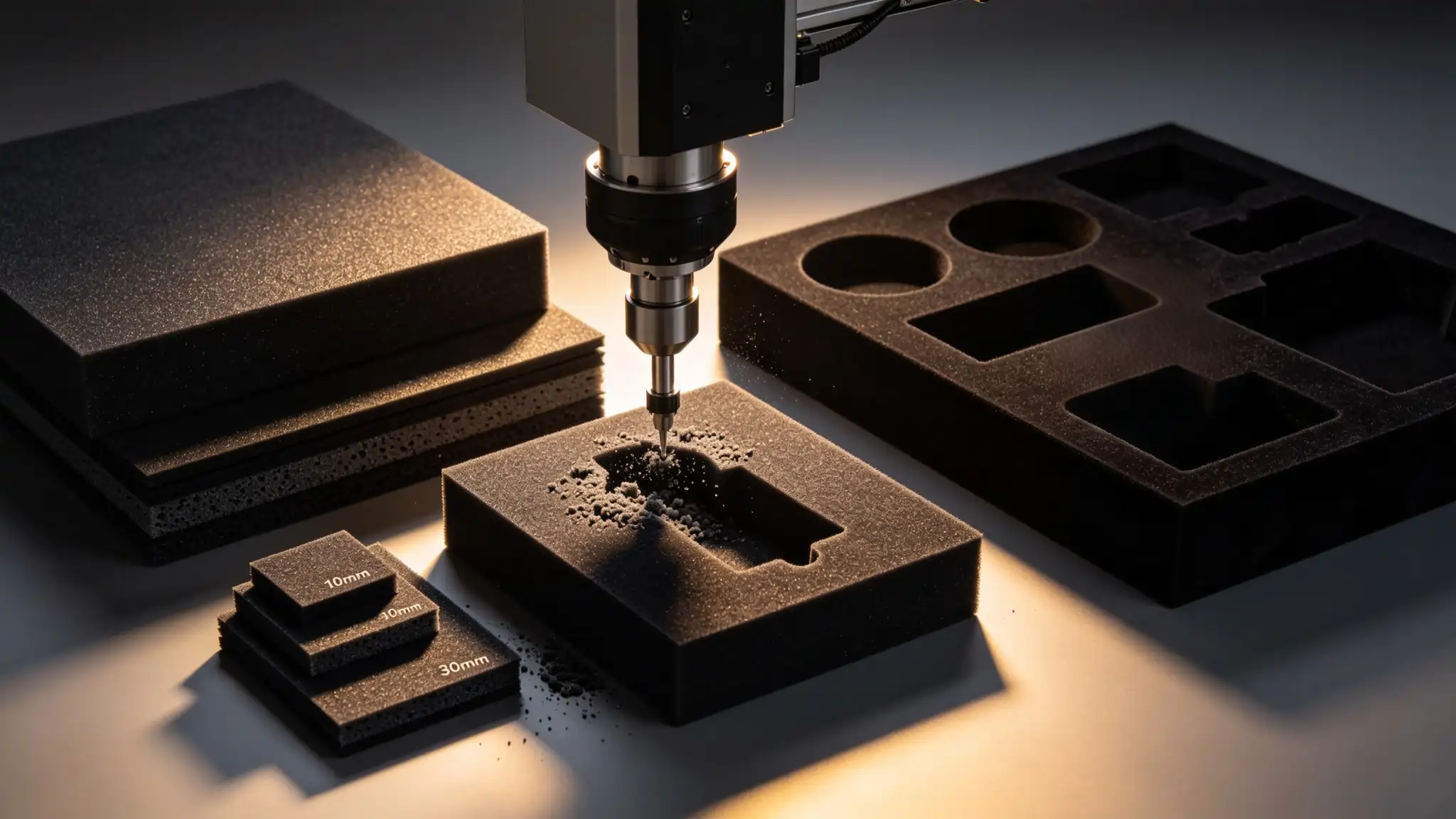
Fabrication complexity, not foam density, is the biggest lever in EVA foam insert pricing. Die cutting is efficient for simple, high-volume flat shapes once tooling exists. CNC routing handles multi-depth pockets and complex layouts but runs slower per unit. A complex multi-cavity insert for a cosmetics gift set costs meaningfully more in machine time than a simple flat foam pad, regardless of resin price.
Flocking and lamination labor is typically the second-largest line item after fabrication. Electrostatic flocking, applying fine fibers to create the velvet surface, is a separate manufacturing step from foam production, with its own fabric, adhesive, and equipment costs, and it doesn’t move with EVA resin pricing at all.
Tooling for custom shapes adds a one-time setup cost amortized into your unit price if your insert needs a custom die or CNC program for a specific product shape. Reordering the same insert shape avoids re-tooling; changing dimensions even slightly often doesn’t.
Thickness and finishing options matter too. Buyers commonly use foam thickness up to 10mm for standard gift box inserts. Going thicker than the product genuinely requires adds cost without adding protection, a common over-spec mistake.
What to Ask Your Supplier
“Is this a resin cost increase or a labor and process cost increase?” Given 2026’s structural EVA oversupply, a genuine resin-driven increase is unlikely even accounting for July’s modest uptick. If your supplier cites general material costs without specifics, ask them to break it down.
“What’s the lowest foam density that still passes your fit and protection testing?” Higher density foam costs more and isn’t always necessary. A supplier should be able to confirm the minimum density for your specific product weight and fragility.
“Can we avoid re-tooling by keeping the existing cavity dimensions?” If you’re reordering a similar product with slightly different dimensions, ask whether minor adjustments can reuse existing tooling before assuming a new die is required.
Where Topvisio Stands on This
We itemize foam, flocking, and tooling separately in every EVA foam insert quote, so the cost breakdown is visible rather than bundled into one number. Given where EVA resin pricing actually sits in 2026, structurally oversupplied even after the recent short-term uptick, we don’t pass along a generic material surcharge on foam components. If your insert price moves, we’ll tell you specifically why. See our Luxury Cosmetic Packaging, Magnetic Gift Box, and Bespoke Packaging lines for insert-inclusive quoting.
FAQ
Has EVA foam gotten more expensive in 2026?
The raw resin remains structurally oversupplied. China’s EVA production capacity reached roughly 3.8 million tonnes by the end of 2025 against around 3.6 million tonnes of demand, with more capacity still coming online in 2026. Prices moved volatile through the year, a March spike, a sharp May decline, June stabilization, and a modest July uptick, but remain well below 2021-2024 boom levels. If your finished EVA foam insert price went up, the increase is most likely coming from fabrication, tooling, or flocking labor, not the resin itself.
What makes a flocked foam insert cost more than plain foam?
Flocking is a separate manufacturing step, applying fine fibers electrostatically to create a velvet surface, with its own fabric, adhesive, and labor cost. It typically represents 25-35% of a finished EVA foam insert’s price, independent of foam resin pricing.
Should I always choose the densest EVA foam for product protection?
No. Higher density costs more without necessarily improving protection beyond what your product needs. The right approach is confirming the lowest density that passes fit and drop testing for your specific item, not defaulting to the thickest or densest option available.
Does EVA foam density affect shipping cost?
Yes, indirectly. Higher-density foam weighs more per unit volume, which can push a shipment closer to a courier’s dimensional weight threshold. Specifying the minimum density that passes your drop-test requirement keeps both material cost and shipping weight in check.