The Section 122 tariff expired exactly on schedule at 12:01 a.m. EDT on July 24, 2026, and a replacement took effect the same minute. For anyone sourcing rigid gift boxes from China, the china tariff picture didn’t get simpler that day — it just changed shape. This piece walks through the china tariff situation as it actually stands today, not as a forecast.
Here’s what actually happened on the deadline, what the combined rate looks like now, and what it means on a real order.
What Expired, and What Replaced It Immediately
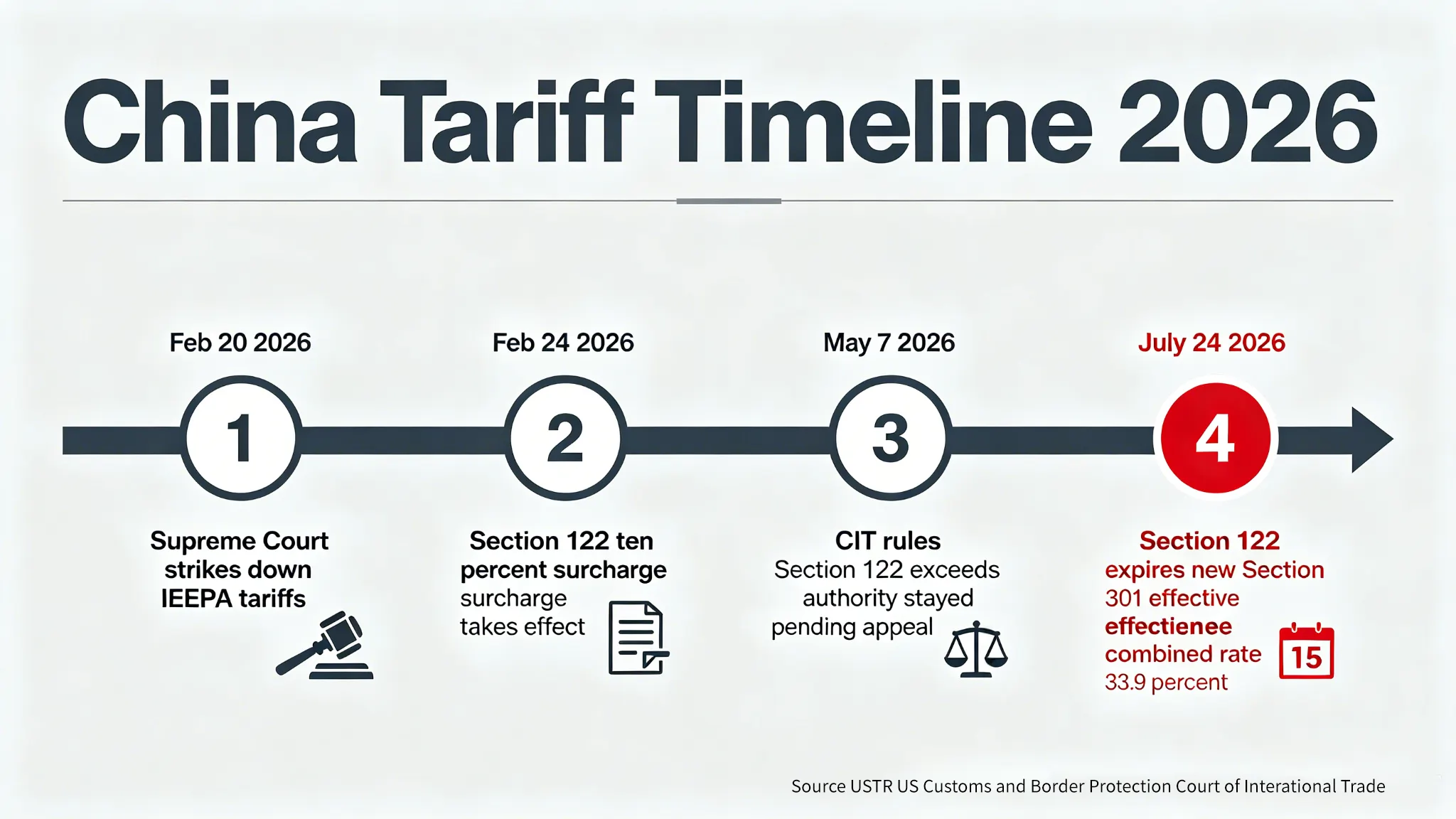
Section 122 of the Trade Act of 1974 caps an emergency import surcharge at 150 days unless Congress extends it. The 10% surcharge, which replaced the IEEPA tariffs the Supreme Court struck down on February 20, 2026, took effect February 24 and hit its statutory limit 150 days later. No extension legislation passed, so it lapsed automatically.
What didn’t happen was a simple drop in the average tariff rate. New Section 301 duties, ranging from 10% to 12.5% depending on the country, took effect on imports from roughly 80 countries the same minute Section 122 expired. For China, this new layer stacks on top of the existing 25% Section 301 duty that was untouched by any of this year’s litigation, bringing the combined china tariff to approximately 33.9% — only slightly below where it sat under Section 122.
Why This Matters More Than a Simple Expiration Would
If Section 122 had simply lapsed with nothing replacing it, the china tariff would have dropped to roughly 25%, the original Section 301 rate alone. That’s not what happened. The new Section 301 duties were the product of two investigations opened back in March — one targeting excess manufacturing capacity, the other addressing forced-labor enforcement across roughly 60 economies — and USTR moved to finalize them right as the Section 122 clock ran out. The practical result: importers who assumed July 24 meant a rate cut got a lateral shift instead.
The Litigation Is Still Unresolved, Separately
A Court of International Trade ruling on May 7, 2026, found the administration’s use of Section 122 exceeded its statutory authority. The Federal Circuit stayed that ruling pending appeal, which is why Customs and Border Protection kept collecting the surcharge through July 24 despite the adverse ruling. That appeal continues independently of the expiration, and duties paid during the Section 122 period remain part of a live refund question depending on how it resolves — similar in structure to the $166 billion in IEEPA refunds processed earlier in 2026.
What This Looks Like on an Actual Box
Duty applies to the CIF value — cost, insurance, and freight combined — not the ex-factory price alone. For a mid-size rigid gift box at $1.85 ex-factory with $0.50 sea freight, CIF comes to $2.35. At the current 33.9% combined china tariff, that’s about $0.80 in duty per unit, landing the cost around $2.65, roughly a 13% jump over the ex-factory price before duty is even applied. On a 3,000-unit order, that’s close to $2,400 in duty sitting on top of the base order value, and it scales linearly from there.
If a retail pricing model was built off the ex-factory quote alone, that gap needs correcting now, not after the next invoice lands.
Five Things Worth Doing This Quarter
With the current china tariff rate now confirmed rather than projected, a few concrete steps make sense before your next order.
Reconfirm your HTS classification against the new Section 301 list. Rigid gift boxes generally fall under HTS Chapter 48, but the specific 10-digit code differs between flat-shipped folding cartons and pre-formed set-up boxes, and the new duties may apply differently by code.
Check whether your product falls within the new Section 301 country list at all. The new duties apply to roughly 80 countries, not universally, so confirming scope for your specific sourcing country matters more now than it did under the flat Section 122 surcharge.
Rebuild your landed cost model around 33.9%, not the older 35% figure. It’s a smaller gap than it looks, but a stale number compounds across a full order.
If you paid Section 122 duties during the February-to-July window, preserve your refund rights with your customs broker regardless of how the appeal resolves. The precedent from the IEEPA refund process suggests this will be a multi-month process once triggered, not an automatic one.
Watch the Federal Circuit appeal separately from the new Section 301 duties. The two tracks are legally independent. A ruling against Section 122 doesn’t undo the duties that replaced it, and vice versa.
A Note on Transshipment Risk
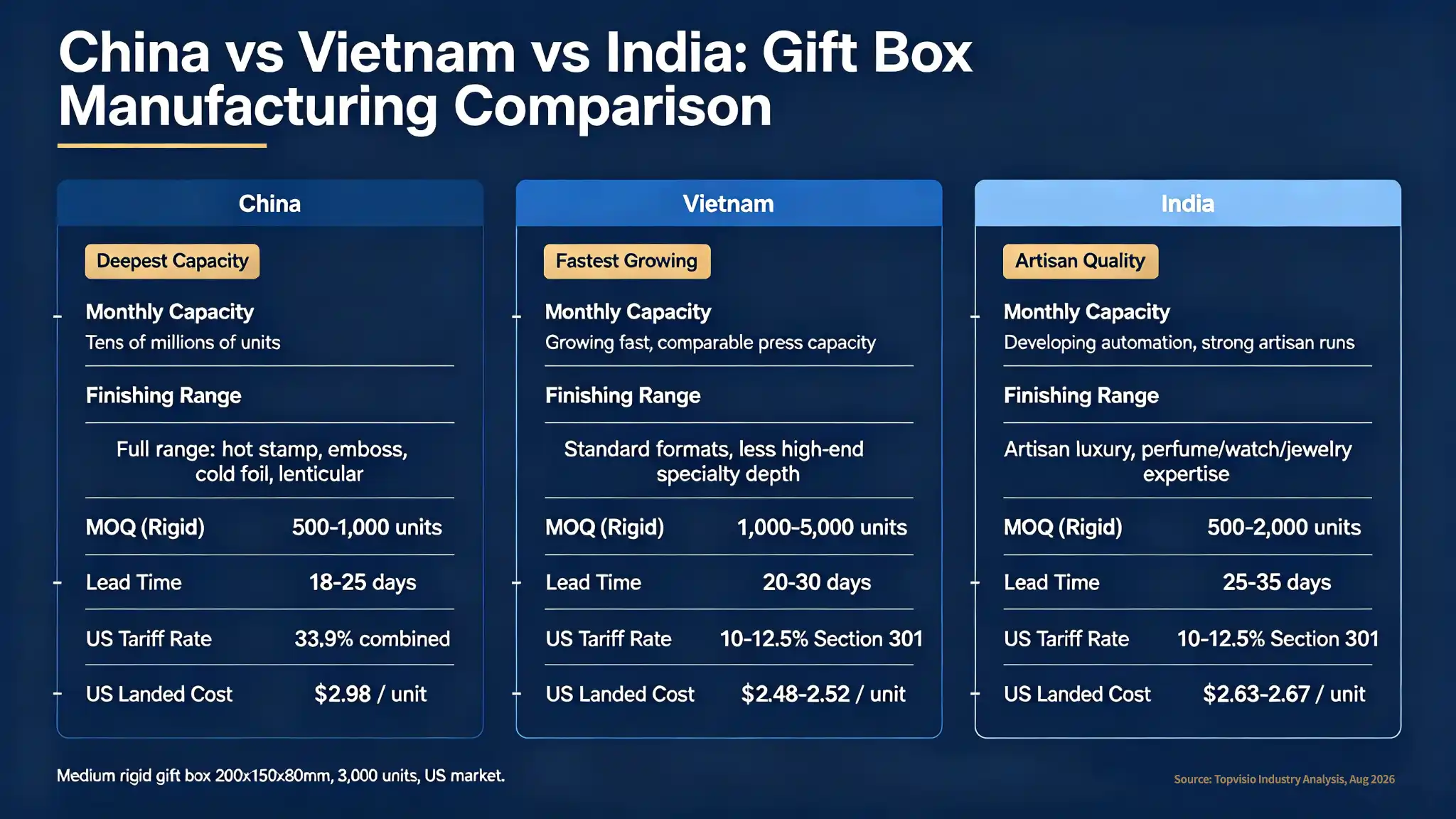
CBP enforcement against routing Chinese-origin goods through third countries to claim a lower china tariff is running at its highest level in years. Substantial transformation — the product genuinely becoming something new in the intermediate country — is the legal bar, and repackaging or lightly modifying a Chinese-made box doesn’t meet it. Penalties for misdeclared origin can run to double the unpaid duty. For brands seriously evaluating alternate sourcing rather than tariff engineering, the real comparison between Vietnam, India, and China sourcing is worth reading before making that call.
Where Topvisio Stands on This
We ship FOB from Yantian or Guangzhou; customs clearance and duty classification are your broker’s responsibility, but every formal quote specifies ex-factory pricing clearly, and we provide the material documentation — board weight, greyboard specification, structural details — that brokers need for accurate HTS classification. That keeps the china tariff line visible and separate rather than buried inside a single all-in number that has to be re-quoted every time the rate shifts. For product-specific quoting, see our Custom Gift Boxes, Magnetic Gift Box, and FSC Certified Packaging lines.
FAQ
What is the current China tariff rate on rigid gift boxes as of late July 2026?
Approximately 33.9%: the existing 25% Section 301 duty plus a new Section 301 layer that replaced Section 122 on July 24, applied to CIF value. Confirm the exact figure for your HTS code with a customs broker.
Did the Section 122 tariff actually expire on July 24?
Yes, on schedule, at 12:01 a.m. EDT. But a new Section 301 duty took effect the same minute on imports from roughly 80 countries, so the effective China tariff barely moved even though the specific mechanism changed.
Is the new Section 301 duty the same as Section 122?
No. Section 122 was a flat, temporary, largely country-agnostic surcharge. The new Section 301 duties stem from separate USTR investigations into manufacturing capacity and forced-labor enforcement, applied country by country rather than as one blanket rate.
Can I still get a refund on Section 122 duties I already paid?
Possibly, depending on the outcome of the ongoing Federal Circuit appeal. The process would likely resemble the multi-month IEEPA refund rollout earlier in 2026 rather than an automatic reversal.
What's the minimum I should do before placing my next order?
Reconfirm your HTS classification, rebuild your landed cost model around the current 33.9% figure, and ask your customs broker whether your specific sourcing country falls within the new Section 301 list. Official rate data is available through the Office of the United States Trade Representative.