There’s still no single federal single-use plastic ban in the United States in 2026. Instead, three states have each moved on their own timeline this year, one of them already fully in effect, and the result looks a lot like the EU’s packaging landscape before PPWR replaced it with one unified regulation. Virginia, Washington, and California have each tightened packaging rules in 2026, and each law defines a single-use plastic ban differently, applies to different products, and takes effect on a different date.
Here’s what each state’s single-use plastic ban actually requires, and what it means if your packaging ships into more than one of them.
Virginia: Foam Food Containers Are Fully Out as of July 1
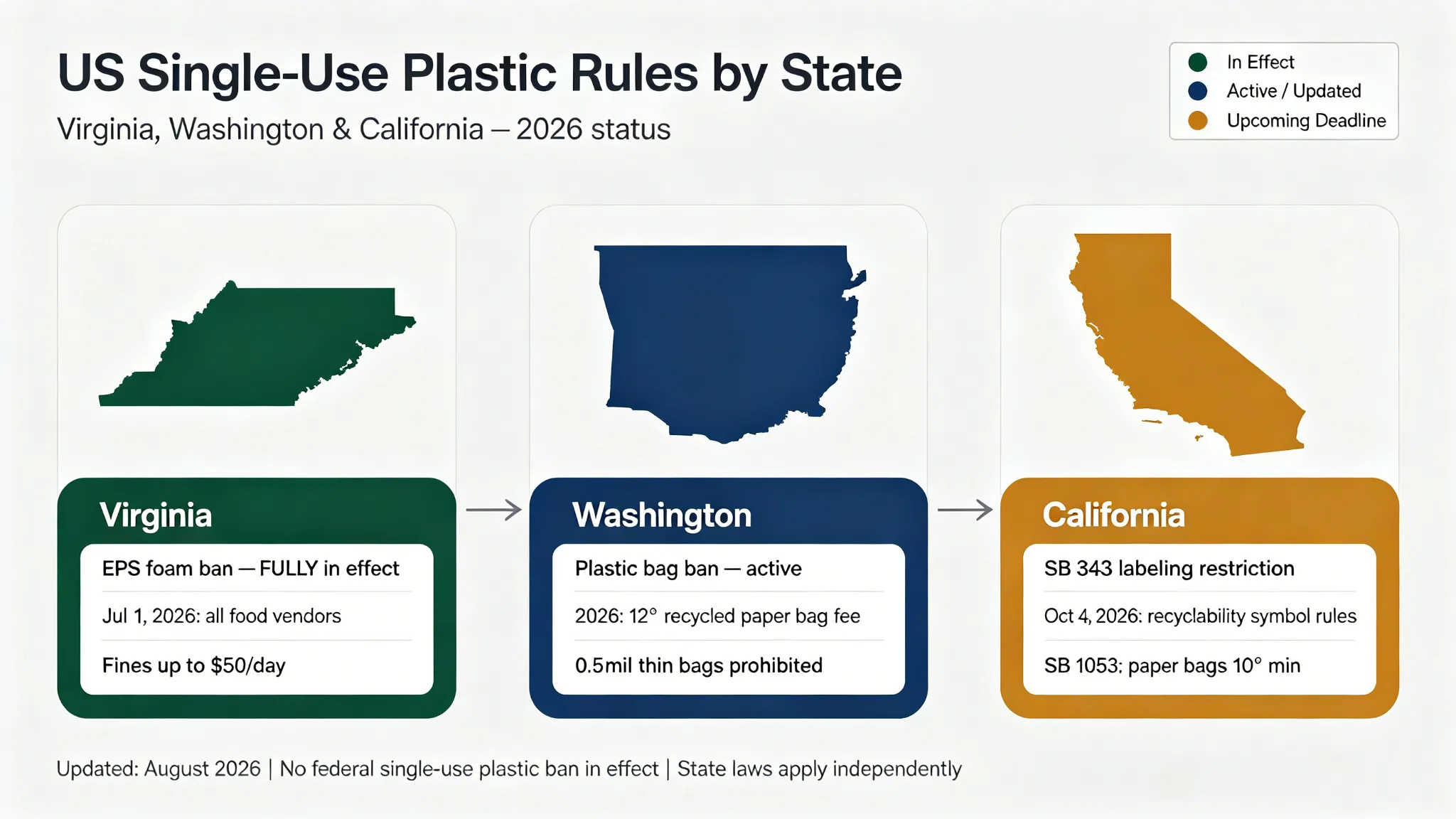
Virginia’s single-use plastic ban targets expanded polystyrene foam specifically, via a single-use plastic ban statute, and as of July 1, 2026, it applies statewide with no remaining size exemption. The first phase, which took effect July 1, 2025, applied only to larger operators, any food vendor with 20 or more Virginia locations. That two-tier rollout has now fully closed: every food vendor in the state, regardless of size, is required to comply.
Local exemptions may still be available for businesses that can demonstrate financial hardship, granted for up to one year at a time through the relevant county or city, per Virginia DEQ guidance. But the default rule going forward is straightforward: no EPS food containers for any Virginia food vendor. Violators face fines of up to $50 per day, which adds up quickly for a multi-location operator that hadn’t switched suppliers in time.
For packaging suppliers, the two-phase rollout is worth noting as a pattern that shows up elsewhere in single-use plastic ban legislation: large operators get hit first, smaller ones get a longer runway, and the final compliance date arrives well after the law was first signed. Virginia’s law was signed in 2021 and only reached full applicability in July 2026, a five-year phase-in that gave the market time to shift away from EPS foam gradually rather than all at once. Businesses that treated the 2025 deadline as the finish line, rather than the midpoint, are the ones most likely to have been caught off guard by this year’s expansion.
Washington: Plastic Bag Restrictions Remain an Ongoing Operational Cost
Washington’s plastic bag law, its own version of a single-use plastic ban, has been in place since 2021, prohibiting thin, 0.5-mil single-use plastic bags at retail stores, restaurants, and takeout establishments statewide. As of 2026, the law is in an updated phase with a higher carryout bag fee: customers now pay 12 cents for a recycled paper carryout bag at any retailer or restaurant, up from the original fee structure.
This is a narrower single-use plastic ban than Virginia’s, it targets bags specifically, not food packaging broadly, but it applies to essentially every retail and food-service business in the state, which makes the fee increase a routine operational change rather than a one-time compliance event.
California: A Different Kind of Restriction, Labeling, Not Just Materials
California’s most consequential 2026 single-use plastic ban move isn’t a materials ban in the traditional sense. Senate Bill 343 restricts who can use the “chasing arrows” recycling symbol on packaging. Under the law, that symbol can only appear on products and packaging that meet specific recyclability criteria set by CalRecycle, and the restriction applies to packaging manufactured after October 4, 2026, the one deadline among these three still ahead of us.
This one matters more to packaging manufacturers than the other two, because it’s not about banning a material, it’s about which materials are allowed to claim recyclability on the box itself. A rigid gift box or cosmetic carton that currently carries a chasing-arrows symbol without meeting CalRecycle’s criteria will need that labeling reworked before the October cutoff, or risk running afoul of the law on any packaging shipped into California after that date. Separately, SB 1053 closed a related loophole by requiring that plastic carryout bags offered at checkout be replaced with recycled paper bags carrying a minimum 10-cent charge, another labeling and materials shift layered on top of SB 343 in the same state.
The distinction between banning a material and restricting a label matters operationally too. A material ban usually means finding a substitute supplier or substrate, a known, if sometimes costly, fix. A labeling restriction means auditing every SKU’s existing artwork, cross-checking it against a regulatory standard that didn’t exist when the packaging was originally designed, and reprinting where necessary. For a brand with dozens of active SKUs sold into California, that audit alone can take longer than sourcing a new material would, and with the October deadline now roughly two months out, the audit window is closing.
Why Three Different Laws Add Up to One Bigger Problem
None of these three laws reference each other, and none of them was written with the other two in mind. That’s the core difficulty: a brand selling into Virginia, Washington, and California at the same time isn’t dealing with one single-use plastic ban, it’s dealing with three separate compliance checklists, three effective dates, and three different definitions of what counts as a violation.
This is a smaller-scale version of a problem covered in our earlier piece on the EU’s PPWR regulation, where 27 countries used to run their own single-use plastic ban and packaging rules under a shared directive before a single regulation replaced the patchwork. The US hasn’t gone that route. US packaging EPR programs are also being implemented state by state; our Circular Action Alliance guide summarizes producer registration, reporting, and fee timelines. Federal action on single-use plastics has stalled repeatedly, leaving states to legislate independently, which means the patchwork is likely to keep growing rather than consolidate. A brand that’s compliant in one state today has no guarantee its packaging clears the next state that passes a similar law next year.
What This Means for Packaging Buyers
If your rigid boxes, cartons, or retail packaging ship into multiple US states, the practical task isn’t finding “the” single-use plastic ban to comply with, since no such single national rule exists, it’s maintaining a state-by-state matrix the same way a brand selling into the EU has to track PPWR obligations by role and by market. For California specifically, that means checking now whether any recyclability claims printed on packaging meet SB 343’s criteria before the October 2026 deadline, since a labeling reprint takes longer to execute than a same-day material substitution.
For Virginia, the practical question is simpler now that the deadline has passed: does the packaging or product involve EPS at any point in the supply chain, and if so, has a substitute material already been sourced and tested. For Washington, the bag fee change is mostly an operational note for retailers rather than a packaging-design question, but it’s worth confirming with a supplier whether any bagging or wrapping materials fall under the restricted category.
How Topvisio Approaches State-Level Packaging Rules
Topvisio doesn’t produce EPS-based packaging that would trigger Virginia’s single-use plastic ban, rigid gift boxes and cartons are built from paperboard rather than foam substrates, which sidesteps that restriction by default rather than as a special accommodation. For customers concerned about California’s labeling rules, Topvisio can work from a customer’s recyclability documentation to align printed labeling with what a compliance team has already determined is accurate, rather than defaulting to a generic recycling symbol that may not hold up under SB 343’s criteria.
As with the PPWR guidance covered elsewhere on this site, the responsibility for compliance with a specific state’s single-use plastic ban sits with the brand placing the product on the market in that state, Topvisio’s role is making sure the underlying material and labeling data is accurate and available, not issuing a legal compliance determination on a customer’s behalf.
FAQ
Does a single-use plastic ban in one state apply nationwide?
No. Each of these laws is state-specific. A product compliant in Washington isn’t automatically compliant in Virginia or California, and there’s currently no federal law that overrides state-level requirements.
Is Virginia's EPS foam ban fully in effect now?
Yes. As of July 1, 2026, the ban applies to all Virginia food vendors regardless of size, closing the two-tier rollout that began with larger operators in July 2025.
Is California's SB 343 a ban on plastic packaging?
Not exactly. It restricts which packaging can display the recyclability symbol, rather than banning specific materials outright. Packaging that doesn’t meet the criteria can generally still be sold, it just can’t carry that particular label after October 4, 2026.
What happens if a business misses one of these deadlines?
Penalties vary by state. Virginia has set fines of up to $50 per day for EPS violations; California and Washington enforce their respective rules through their own regulatory processes, which can include penalties for false or non-compliant labeling claims.
Are more states expected to pass similar laws?
Likely, though there’s no way to predict the exact timing or scope. Federal single-use plastic legislation has been proposed and stalled multiple times, and in the absence of national action, individual states have continued to move independently on their own schedules.