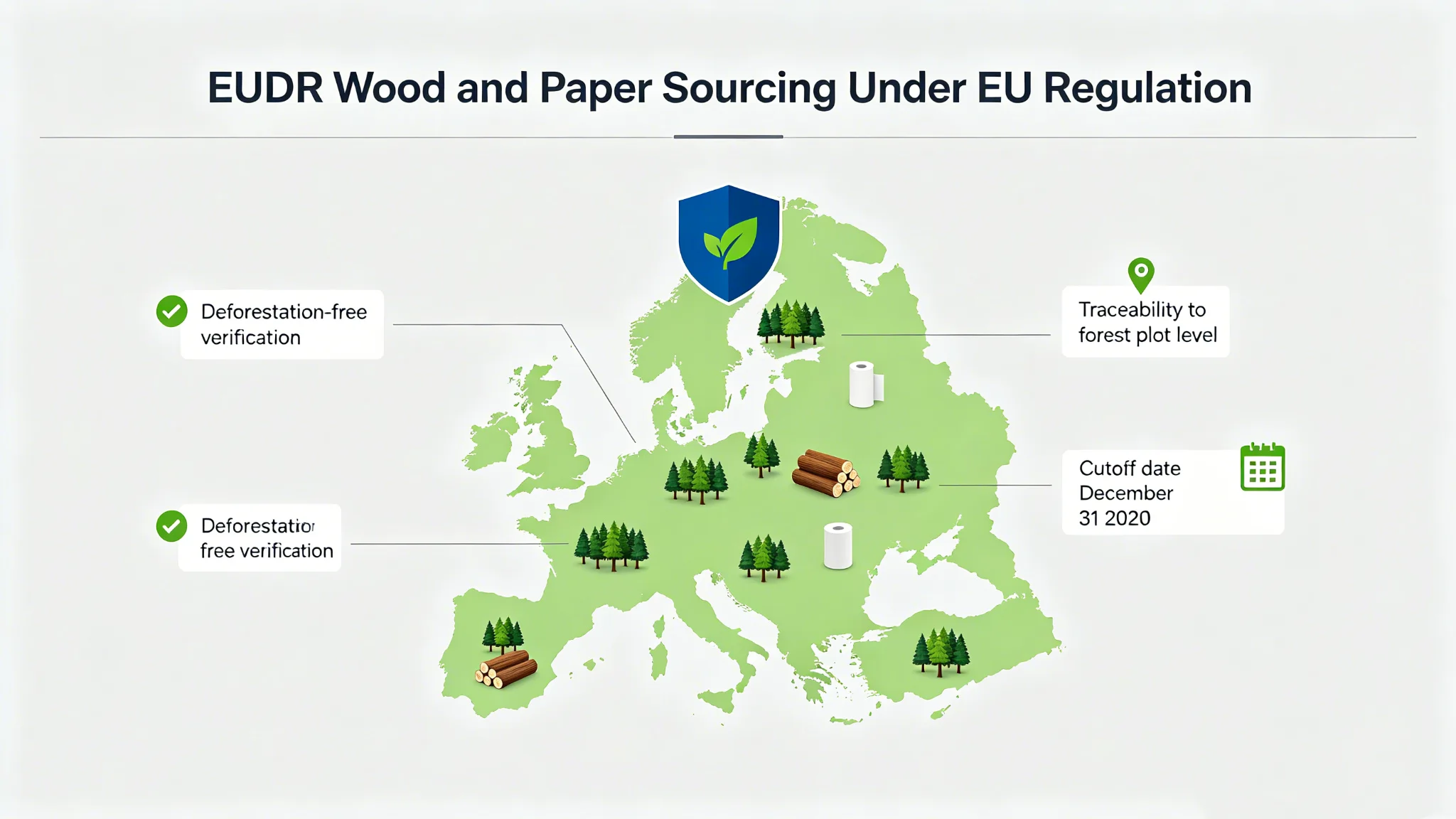
EUDR is the EU’s deforestation-free products regulation, and after two delays, it now applies from December 30, 2026 for most companies. Formally Regulation (EU) 2023/1115, EUDR requires businesses to prove that certain commodities placed on the EU market — or exported from it — weren’t produced on land deforested or degraded after December 31, 2020.
If your supply chain touches wood, paper, or paperboard, or if your packaging contains products made from cocoa, coffee, or palm oil, EUDR is worth understanding before the deadline arrives. Here are five things worth knowing.
EUDR Covers Seven Commodities — Including Wood
EUDR applies to seven commodities identified as major deforestation drivers: cattle, cocoa, coffee, palm oil, rubber, soy, and wood. It doesn’t stop at the raw commodity — the regulation also covers a wide range of derived products, which for wood includes paper, paperboard, and printed materials in some categories, subject to the exemptions covered below.
For a rigid box manufacturer or a brand sourcing paperboard packaging, this is the detail that matters most. This isn’t a distant regulation about palm oil plantations — it directly touches the raw material behind cartons, gift boxes, and paper-based packaging, which is why supply chain due diligence for wood products has become a live compliance question rather than a theoretical one.
Further reading:European Commission: EUDR overview · World Resources Institute: What is EUDR?
The commodity list itself isn’t static. As part of the 2026 simplification package, the Commission has proposed adding items like soluble coffee and certain palm oil derivatives to the scope through a delegated act, while removing others such as retreaded rubber tires and cattle hides. That process runs through delegated acts rather than a full legislative reopening, which means the exact product list can shift after the main deadline without requiring a new round of parliamentary approval — worth tracking even after December 2026 rather than treating the current list as permanently fixed.
The Deadline Has Moved Twice — It’s Now December 30, 2026
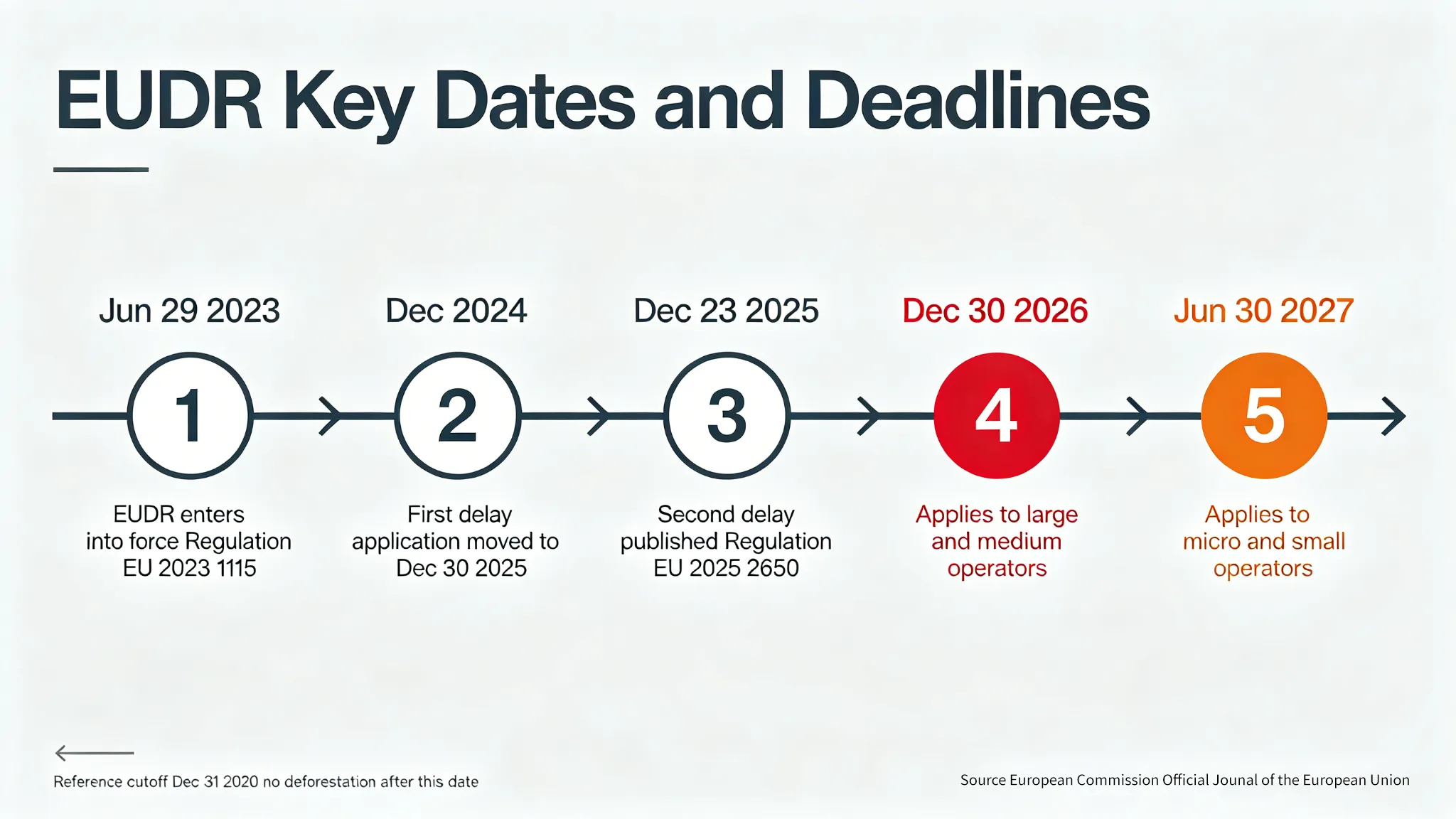
EUDR entered into force on June 29, 2023, with an original application date of December 30, 2024. That date was pushed back twice. The first delay, adopted in December 2024, moved the deadline to December 30, 2025. The second delay, under Regulation (EU) 2025/2650, moved it again to December 30, 2026 for large and medium operators, with micro and small operators getting until June 30, 2027.
Each delay came with a reason attached to it — the first responded to concerns that the EU’s Information System and partner-country readiness weren’t in place; the second followed extensive industry feedback about compliance burden, resulting in the European Parliament introducing amendments that simplified the rules alongside the extension, rather than just pushing the date. The second delay was formalized quickly once agreed: trilogue agreement was reached on December 4, 2025, Parliament adopted it on December 17, the Council endorsed it the following day, and the text was published in the Official Journal on December 23, 2025 — a compressed timeline that reflected how much pressure had built up around the original deadline.
Further reading:Access2Markets: EUDR delay details · Mayer Brown: EUDR outlook for 2026
Due Diligence Mostly Falls on Whoever Places the Product on the Market First
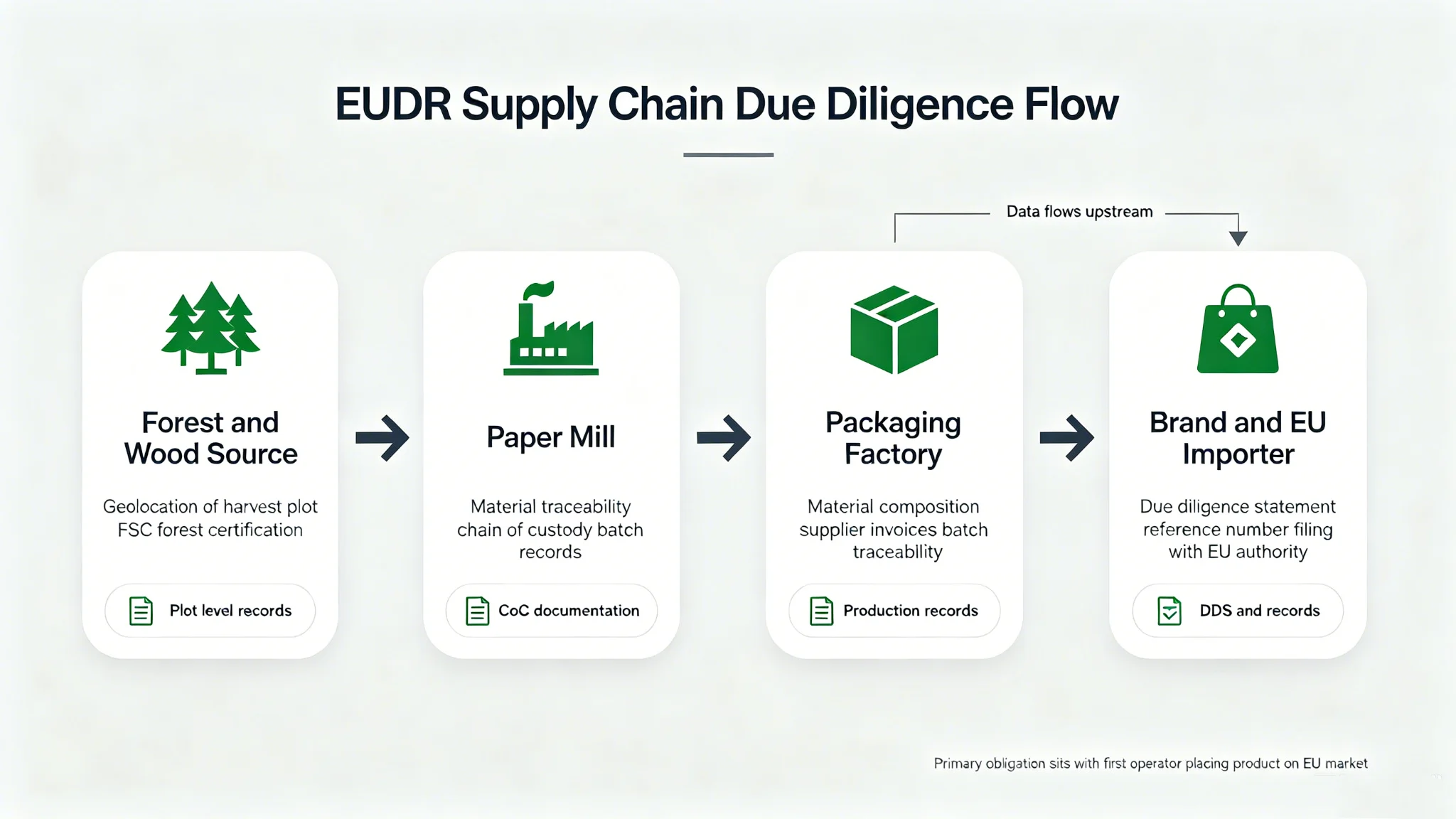
EUDR assigns obligations based on role, similar in spirit to how PPWR separates Manufacturer and Supplier responsibilities. The heaviest burden sits with the “operator” — generally the company first placing a covered product on the EU market or exporting it. Following the 2025 amendments, due diligence is now limited to that first operator; downstream operators and traders no longer need to submit their own due diligence statements or pass detailed reference numbers further through the chain — only the first actor downstream collects a due diligence reference number.
This matters for anyone sourcing paperboard from outside the EU. A non-EU supplier itself has no direct obligation under the regulation, but the EU-based company that first imports and places that paperboard on the market does — and it needs the underlying traceability data from its supplier to meet that obligation.
Consider a concrete example: a US-based brand buys rigid gift boxes from a factory in China and sells them, filled with product, to a distributor in Germany. The German distributor, as the party first placing the packaged product on the EU market, generally carries the primary due diligence obligation — not the US brand and not the Chinese factory directly. But the German distributor can’t produce that due diligence without geolocation and sourcing data flowing back through the US brand from the factory. The obligation sits with one party; the data has to originate somewhere further up the chain.
Packaging May Be Exempt — But Not Always
One detail easy to miss: a draft delegated act published as part of the Commission’s 2026 simplification package proposes exempting certain packaging from its scope specifically — packaging used to support, protect, or carry other products, along with accessory materials, samples, and used or secondhand products. If finalized, this would mean a paperboard box used purely to package and ship another product may fall outside the regulation’s direct requirements.
That exemption doesn’t extend to everything, though. Printed materials like books have already been removed from scope under the December 2025 amendments, but packaging containing an EUDR-covered commodity as the actual product — a chocolate gift box where the cocoa itself is the regulated commodity, for example — still triggers due diligence obligations for that commodity, even if the box itself qualifies for the packaging exemption. The distinction is between the box as packaging and the product inside it as a regulated commodity.
Further reading:Latham & Watkins: EU Commission’s 2026 EUDR measures · European Commission: EUDR implementation guidance
The Core Text Isn’t Being Reopened — Only the Details Are Being Simplified
The European Commission has confirmed it will not reopen EUDR’s core legislative text. The 2026 simplification work — the delegated act on product scope, updated FAQs, and Information System revisions — adjusts implementation details rather than the regulation’s fundamental goals. Businesses waiting for a more dramatic rollback are likely to be disappointed; the direction of travel is toward operational simplification, not toward scrapping deforestation-free requirements.
For companies with wood or paperboard in their supply chain, that means the practical work of building traceability — knowing which forest plots supplied which shipment — remains necessary regardless of how the finer compliance mechanics get simplified between now and December 2026.
What This Means for Packaging Buyers
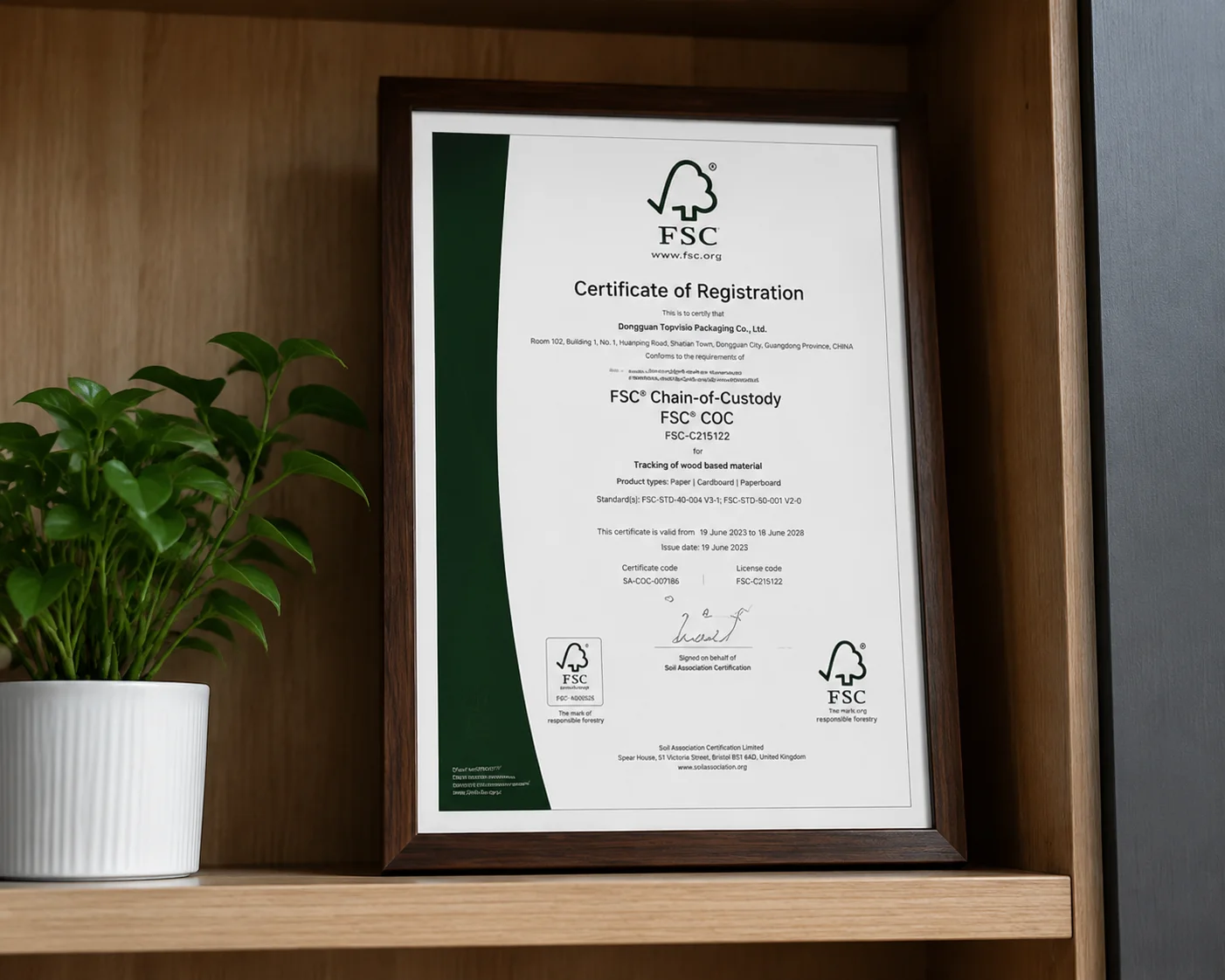
If you’re sourcing rigid boxes, cartons, or other paperboard packaging for the EU market, the immediate question isn’t whether the regulation applies in the abstract — it’s whether your specific packaging qualifies for the proposed support/protection exemption, and if it doesn’t, whether your supplier can provide the geolocation and traceability data that due diligence requires. FSC chain-of-custody documentation, which many paperboard suppliers already maintain, covers similar ground to what this due diligence process asks for, though it isn’t automatically the same thing — FSC certification demonstrates sustainable forest management, while the regulation specifically requires proof against the December 31, 2020 deforestation cutoff date.
Topvisio, a rigid gift box manufacturer supplying brands across the US, EU, Middle East, and APAC, maintains FSC-linked material sourcing documentation as a standard part of production. That documentation doesn’t automatically satisfy those specific due diligence requirements — that determination sits with the EU-based operator placing the product on the market — but it does mean the underlying material traceability data exists as a starting point rather than something assembled from scratch when a customer’s compliance team asks for it.
FAQ
When does EUDR actually apply?
December 30, 2026 for large and medium operators, and June 30, 2027 for micro and small operators, following two delays from the original December 2024 date.
Does EUDR apply to companies outside the EU?
Indirectly. Non-EU producers and suppliers don’t have direct EUDR obligations, but they may be asked to provide traceability data — such as plot-level geolocation — to EU-based companies that do carry obligations under the regulation.
Is packaging exempt from EUDR?
A draft delegated act proposes exempting packaging used to support, protect, or carry other products, but this isn’t finalized yet, and it doesn’t exempt the regulated commodity inside the packaging if that commodity — cocoa or coffee, for example — is itself in scope.
Will EUDR be delayed a third time?
The European Commission has stated it does not intend to reopen the regulation’s core text or extend the timeline further, focusing instead on simplification through delegated acts rather than additional postponement.
Does FSC certification automatically satisfy EUDR requirements?
Not automatically. FSC chain-of-custody certification demonstrates sustainable forest management practices and shares much of the same underlying traceability infrastructure, but EUDR due diligence has its own specific requirements, including geolocation data tied to the December 31, 2020 cutoff date, that a certification alone doesn’t formally substitute for.
This article reflects publicly available information on EUDR as of publication. The Commission’s 2026 simplification package, including the delegated act on product scope, remains subject to finalization, so confirming current requirements against the European Commission’s official EUDR guidance is worth doing before finalizing compliance plans. Given how much the timeline and scope have already shifted since 2023, treating today’s rules as the final version is likely to mean revisiting the plan at least once more before December 2026 arrives.
Send us your product specs and target market — we’ll respond with material recommendations, structural options, and a sample within 7 days.
Related Articles
12:06 pm
What Is Bespoke Packaging? Benefits for Your Brand
8:25 am
How to Design Cosmetic Packaging That Sells
Extended producer responsibility for packaging: who's responsible, which countries have EPR, and what buyers need to know. FSC on request, PPWR compliant.