FSC Mix Packaging: New Trademark Rules Effective July 2026
Every FSC Mix packaging label made before July 2026 is technically about to become outdated, even if nothing about the paperboard underneath it changes. On July 1, 2026, FSC’s revised trademark standard takes effect, and it changes what has to appear on an on-product label carrying the Mix claim — not the certification itself, but the label that proves it.
This matters more than it sounds. A lot of brands treat the FSC logo as a fixed asset, something a designer drops into a layout once and never revisits. That assumption is what makes this FSC Mix packaging update worth flagging now, months before most companies will actually notice it.
What’s Changing: FSC Trademark Standard V3-0
FSC published FSC-STD-50-001 Version 3-0, Use of the FSC Trademarks by Certificate Holders, on January 1, 2026, alongside a companion document on promotional statements. The new requirements become effective July 1, 2026, with a transition period running until January 1, 2029, during which certificate holders can operate under either the old or new version. FSC describes the revision as a way to streamline existing requirements, adapt to current market trends, and align with tightening legislation on environmental labeling.
That last point is worth sitting with. Anti-greenwashing rules are spreading across multiple jurisdictions right now, and FSC built this revision partly in response. A label standard that used to be mostly about brand consistency is now also a compliance tool.
Why Mix Is the Claim That Matters Most for Packaging
FSC certification carries three possible claims — 100%, Mix, and Recycled — and each one describes a different sourcing composition. A 100% claim means every fiber traces back to FSC-certified forests. A Recycled claim means the material comes from post-consumer or reclaimed sources. Mix sits in between, allowing a blend of FSC-certified material and controlled wood, sourced responsibly but not independently certified at the same level.
For rigid gift box and paperboard packaging specifically, Mix is by far the most common of the three claims, since blending certified and controlled fiber gives suppliers more flexibility in sourcing without sacrificing the underlying due diligence standard. That volume is exactly why a labeling change targeting how the Mix claim gets displayed has more practical reach than it might for the smaller volume of 100% or Recycled claim products.
What This Means for FSC Mix Packaging Specifically
The trademark update changes what has to appear on the label when a package carries the Mix claim, not whether the underlying certification is valid.
The Mix Claim Is Now Mandatory On-Product
Under the previous version of the standard, the specific claim — 100%, Mix, or Recycled — was often treated as optional detail on product labels. Under V3-0, it’s compulsory for on-product labels specifically, meaning promotional or marketing use still has more flexibility, but the actual label on a box has to state the claim plainly. A generic FSC logo without the word “Mix” no longer satisfies the requirement for FSC Mix packaging carrying that specific claim.
The FSC organization address, previously optional, is also now mandatory on labels. And product type — the category of certified material the claim applies to — moves from conditional to mandatory, with room for up to three different product types on a single label if a package uses multiple certified materials, a jewelry box with both a certified paperboard shell and a certified fabric lining, for instance.
Product Type Labeling: Up to Three Materials Now Allowed
This detail matters more for complex packaging than it might first appear. A rigid gift box combining certified board, a certified paper wrap, and a certified interior lining previously had limited ways to represent that on one label. The revised standard allows a single label to reference up to three distinct product types, which means FSC Mix packaging with layered material construction can now document its certified components more precisely instead of collapsing everything into one generic claim.
The Alternative QR Label: A Fix for Small Packaging
One of the more practical additions in V3-0 is the Alternative QR Label option under Clause 3.8, aimed at FSC Mix packaging where physical space is the actual constraint. Small-format boxes, sample packaging, and compact presentation cases often don’t have room for a full label with claim, product type, license code, and organization address all printed at readable size. The QR alternative lets a package carry a scannable code linking to the full label information instead of printing everything directly on the surface.
For FSC Mix packaging in smaller formats — jewelry boxes, sample-size cosmetics packaging — this is a genuinely useful option rather than a compliance workaround. It solves a real design problem: fitting a compliant label on a package too small to hold one legibly.
Other Changes Worth Knowing
The revision also permits dual-labeling alongside other certification marks under defined conditions, something the previous standard restricted more tightly. And FSC published a companion document, FSC-STD-50-001a, providing pre-approved promotional statements specifically to help certificate holders avoid inadvertent greenwashing language when describing FSC-certified products in marketing materials, separate from the on-product labeling requirements.
Timeline: What to Do Before January 2029
The transition period runs until January 1, 2029, which sounds distant, but a few practical details shorten that runway for anyone producing FSC Mix packaging on a rolling basis. Existing stock — FSC-certified finished and labeled products already produced under the old standard — can continue to be sold and distributed during and after the transition. What can’t carry over indefinitely are the devices used to apply the label itself: printing plates, engraving tools, embossing and debossing equipment, which FSC explicitly excludes from the stock exemption.
For a brand ordering custom FSC Mix packaging on a recurring basis, this means tooling decisions made now should account for the new label requirements rather than assuming old artwork can simply be reprinted through 2029. A supplier still working from V2-1 label specifications on new tooling built after mid-2026 is setting up a redesign that will need to happen anyway before the transition window closes.
Why This Matters More for Brands Sourcing Overseas
A brand designing FSC Mix packaging in-house and printing domestically can update label artwork relatively quickly once a designer knows the new requirements. That process gets slower once a supplier relationship, tooling lead times, and cross-border production schedules are added to the mix, which describes most rigid box and gift packaging supply chains. A factory working from outdated label specifications months into the transition period isn’t being careless — it’s often simply working from the same artwork file a brand approved years earlier and never flagged as due for a refresh.
This is a case where asking the question early costs nothing and asking it late costs a reprint. A five-minute conversation with a supplier about which trademark standard current tooling is built against is considerably cheaper than discovering a label discrepancy after a shipment has already left the factory.
What to Ask Your Packaging Supplier Now
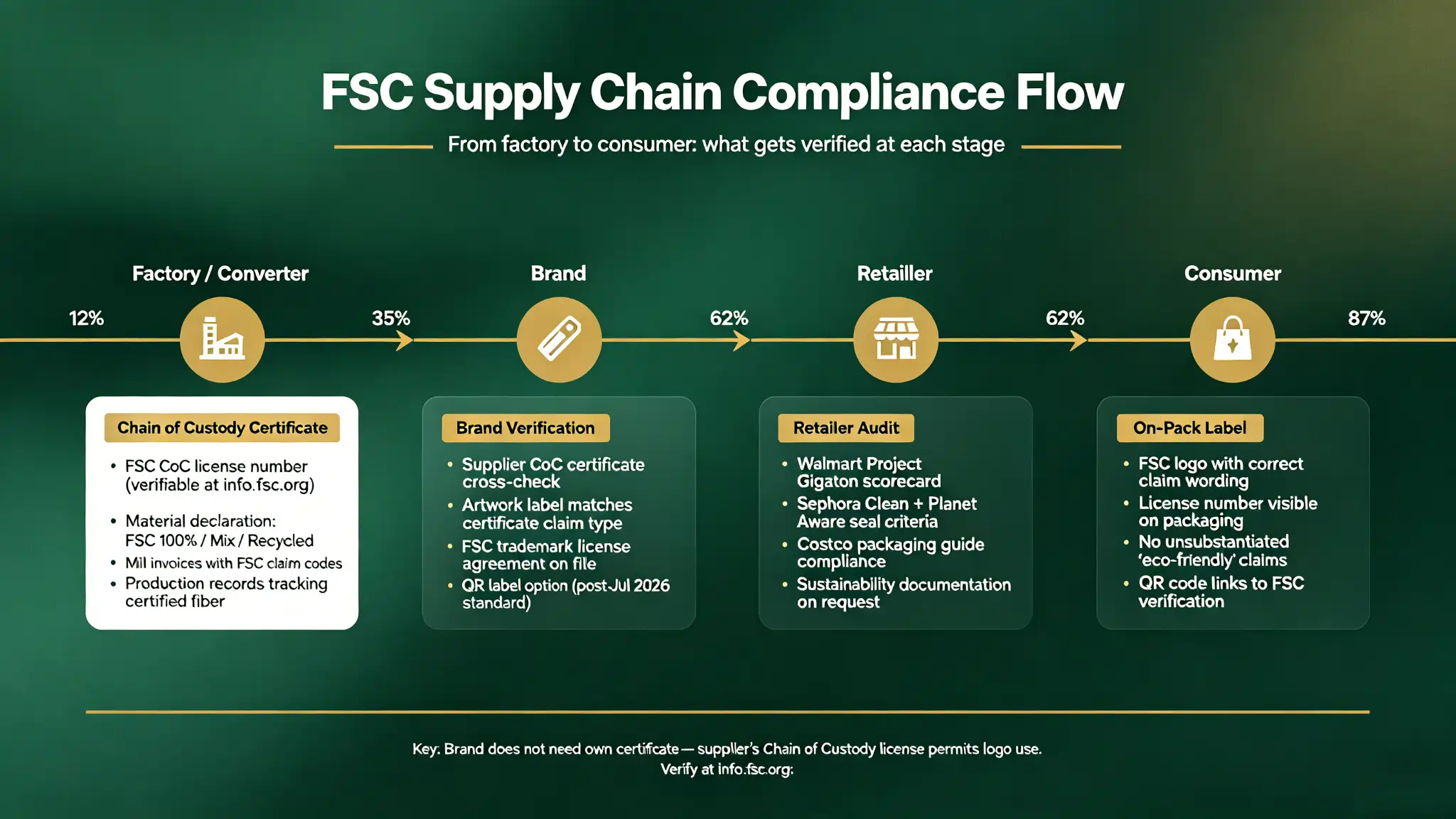
Given the transition timeline, a few direct questions are worth raising with any supplier producing FSC Mix packaging on your behalf. Ask whether new tooling and label artwork are being built against the V3-0 requirements or the outgoing standard, since new tooling built on old specifications creates rework later for FSC Mix packaging orders. Ask whether your product’s material mix, if it spans more than one certified component, is being represented accurately under the new product-type rules rather than defaulting to a single generic claim. And if your packaging runs small, ask whether the QR label alternative is a better fit than trying to compress a full label onto limited surface area. For more on how FSC-certified packaging is sourced and documented, see our dedicated FSC-certified packaging page.
Topvisio produces FSC Mix packaging and other FSC-certified paperboard structures on request, with chain-of-custody documentation prepared as part of the order. For brands updating FSC Mix packaging label artwork or tooling ahead of the July 2026 deadline, that’s the conversation worth having directly with your supplier now rather than after new stock is already in production.
What is FSC Mix packaging?
It’s packaging carrying the FSC Mix claim, meaning the certified material is a blend of FSC-certified wood or fiber and other controlled sources, rather than being fully FSC-certified (100%) or made entirely from recycled material.
When does the new FSC trademark standard take effect?
FSC-STD-50-001 Version 3-0 became effective July 1, 2026, with a transition period allowing certificate holders producing FSC Mix packaging or other certified formats to operate under either the old or new standard until January 1, 2029. For a checklist of every label element that changed, see our guide to FSC label requirements.
Do I need to reprint packaging I already have in stock?
No. Existing finished and labeled stock produced under the previous standard can still be sold and distributed during and after the transition. The requirement applies to new labels and new tooling going forward.
Can I still use the FSC logo without specifying “Mix,” “100%,” or “Recycled”?
Not on-product. Under V3-0, the specific claim is now mandatory on product labels, though promotional and marketing use retains more flexibility.
Why is Mix the most relevant claim for gift box and paperboard packaging?
Mix allows a blend of FSC-certified and controlled material, giving suppliers more sourcing flexibility while still meeting FSC’s due diligence standard, which is why it’s the most common claim across paperboard packaging compared to 100% or Recycled.
Where can I find official guidance on the new standard?
FSC has published the full standard and an implementation guidance document and e-training module through its official trademark and chain-of-custody resources for certificate holders and label applicants.