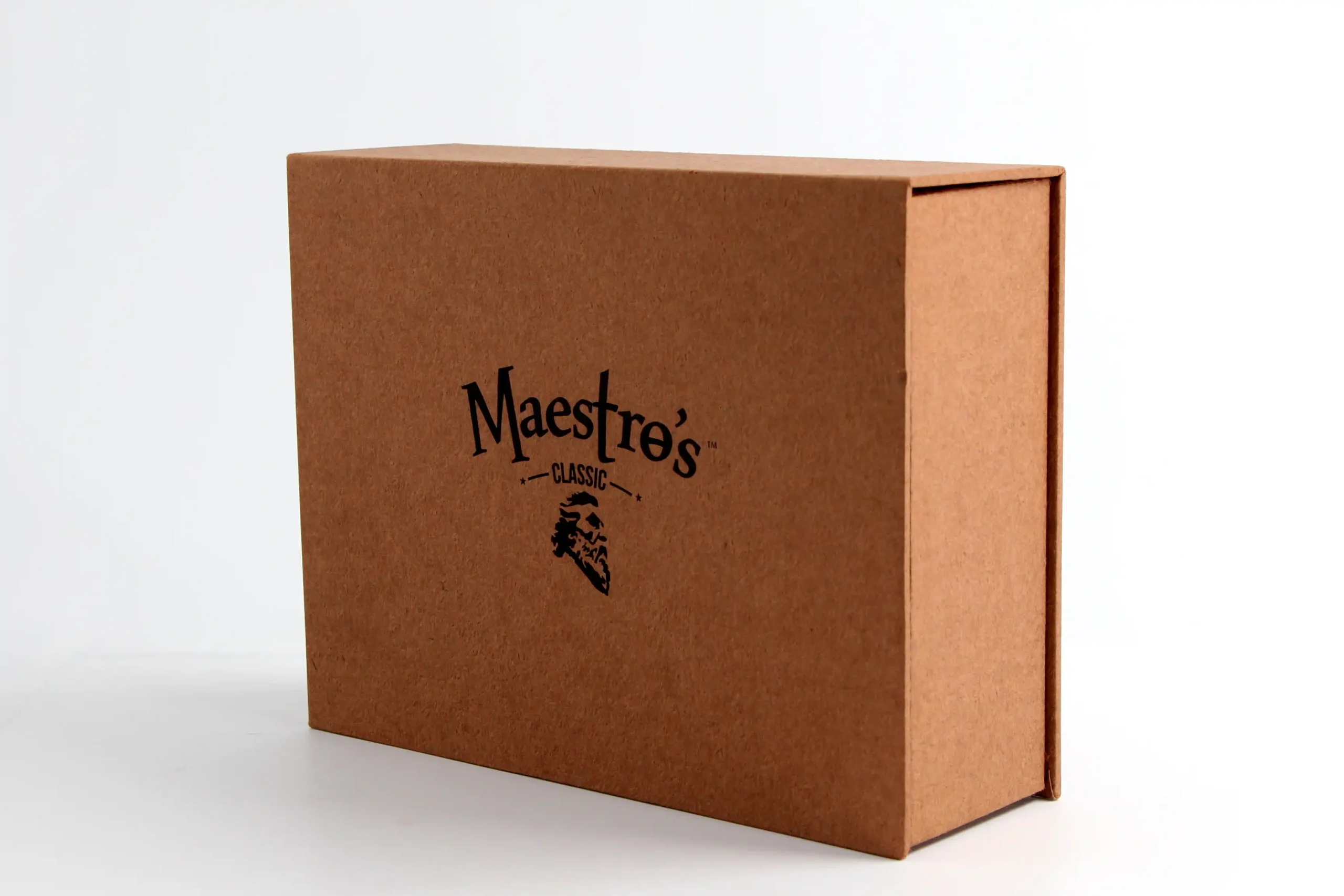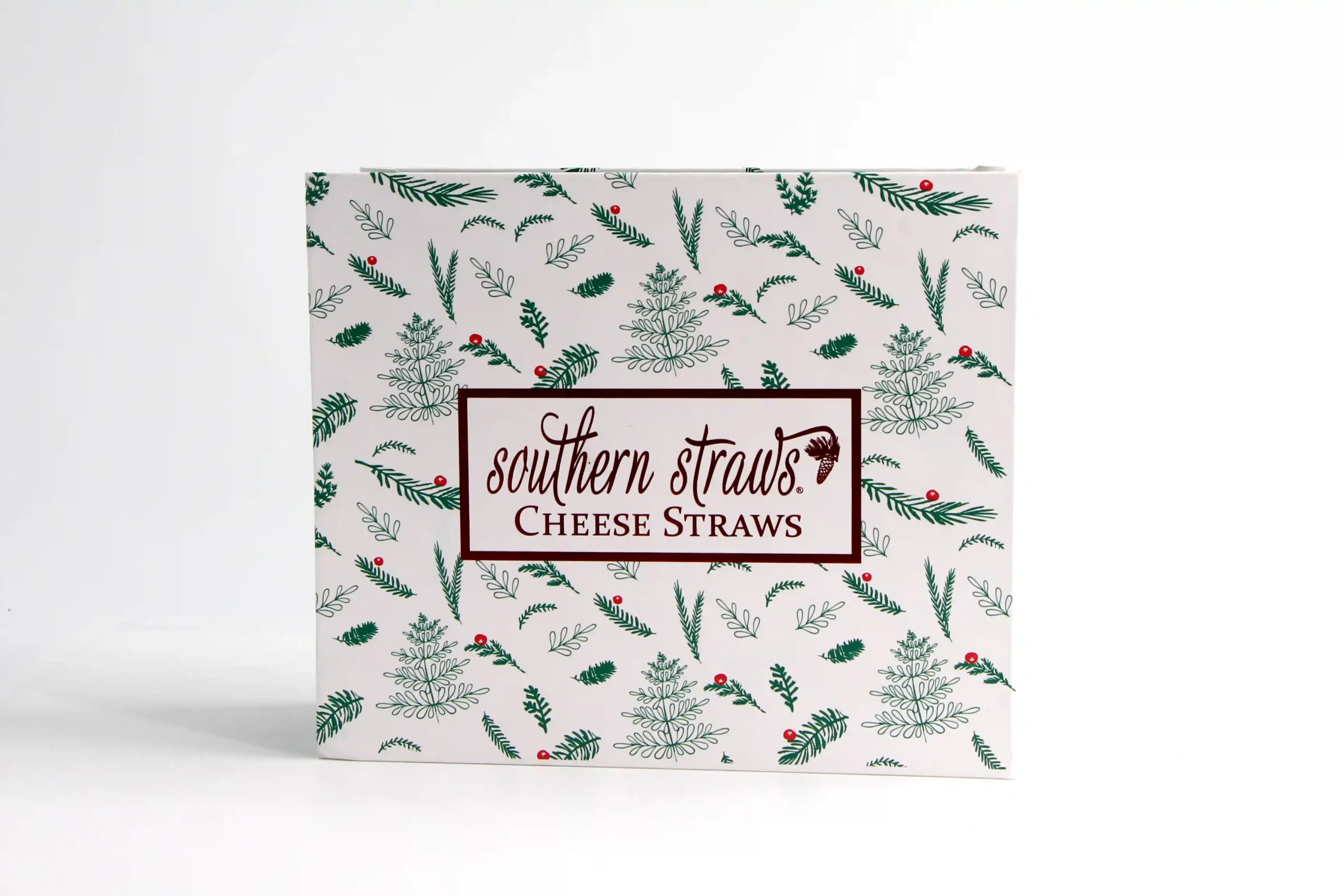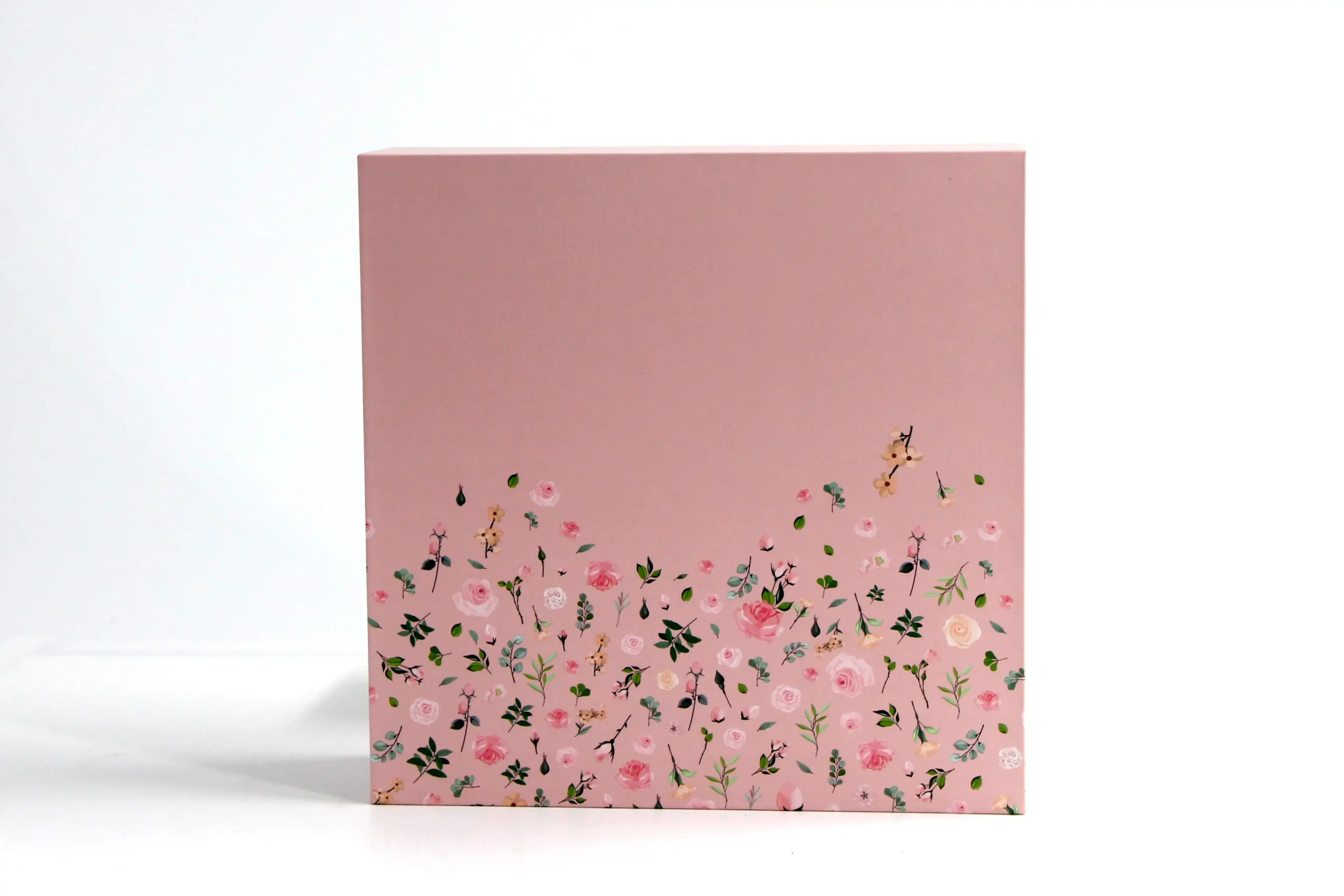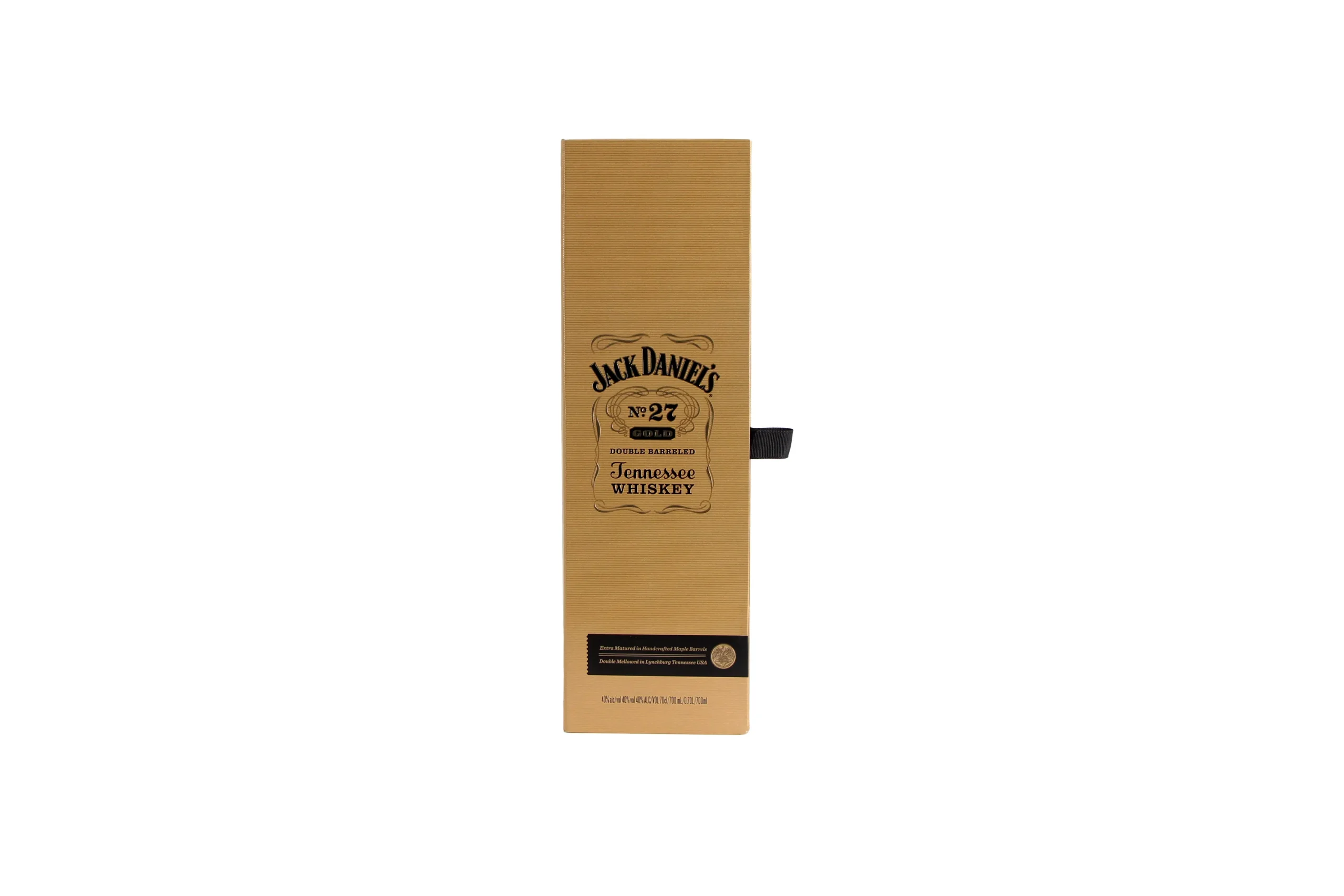
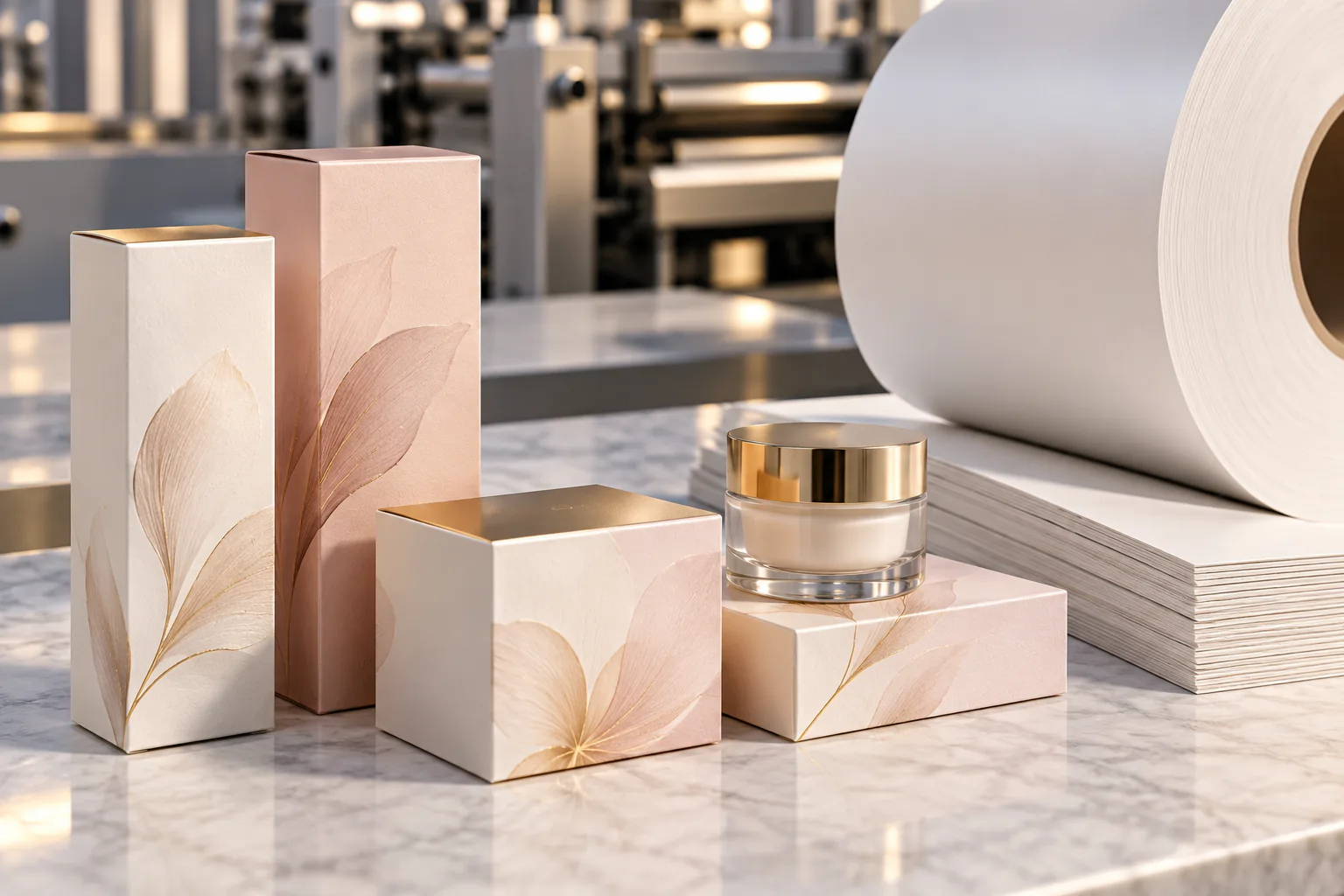
GC1 vs SBS board comes down to one trade-off. GC1 is a multi-ply folding boxboard that gets its stiffness from a bulky middle layer, so it stays rigid at a lower weight, while SBS is a solid bleached board made from chemical pulp all the way through, which gives it a denser, whiter body that handles fine print, foil and deep embossing more predictably. The question got fresh attention in January 2026, when Stora Enso launched Performa Lumi, a lightweight GC1 board aimed squarely at beauty and personal-care cartons.
This guide compares the two boards point by point for cosmetic boxes, written from the floor of our packaging factory in Dongguan, Guangdong, China, where Topvisio Packaging runs 14+ automated lines, supplies board FSC on request and builds every carton to be PPWR compliant.
What Is the Difference Between GC1 and SBS Board?
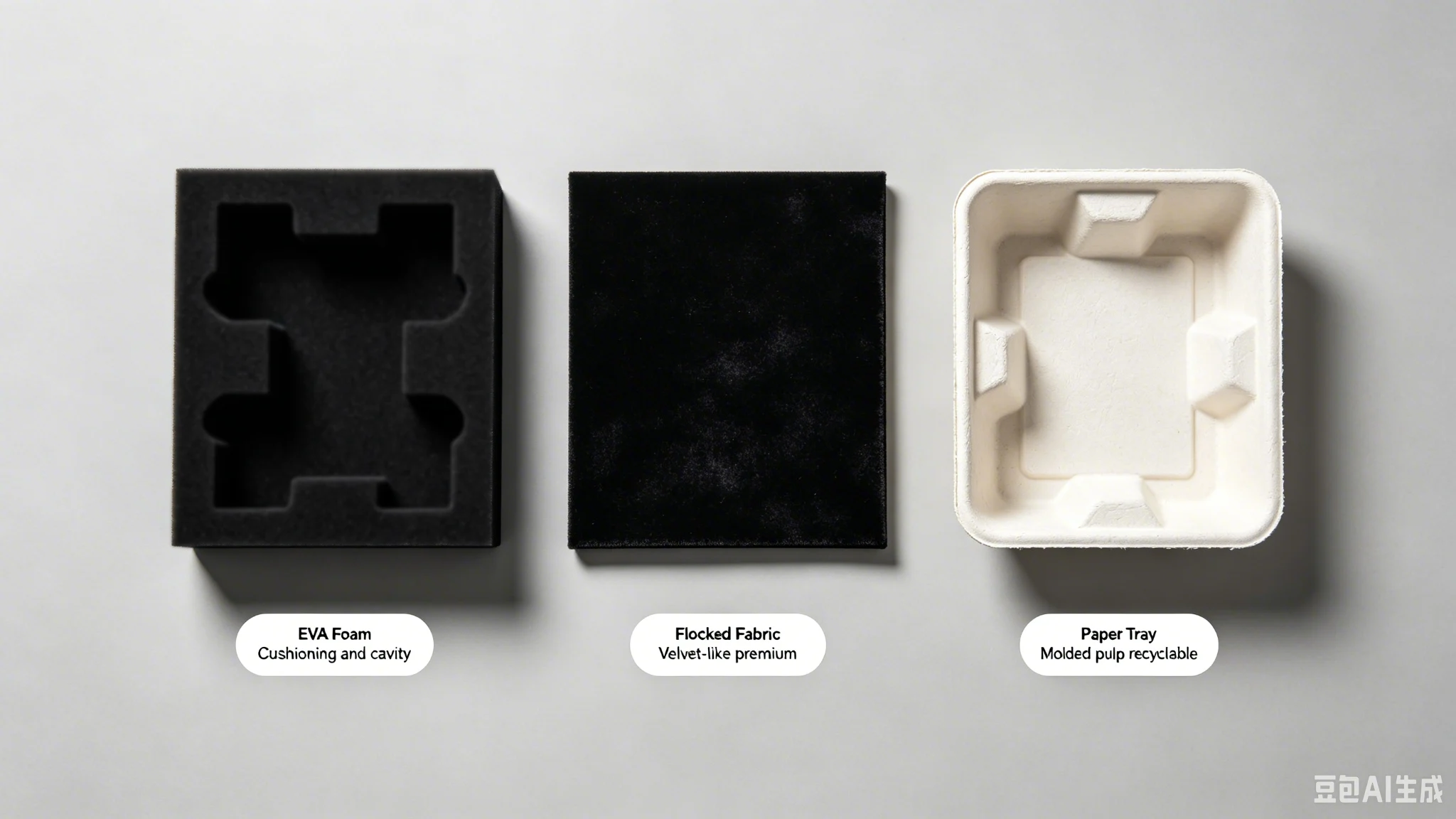
Both are carton boards, and both end up as the printed folding box a serum or lipstick ships in, but they are built differently. GC1 belongs to the folding boxboard family, often shortened to FBB. It has bleached chemical pulp on the top and bottom with a mechanical pulp core, usually CTMP, in between. That light, bulky core is where GC1 gets its stiffness. The “1” means the reverse side is white; GC2 has a cream back and is used where the inside is never seen.
SBS stands for solid bleached sulfate. There is no mechanical pulp in it at all, so the board is uniform from face to back and white right through the cut edge. In the German DIN 19303 grading system most European mills follow, coated solid bleached board is listed as GZ, but buyers in North America and Asia simply call it SBS. Any GC1 vs SBS board comparison is really a layered structure built for stiffness per gram against a solid structure built for surface and strength.
GC1 vs SBS Board at a Glance
The table is the short version of the GC1 vs SBS board comparison; the sections after it show where each difference appears on a finished carton.
| Specification | GC1 (Folding Boxboard) | SBS (Solid Bleached Board) |
|---|---|---|
| Construction | Bleached chemical pulp outer plies with a mechanical pulp (CTMP) core | Bleached chemical pulp throughout |
| Stiffness per gram | Higher, thanks to the bulky core | Lower, so a heavier grammage is needed for the same rigidity |
| Surface and print | Coated top side, very good for offset printing | Smooth, dense coated surface, slightly crisper for fine detail |
| Foil stamping and embossing | Good at standard depths; deep embossing can stress the layered core | Handles deep embossing and fine foil more consistently |
| Cut edge and long-term whiteness | Edge shows the lighter core; can yellow slightly under long light exposure | White through the edge; stable whiteness |
| Cost per carton | Usually lower, because less fiber is needed | Usually higher |
| FSC availability | FSC on request | FSC on request |
Why Did Stora Enso Launch Another GC1 Board?
Performa Lumi was announced on 22 January 2026 and is made on the company’s new BM6 board machine in Oulu, Finland. According to Stora Enso’s press release, it is a double-coated CTMP board offered from 205 to 310 gsm, built with the mill’s FiberLight Tec process to stay strong while cutting weight.
The company says it delivers high whiteness, a smooth print surface and high stiffness, and that it suits direct food contact. Those are the manufacturer’s claims, and any brand switching board should test them on its own artwork.
The launch matters more as a direction than as one product. For years the GC1 vs SBS board choice in beauty packaging leaned toward SBS when a brand wanted a premium look, and toward GC1 when weight and cost came first. Mills are now pushing GC1 grades that try to close the visual gap.
With packaging weight under more scrutiny through the EU’s Packaging and Packaging Waste Regulation, a board that hits the same stiffness with less fiber is an easy story for a sustainability team. Whether it survives a deep emboss is a separate question.
GC1 vs SBS Board: Which Holds Its Shape Better?
At the same grammage, GC1 is stiffer. Its core has more air between the fibers, so the board is thicker for its weight, and thickness is what resists bending. A GC1 carton can usually run at a lower grammage than an SBS carton of similar rigidity, with the exact gap depending on the grades compared.
SBS is denser, with stronger bonding between plies, so it resists tearing, scuffing and corner damage well, even if you need a slightly heavier board to match GC1 on pure stiffness. A well-specified SBS carton and a slightly lighter GC1 carton can feel almost identical in the hand, so on stiffness alone the GC1 vs SBS board decision is usually a draw once the grammage is set correctly.
GC1 vs SBS Board for Foil Stamping and Embossing
This is where the two boards separate most clearly. Deep embossing stretches the board. On SBS the fibers are the same through every ply, so the board deforms as one piece and the raised edge stays clean. On GC1 the outer layers have to stretch over a softer core, and with a deep emboss or a tight radius the surface can crack or the plies can begin to separate. Shallow embossing and standard debossing usually run fine on good GC1.
Hot foil follows the same pattern. Both boards take foil well on a flat panel, but fine lines, micro text and foil combined with embossing come out sharper on SBS because the surface stays firmer under heat and pressure. If your design leans on foil, our guide to hot stamping foil covers the foil types and settings that change the result.
Does GC1 Look Cheaper on the Shelf?
Not on the printed face. Put a GC1 vs SBS board pair side by side on a shelf and few shoppers could tell them apart from the front. The differences sit elsewhere. SBS is white through the cut edge, while GC1 shows its lighter core, which luxury brands sometimes notice on window cut-outs. The mechanical pulp in GC1 also holds more lignin, which can cause slight yellowing after long exposure to light.
Which One Costs Less?
GC1 almost always costs less per carton. Board is priced by weight, and GC1 reaches the same stiffness with less fiber, so each box uses less material. SBS can close the gap when a design needs deep embossing or heavy foil, because one failed run on GC1, plus reprinting and delays, wipes out the saving fast. On price, the honest GC1 vs SBS board answer is that GC1 wins on the quote and SBS sometimes wins on the approved carton.
Topvisio Insights: What We Do When SBS Cracks
For cosmetic folding cartons, we run SBS as our standard board. It gives brands the clean white edge and stable surface that foil and embossing need. It still has problems, and the one we see most is cracking along an embossed area or a crease, where the coating or fibers split as the board is pushed into shape.
When that happens, we do not reach straight for another board. The first step is working out whether the board or the press setting is at fault. If the cause is the material, for example a batch too dry or brittle for the emboss depth, we change the board. If the material checks out, we adjust the pressure on the embossing or creasing tool until the board forms without splitting. For buyers, the takeaway is simple: a cracked sample is not a reason to abandon SBS, but it is a reason to ask your supplier which cause they found.
When Should You Choose GC1 vs SBS Board?
Here is the split we would give a cosmetic brand starting a new carton:
- Choose SBS if the design uses deep embossing, debossing, fine foil or window cut-outs with visible edges, or if the product will sit under shop lighting for a long time.
- Choose GC1 if the carton is mostly printed, finishing is flat foil or spot UV, and volumes are high enough that every gram counts.
- Test both if you are moving an existing SBS design to GC1. Run the real artwork, foil and emboss depth before signing off.
Whichever board you pick, both are easy to source with FSC certification on request, and the Forest Stewardship Council explains what each FSC label means on pack.
When a Folding Carton Is No Longer Enough
Sometimes the GC1 vs SBS board question is a sign the product has outgrown a folding carton. If a brand is pushing both boards to their limit with heavy embossing, magnetic flaps or a gift-set layout, a rigid box may be the better tool. Our comparison of rigid boxes and folding cartons explains where that line usually falls, and our custom cosmetic boxes show what the step up looks like. To compare SBS and GC1 on your own artwork, send us your dieline and we will sample both side by side.
FAQ
Is GC1 vs SBS board mainly a cost decision?
Cost is part of it, not all of it. GC1 is usually cheaper per carton because it reaches the same stiffness with less fiber, while SBS is more reliable with deep embossing, fine foil and visible cut edges. Your finishing should decide it as much as price does.
Is GC1 board recyclable?
Yes. Both GC1 and SBS are fiber-based boards that go into standard paper recycling, as long as the carton is not laminated with plastic film. Coatings, foils and window films affect recyclability more than the board choice does.
Can SBS crack during embossing?
It can. Cracking along an emboss or crease usually comes from a board batch too dry or brittle for the depth, or from too much tool pressure. The fix is to find which one it is, then change the material or adjust the pressure.
What gsm should I use for a cosmetic carton?
Most cosmetic cartons fall between 250 and 400 gsm, depending on carton size, product weight and board type. In any GC1 vs SBS board choice, GC1 can usually run a step lighter for the same stiffness. A sample with your product inside is the surest check.
Can Topvisio supply GC1 or SBS cartons with FSC certification?
Yes, both boards are available FSC on request. Our Dongguan factory also holds ISO 9001, ISO 14001 and SEDEX, and our packaging is PPWR compliant for brands selling into the EU.
How long does sampling take?
Samples take 7 working days from a confirmed specification. Standard MOQ is 1,000 units per design, and with 14+ automated lines at Topvisio Packaging we can scale from a first run to repeat orders in the same factory.