A PFAS packaging ban is no longer a single-jurisdiction issue, and by late July 2026, most of the year’s key deadlines have already passed rather than approached. Twelve or more US states now restrict intentionally added PFAS in food packaging, Canada replaced its core PFAS prohibition regulation on June 30, and the EU’s PPWR introduces its own PFAS limits for food-contact packaging on August 12, the one deadline in this picture still ahead of us. None of these three fronts coordinate with each other, which means a brand navigating a PFAS packaging ban across all three markets has been tracking three separate sets of rules, not one global standard, all year.
Here’s where each actually stands now, and what’s still coming.
US States: A 12-State Patchwork, Most Deadlines Already Behind Us
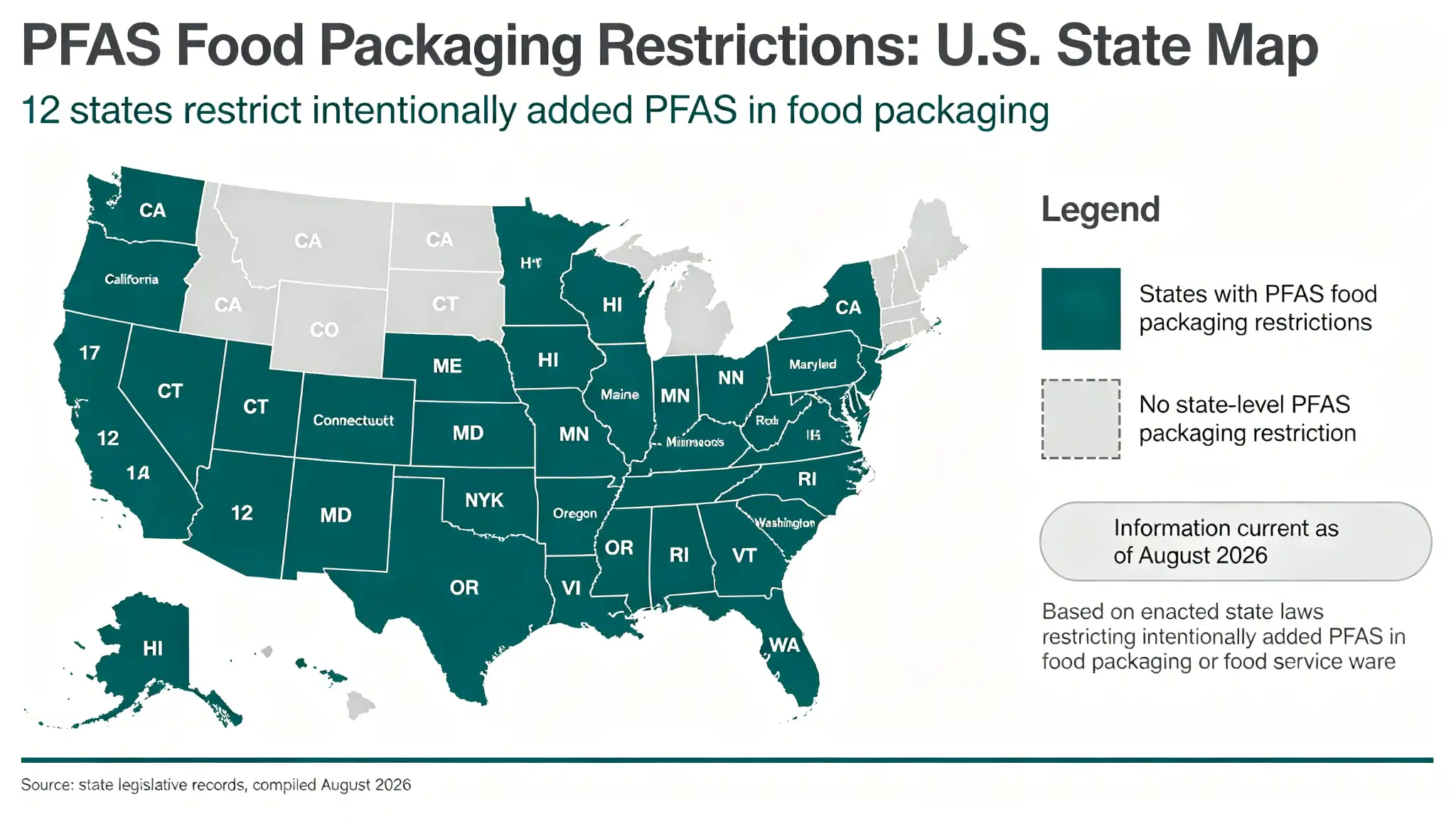
At least 12 US states have enacted their own version of a PFAS packaging ban restricting intentionally added PFAS in food packaging or food service ware: California, Colorado, Connecticut, Hawaii, Maine, Maryland, Minnesota, New York, Oregon, Rhode Island, Vermont, and Washington. Several took effect years ago, New York in December 2022, California in January 2023, but 2026 brought the year’s most consequential wave.
Maine’s plant-fiber food contact packaging restriction took effect May 25, 2026, barring manufacturers, suppliers, and distributors from offering trays, wraps, molded pulp containers, and fiber bowls with intentionally added PFAS above incidental presence, across nine specified categories. That deadline has now passed. Maine’s separate PFAS notification requirement to its Department of Environmental Protection took effect January 1, 2026, ahead of the state’s broader 2032 deadline banning intentionally added PFAS in virtually all consumer products unless deemed an unavoidable use.
Minnesota’s Amara’s Law took a different approach: PFAS has been barred from food packaging there since January 1, 2025, and manufacturers faced a July 1, 2026 reporting deadline to the Minnesota Pollution Control Agency, also now behind us, disclosing product details, PFAS purpose, and concentration for any covered product still on the market. Connecticut’s existing food packaging ban expanded into broader product categories on that same July 1 date, with a disclosure requirement ahead of a January 2028 outright ban.
This state-by-state expansion sits on top of a federal backdrop: the FDA confirmed in 2024 that manufacturers had voluntarily phased out PFAS-based grease-proofing agents in paper and paperboard food packaging, meaning those specific uses are no longer supplied into the US market at all. State bans remain relevant anyway because they cover more packaging formats, set enforceable testing thresholds, and create standing legal exposure that the voluntary federal phase-out doesn’t.
Canada: A Federal Regulation Replacement, Already in Effect
Canada’s approach to its own PFAS packaging ban framework looks different from the US state model. Rather than a packaging-specific statute, Canada regulates PFAS through the Prohibition of Certain Toxic Substances Regulations, which apply under the Canadian Environmental Protection Act. The 2025 version of these regulations was published in the Canada Gazette on December 31, 2025, and came into force on June 30, 2026, replacing the 2012 version and tightening restrictions on PFOA, PFOS, and long-chain perfluorocarboxylic acids, the same PFAS subgroups historically used in grease-resistant coatings for food packaging, narrowing the exemptions that previously allowed limited use.
This isn’t the end of Canada’s PFAS timeline for packaging specifically. The federal government’s broader risk management approach outlines a phased plan: firefighting foam restrictions targeted for spring 2027, followed by a second phase targeting consumer products with available alternatives, explicitly including food packaging degreasing agents, proposed for consultation in 2027 ahead of formal regulations. The June 2026 regulation tightens what’s already restricted; the food-packaging-specific rules most comparable to Maine’s or Minnesota’s are still a couple of years out.
The EU: The One Deadline Still Ahead
The EU’s approach to its PFAS packaging ban is the simplest of the three on paper, even if the underlying regulation is broader, and it’s the only deadline in this piece that hasn’t landed yet. Under PPWR, food-contact packaging faces a PFAS limit from August 12, 2026, 25 ppb for a single PFAS substance, or 250 ppb combined, applying uniformly across all 27 member states with no country-by-country variation. This threshold is one obligation within PPWR’s larger August 2026 deadline, not a separate law to track on its own calendar.
Why Three Non-Aligned Timelines Matter More Than Any Single One
None of these three regulatory tracks behind this PFAS packaging ban landscape reference each other, use the same testing thresholds, or share a compliance calendar. Maine’s deadline landed May 25. Minnesota’s and Connecticut’s landed July 1. Canada’s landed June 30. The EU’s lands August 12. A brand selling food-adjacent packaging into all three regions has spent the summer moving through four distinct dates inside one stretched window, each with different scope, different thresholds, and different enforcement mechanisms.
The practical risk isn’t any single deadline, it’s assuming that clearing one region’s pfas packaging ban requirement clears the others. Packaging that meets the EU’s 25/250 ppb threshold isn’t automatically compliant with Maine’s “any amount greater than incidental presence” standard for plant-fiber packaging, and passing a US state’s test says nothing about Canada’s forthcoming food-packaging-specific rules once those are finalized. Treating any single region’s rule as a stand-in for a global pfas packaging ban is the mistake that shows up as a compliance gap only once a shipment is already headed for a state, province, or country whose specific threshold wasn’t checked.
What This Means If You Sell Chocolate, Bakery, or Other Food-Adjacent Gift Packaging
Most rigid gift boxes and cosmetic cartons were never built around PFAS in the first place, the grease-resistance problem that drove most of these bans is specific to packaging in direct, sustained contact with oily or moist food, like pizza boxes, popcorn bags, and fast-food wrappers. But the category gets less clear-cut for chocolate boxes, bakery packaging, and other gift packaging with a food-contact liner or coated interior, where a moisture- or grease-resistant treatment may have been specified without anyone checking whether it’s PFAS-based.
For brands in that category, the practical step isn’t reformulating packaging on a guess, it’s confirming, in writing, what the interior coating or liner actually contains, particularly for anything shipping into Maine or Minnesota now that both deadlines are active, not upcoming.
How Topvisio Approaches This
Topvisio’s rigid gift boxes are built on paperboard structures rather than the coated, grease-resistant substrates that drove most PFAS packaging bans in the first place, which keeps the bulk of its product line outside the highest-risk category any PFAS packaging ban targets by default. For customers whose packaging does include a food-contact liner, coating, or laminate, chocolate box interiors and bakery packaging being the clearest examples, Topvisio maintains material composition records for those components as part of standard production documentation, available on request, so the question of what’s in a coating doesn’t have to be answered from scratch when a customer’s compliance team asks.
That documentation doesn’t substitute for a customer’s own legal review, pfas packaging ban compliance across three regions and a dozen-plus jurisdictions is ultimately the brand’s determination to make. What it does mean is that the underlying material data exists on request, rather than needing to be reconstructed after an order has already shipped into a restricted state.
FAQ
Is there one global PFAS packaging ban?
No, there is no single global PFAS packaging ban. The US operates through a patchwork of state laws, Canada regulates PFAS through a broader toxic substances framework rather than a packaging-specific statute, and the EU addresses it as one threshold within PPWR. Each uses different thresholds, scope, and enforcement.
Have Maine's and Minnesota's 2026 PFAS deadlines already passed?
Yes. Maine’s plant-fiber food contact packaging restriction took effect May 25, 2026, and Minnesota’s manufacturer reporting deadline landed July 1, 2026, alongside Connecticut’s category expansion the same day. All three are now active requirements, not upcoming ones.
What deadline is still ahead?
The EU’s PPWR PFAS threshold for food-contact packaging takes effect August 12, 2026, the only one of the four major 2026 dates covered here that hasn’t landed yet as of this writing.
Does a PFAS packaging ban apply to non-food packaging like gift boxes?
Generally, these laws target food packaging and food service ware specifically. Gift packaging without direct food contact typically falls outside scope, though packaging with a food-contact liner or coating, such as chocolate box interiors, can fall inside it depending on the state and the specific material used.
Has the US FDA banned PFAS in food packaging federally?
Not through a formal ban. The FDA confirmed in 2024 that manufacturers had voluntarily phased out PFAS-based grease-proofing substances in paper and paperboard food packaging, but state laws remain the enforceable mechanism covering a broader range of packaging formats and materials.