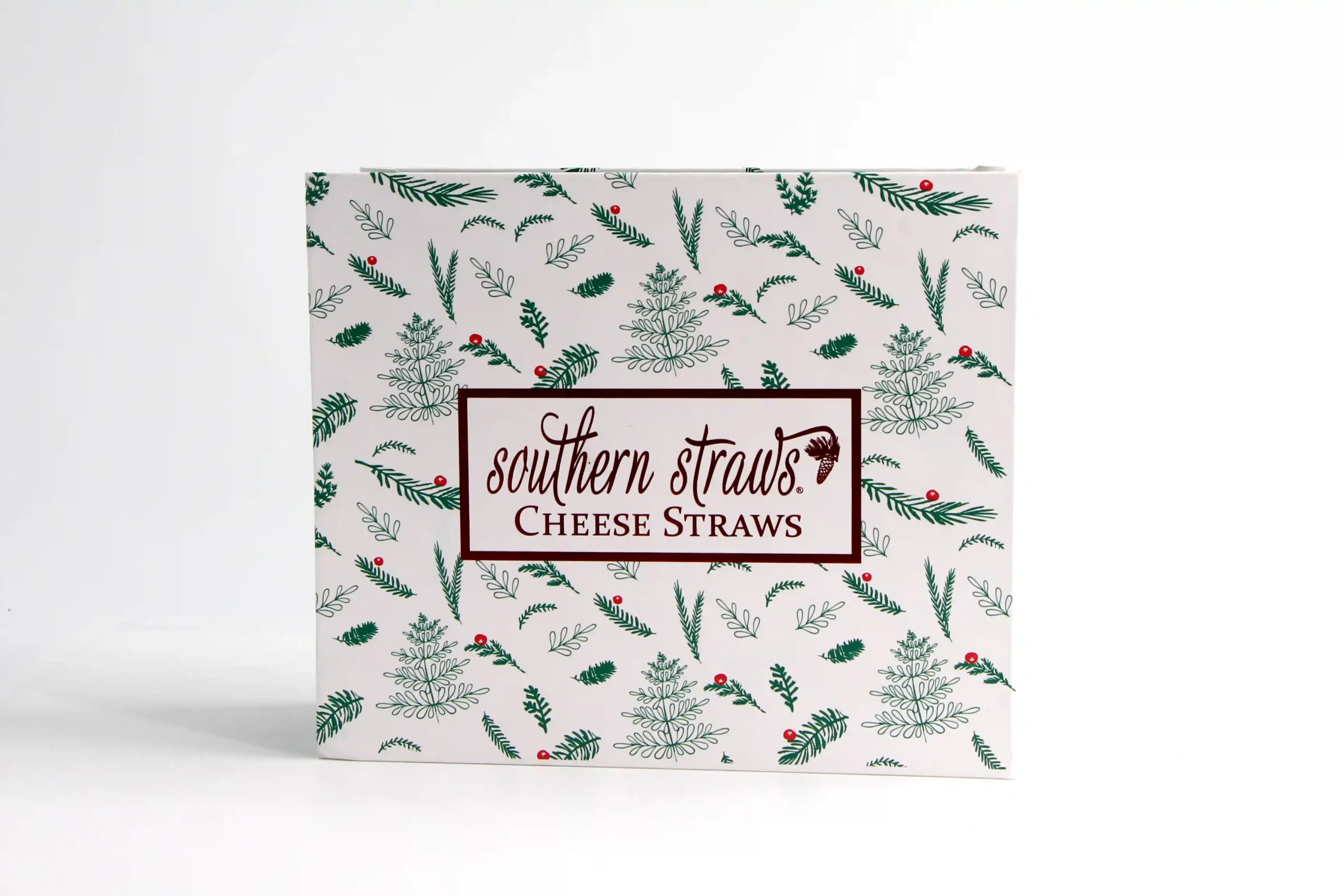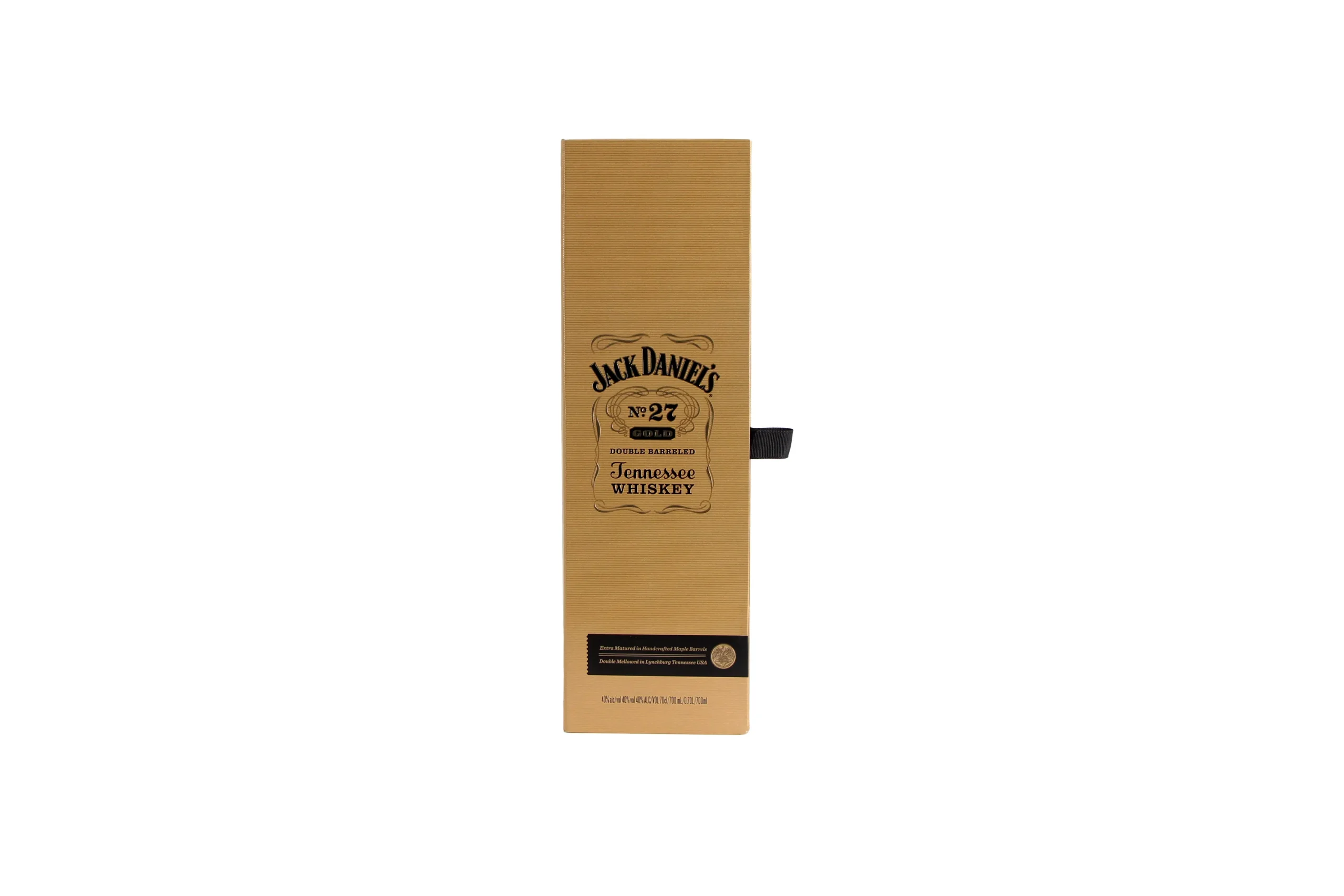
RFID cosmetic packaging puts a small radio tag, made of a chip and an antenna, into a beauty product’s label, carton or gift box so the item can be identified without being scanned by line of sight. Brands use it for anti-counterfeiting, stock counts, faster checkout and, increasingly, for linking a product to digital information.
Two launches in 2026 show where it is heading: Avery Dennison’s AD Flicker U9 inlay, built for retail goods including cosmetics, and INVENTRA, a shrink sleeve from Sleever and Avery Dennison with RFID built into the label itself. This guide explains how RFID cosmetic packaging works and what changes when the tag goes inside a printed box, based on our own RFID and NFC gift box projects at Topvisio Packaging in Dongguan, Guangdong, China, whose boxes ship with board FSC on request and meet PPWR compliant standards.
What Is RFID Cosmetic Packaging?
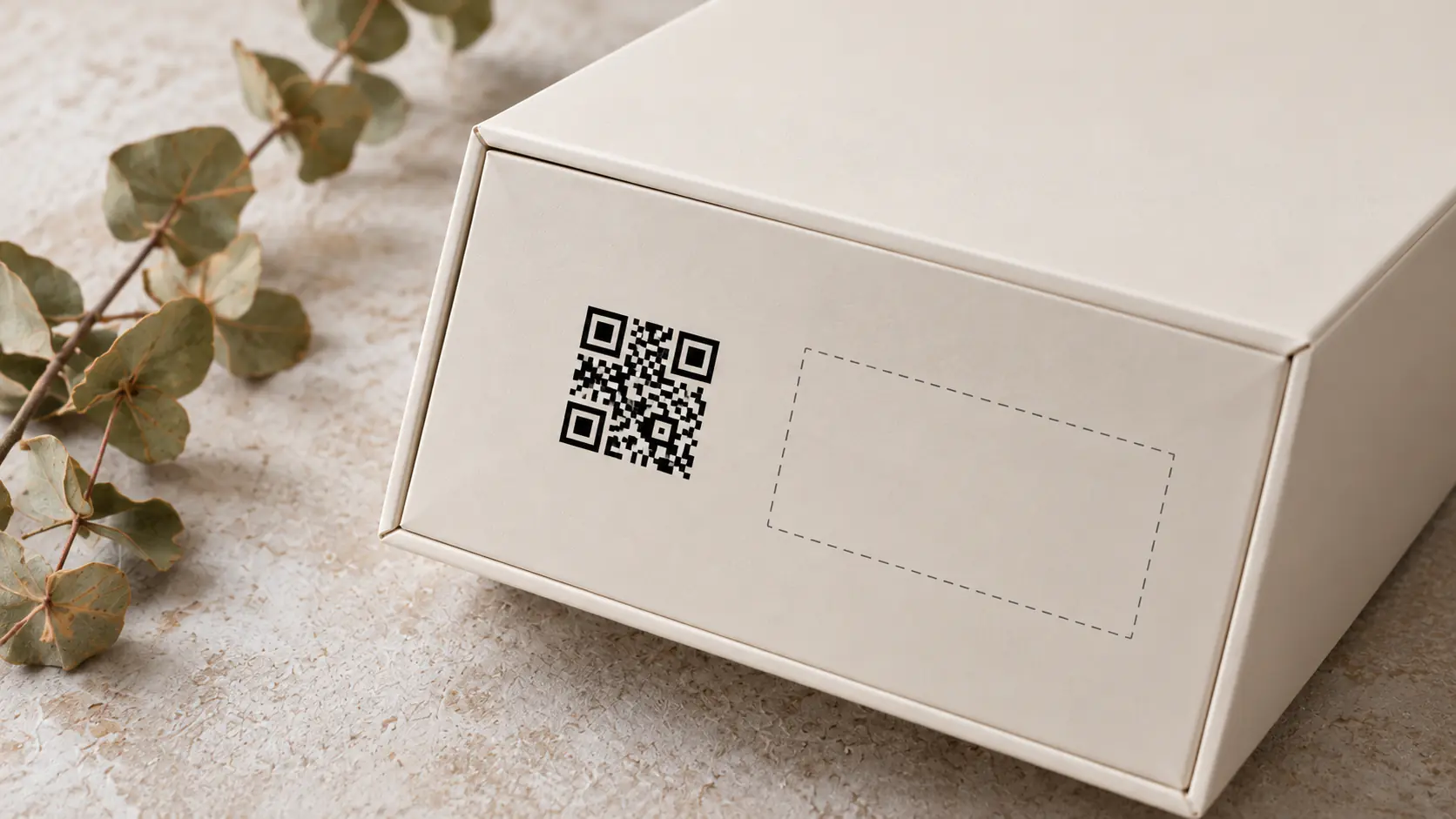
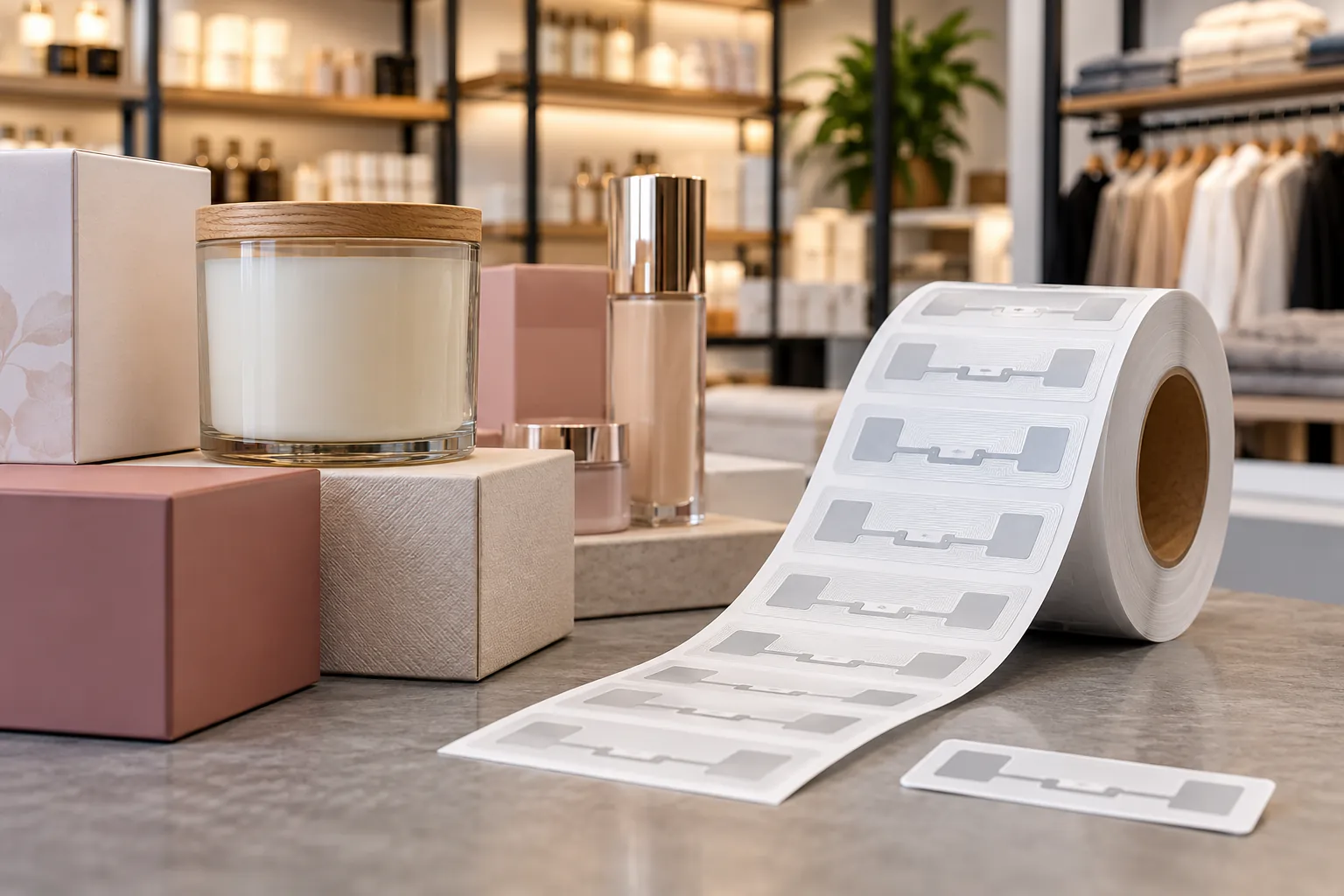
An RFID tag has two parts: a tiny chip that stores an ID and an antenna that lets a reader power and talk to it by radio. When the chip and antenna are mounted on a thin film, the result is called an inlay, and that inlay can be laminated into a label, glued inside a carton or hidden under the wrap paper of a rigid box. Nothing needs to be visible on the outside.
Two families matter for beauty brands. UHF RFID can be read from a distance and in bulk, so a whole carton of lipsticks can be counted in seconds. NFC, a short-range form of HF RFID, is read at a few centimeters by a phone, which makes it useful for authentication and consumer engagement. A lot of RFID cosmetic packaging uses UHF for the supply chain and NFC for the customer, sometimes in the same box.
Two 2026 Launches Worth Knowing
Avery Dennison describes the AD Flicker U9 as a UHF tag and inlay for nearly all merchandise, naming decor, candles, apparel and cosmetics among its uses. Its antenna measures 48 by 11 mm, a narrow shape that fits labels and hang tags. The company says it has been tested against Auburn University’s ARC specifications, a common benchmark retailers use to approve tags. Those are supplier statements, and real read performance will depend on the product and the pack around it.
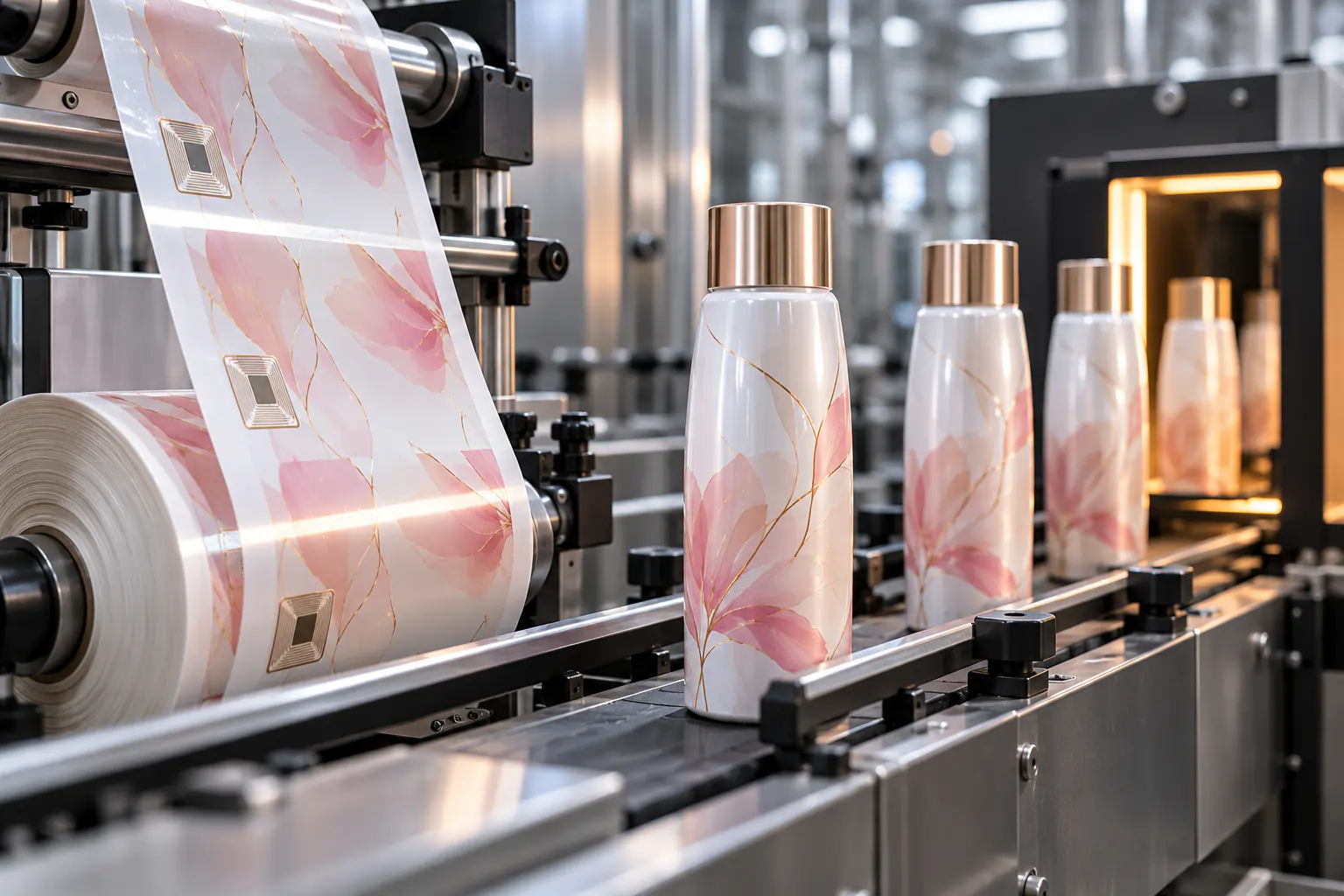
INVENTRA takes a different route. Unveiled at Paris Packaging Week in February 2026 and reported by Premium Beauty News, it builds RFID into the heart of a shrink sleeve label rather than sticking a tag on the surface.
The companies are targeting makeup, where the sheer number of shades makes inventory hard to manage, and they point to security, traceability, inventory, self-checkout and consumer experience as the main uses. They also link it to the EU’s coming digital product passport, part of the Ecodesign for Sustainable Products Regulation.
Why Beauty Brands Are Adopting RFID Cosmetic Packaging
The first reason is counterfeiting. Fake fragrance and skincare are a constant problem, and a tag with a unique ID is far harder to copy than a hologram. The second is inventory. Makeup ranges can run to hundreds of shades, and counting them by hand is slow and error-prone.
Bulk UHF reads make cycle counts fast and show what is actually on the shelf. The third is the customer. An NFC tag in a box can open a product page, a refill offer or a proof-of-authenticity screen when tapped with a phone. Each of these gives RFID cosmetic packaging a different job, and the job decides the tag type, so define it before you choose a supplier.
Tag on the Bottle or Tag in the Box?
INVENTRA and most retail labels put the tag on the primary pack: the bottle, jar or tube. That is the right choice when the item will be sold without its outer box, or when the tag must follow the product into the customer’s bathroom. The alternative is to build RFID cosmetic packaging at the secondary level, inside the carton or gift box. This suits sets, premium gift boxes and products where the box is the main brand experience.
| Specification | Tag on Primary Pack | Tag in Carton or Gift Box |
|---|---|---|
| Typical format | Label, shrink sleeve or hang tag | Inlay under wrap paper, in the insert or on an inner panel |
| Best for | Single items, item-level tracking after sale | Gift sets, limited editions, premium presentation boxes |
| Visibility | Can be hidden in the label | Fully hidden inside the structure |
| Main risk | Liquid contents and curved surfaces affect reads | Metal finishes and magnets near the tag affect reads |
| Who applies it | Label or sleeve converter | Box manufacturer during production |
What Affects RFID Cosmetic Packaging Inside a Gift Box?
Radio waves do not like metal or water. Both reflect or absorb the signal and can stop a UHF tag from reading at all. In a cosmetic gift box, metal turns up more often than people expect. Large areas of hot foil, metallized paper and metallic board all sit right on top of where a tag might go.
Magnetic closures are another source, because the magnets and any steel plates sit in the lid or flap. Our guide to hot stamping foil and our notes on magnet grades are useful background when you plan a box with both a tag and these finishes.
Liquids matter too in RFID cosmetic packaging. A serum or perfume bottle sitting directly against a UHF inlay can weaken the read. Moving the tag a few millimeters away, into the insert or the base board, often helps. Finally, think about privacy and data. If the tag stays active after sale, say so in your packaging or product information, and keep what it stores to what the program actually needs.
Topvisio Insights: How We Build RFID and NFC Into Gift Boxes
We have built gift boxes with embedded RFID and NFC tags, and the work is mostly about placement and testing rather than the tag itself. The inlay is placed during box production, usually under the wrap paper or within the insert, so nothing shows on the finished box. Because we make the structure, we can position the tag away from foil areas and magnets from the start instead of trying to fix reads after the design is locked.
Our advice to brands is to choose the tag and the box design together. If the artwork calls for a fully foiled lid and a magnetic closure, the tag needs a home well away from both, and that may mean placing it in the base or the insert. We confirm reads on a packed sample with the real product inside before mass production, so a pallet of finished boxes does not turn out to be invisible to the reader at the warehouse door.
How to Plan an RFID Cosmetic Packaging Project
Most projects go smoothly when the brand, the box maker and the RFID partner agree on four things before artwork is final. First, decide what the tag is for, because inventory, authentication and consumer content each point to a different tag type and read range. Second, confirm the reader setup at the warehouse or store, since a tag that reads well on a handheld may struggle at a dock door.
Third, map the box design: where the foil sits, whether there is a magnetic closure and where the product touches the walls. Fourth, agree on how many packed samples will be tested and what read rate counts as a pass.
Sustainability should be part of the same conversation. An inlay adds a small amount of film, metal and chip to an otherwise paper-based box, so it is worth asking how the tagged box will be recycled in your main markets. The board around the tag can still be sourced with FSC certification on request, and keeping the inlay small and easy to separate helps. Treat RFID cosmetic packaging as a system, not a sticker, and the first production run will behave like the sample did.
Is RFID Cosmetic Packaging Worth It for Smaller Brands?
For RFID cosmetic packaging, it depends on the problem you are solving. For a brand selling through its own website, NFC for authentication or engagement is often enough, and the extra cost per box is modest. For a brand entering large retailers, UHF may become a requirement, because more retailers expect item-level tags from suppliers. In both cases, start with a limited run, check the reads in real conditions, then scale. RFID cosmetic packaging pays off when it replaces a manual process, not when it is added as decoration.
To see how a tagged box could fit your range, browse our luxury cosmetic packaging and custom cosmetic boxes, then send us your product list and the reader setup you plan to use.
FAQ
What is RFID cosmetic packaging used for?
It is used for anti-counterfeiting, fast stock counts, retail self-checkout and consumer engagement. UHF tags serve the supply chain and NFC tags let customers tap the pack with a phone.
Can the tag in RFID cosmetic packaging be hidden inside a gift box?
Yes. The inlay can sit under the wrap paper, inside the insert or on an inner panel, so nothing is visible on the outside. It is placed during box production.
Does foil stamping stop RFID from working?
Large areas of foil, metallized paper and magnets near the tag can block or weaken UHF reads. Keeping the tag away from these areas, and testing a packed sample, avoids the problem.
What is the difference between RFID and NFC in packaging?
NFC is a short-range type of RFID read by phones at a few centimeters, which suits authentication and consumer content. UHF RFID reads at longer range and in bulk, which suits inventory and logistics.
Can Topvisio make RFID cosmetic packaging?
Yes. We build gift boxes with embedded RFID and NFC tags at our Dongguan factory, with 14+ automated lines and ISO 9001, ISO 14001 and SEDEX in place. Board is available FSC on request.
How long does an RFID cosmetic packaging sample take?
A box sample is ready 7 working days after the spec is signed off, plus any lead time for the inlay you choose, and orders start at 1,000 units per design. More on our capabilities at Topvisio Packaging.