Most brands ordering a magnetic-closure gift box never ask what grade of magnet is inside it. They feel the click, it holds, the box looks premium, done. But with neodymium pricing having swung sharply and unpredictably through 2026, that’s exactly the magnet grade most likely to get quietly downgraded without anyone noticing.
This piece covers what the grade codes actually mean, what they cost, and how to make sure your purchase order protects you from a substitution you’d never catch by eye.
What N35, N42, and N52 Actually Mean
The number after the N is the magnet’s maximum energy product, measured in mega-gauss oersteds, in plain terms, how much magnetic strength is packed into a given volume. Higher number means a stronger magnet, but the relationship between magnet grade and price isn’t linear.
Grade | Max Strength (BHmax) | Typical Use Case | Cost vs N42 |
N35 | 33–35 MGOe | Lightweight closures, displays, low-cost SKUs | Lower |
N42 | 40–42 MGOe | Standard choice for magnetic clasps and box closures — best strength-to-cost ratio | Baseline |
N48–N52 | 48–52 MGOe | High-torque motors, compact industrial holding — rarely needed for a gift box | ~2x, for ~20% more strength |
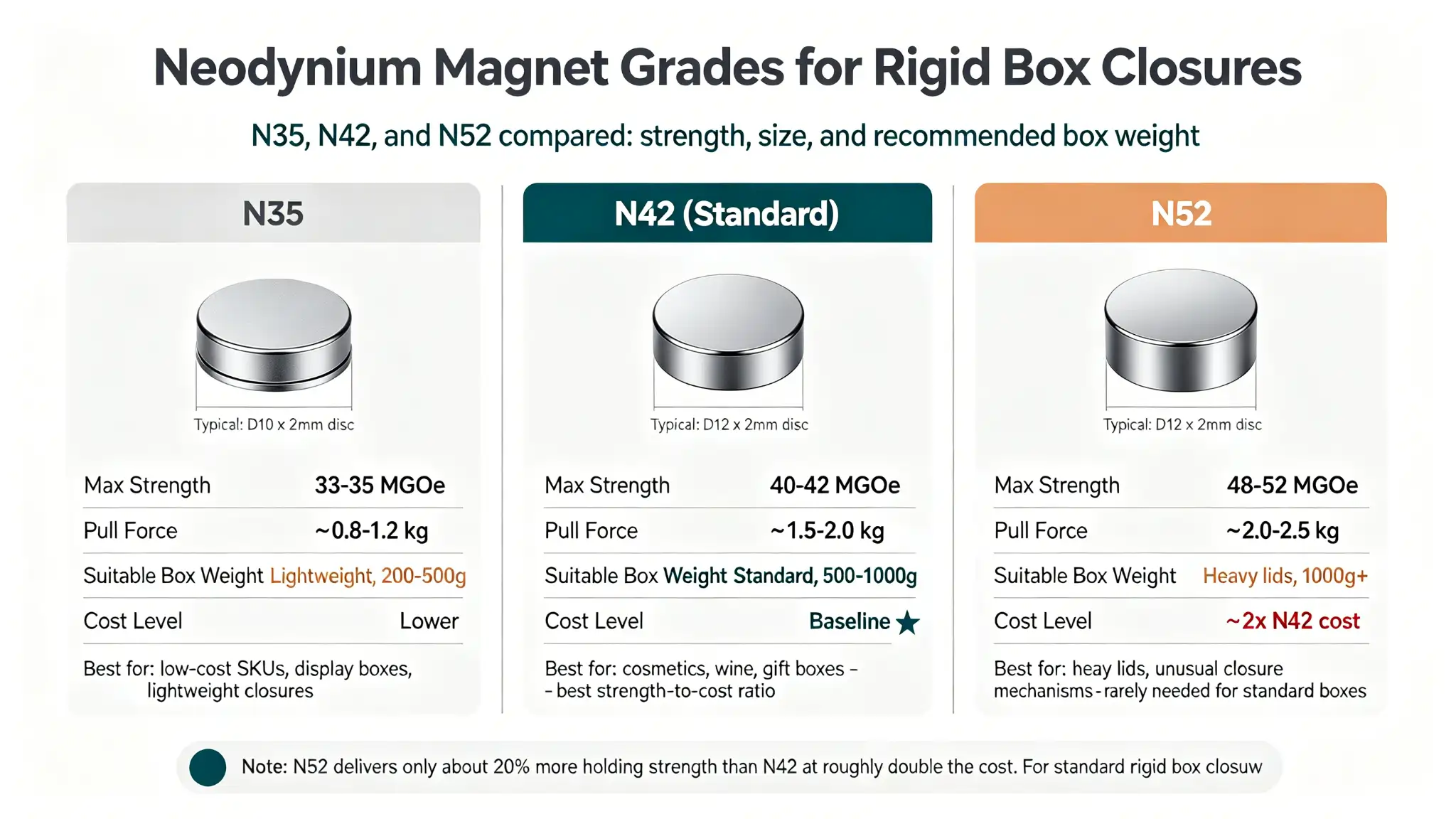
An N52 magnet typically costs around twice as much as an N42 of the same size, while delivering only about 20% more holding strength, per Mainrich’s grade explainer. For a rigid box closure, where the magnet just needs to hold a lid shut, N42 is the magnet grade nearly every legitimate manufacturer specifies, and the grade you should expect to see on your bill of materials unless there’s a specific reason for more.
Why This Matters More in 2026 Specifically
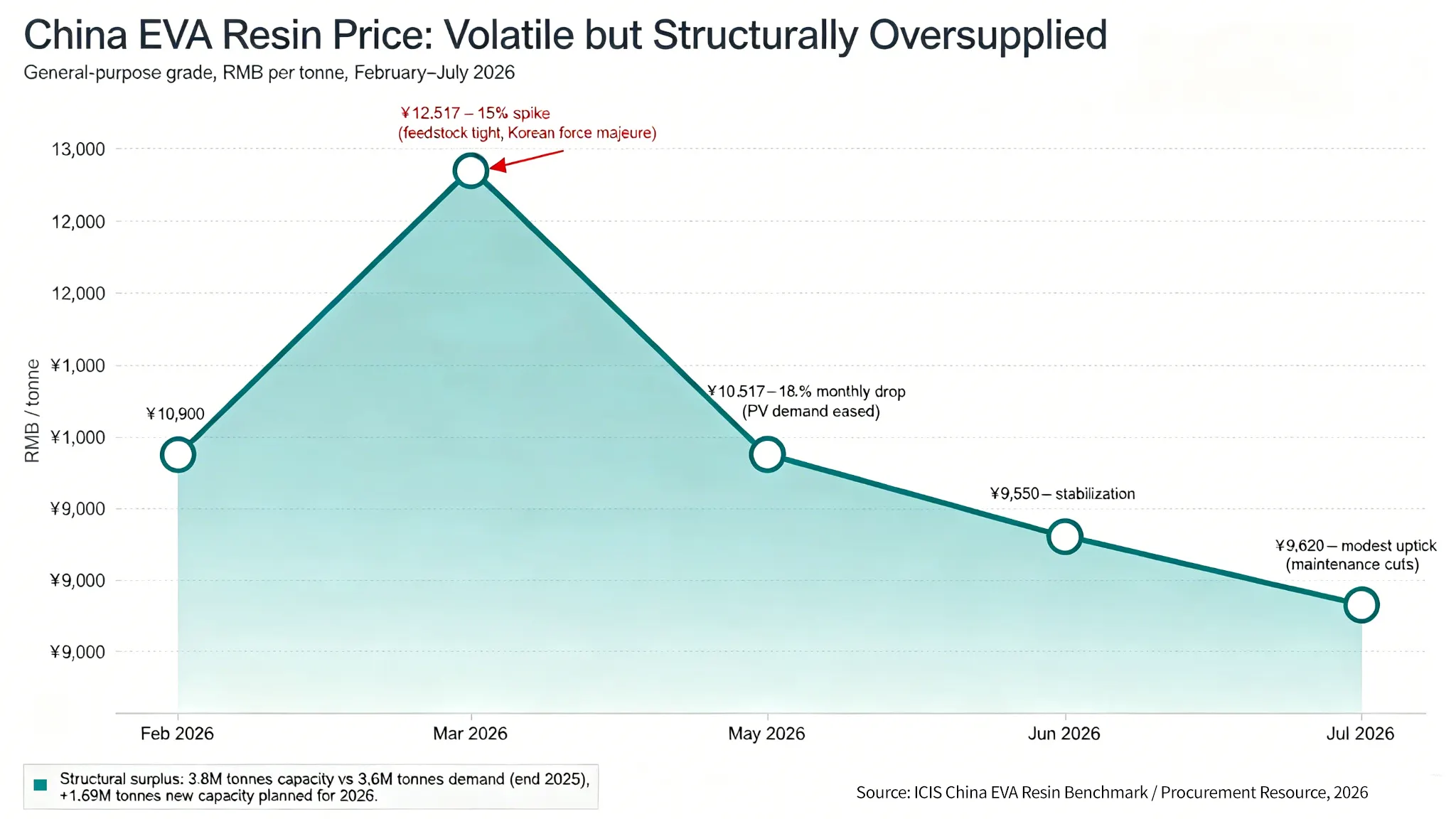
Magnet pricing has been unusually volatile this year, and the volatility hasn’t settled the way an early-summer snapshot might have suggested. The praseodymium-neodymium alloy that feeds NdFeB magnet production opened January at roughly $53/kg, spiked to $136.70-139.60/kg by late April, corrected to around $90/kg by June 1, then climbed back to roughly $133/kg by early July, a new high for the year. That kind of swing creates real pressure on converters to quietly substitute a lower magnet grade or a thinner magnet without telling the buyer, especially on fixed-price orders placed before the spike.
We covered the full price story, what drove it and what it means for your cost, in our foil and magnet price report. This piece focuses on the part that price alone doesn’t fix: making sure you’re actually getting the magnet grade you’re paying for.
The Substitution Risk Is Real, Not Theoretical
Magnet suppliers in the wider industry have documented this directly. One Mainrich sourcing guide notes plainly that material labeled N42 can test closer to N38 in practice, and that a temperature rating proven only in a lab can fail once the magnet is sealed inside a hot, humid assembly. The same source describes a client who used N52 magnets in an outdoor application; after 18 months of sun exposure, roughly 40% had partially demagnetized, not because N52 is a bad grade, but because it was the wrong grade for the operating conditions, and nobody had verified it against real-world performance before committing to volume.
A gift box closure isn’t outdoor industrial equipment, but the underlying lesson holds: the magnet grade printed on a spec sheet and the grade actually delivered in a production batch aren’t always the same thing, and the gap is invisible until the product underperforms, a magnet that feels weak after a few months, or a closure that doesn’t hold as firmly as the sample did.
What this costs you if it goes wrong: a magnetic box that holds well in the sample round but loosens after a few months in the customer’s hands reads as a quality failure, not a magnet grade issue, and the customer has no way to know the difference. The fix costs nothing at the ordering stage, specify the grade in writing, and a great deal after the fact in returns, reputation, and a reorder you don’t get.
How to Specify Magnet Grade Correctly on Your PO
Name the grade explicitly. “Magnetic closure” is not a specification. “N42 NdFeB, nickel-plated” is. Put the grade, the coating, and the dimensions in writing on the purchase order, not just in a verbal conversation with your sales contact.
Ask for the demagnetization curve or a batch test report. A reputable supplier can show you remanence and coercivity data for the actual batch, not just a generic datasheet for the grade. If a supplier can’t produce this on request, that’s worth noting.
Test the sample, not just the photo. Pull force is felt, not seen. If your sample arrives and the magnet holds noticeably weaker than expected for the stated grade, ask before approving the production run, not after 5,000 units ship.
Match the grade to the job, not the marketing. N52 sounds more impressive on a spec sheet, but for a standard box closure it adds roughly double the magnet cost for a holding-force improvement most customers will never notice by hand. N42 is the right call for the overwhelming majority of magnetic-closure gift boxes.
What It Actually Costs at Each Grade
Using the current NdPr benchmark near $133/kg as the raw material base, and a typical 15-25 gram magnet content per box closure: N35 sits at the lowest relative magnet material cost but is only acceptable for very light, low-cost SKUs, since the weaker hold is noticeable to a customer on a premium box. N42 sits at baseline cost and remains the standard recommendation for magnetic-closure rigid boxes across cosmetics, wine, and gifting categories. N48-N52 runs roughly twice the N42 cost and is rarely justified for a gift box, since the extra holding force isn’t perceptible in normal use.
Where Topvisio Stands on This
We specify N42 as our standard magnet grade for magnetic-closure boxes, with the grade and coating written into every quote, not left as an unstated default. If a project genuinely needs a different grade, a heavier lid, an unusual closure mechanism, we’ll say so and explain why, rather than defaulting to whatever is cheapest that week. See our Magnetic Gift Box, Magnetic Closure Box, and Rigid Gift Box lines for grade-specified quoting.
FAQ
What magnet grade should a rigid gift box use?
N42 is the standard recommendation for magnetic-closure gift boxes. It offers the best strength-to-cost ratio for this application, roughly 20% stronger than N35 at a moderate cost premium, while N52 costs about double N42 for holding force most customers won’t notice by hand.
How can I verify my supplier is using the magnet grade they claim?
Request the demagnetization curve or a batch test report showing remanence and coercivity for the actual production batch, not a generic datasheet for the grade name. Test the physical sample’s pull force directly before approving a production run.
Why did magnet prices spike so much in 2026?
The core input, praseodymium-neodymium alloy, rose from roughly $53/kg in January to $136.70-139.60/kg by late April, corrected to around $90/kg by June, then climbed back to roughly $133/kg by early July. See our full foil and magnet price breakdown for the complete picture.
Is a stronger magnet grade always better for a gift box?
No. Higher grades like N52 add meaningful cost without a noticeable improvement in user experience for a standard box closure. The right approach is matching the magnet grade to the actual job, not defaulting to the strongest available option.