PPWR is the new EU packaging law, and it becomes fully applicable on August 12, 2026. Formally titled Regulation (EU) 2025/40, PPWR replaces the Packaging and Packaging Waste Directive that had been in place since 1994. Unlike a directive, PPWR is a regulation — it applies the same way in all 27 EU member states on the same date, with no national transposition and no grace period for existing stock.
If your business ships rigid boxes, gift packaging, cartons, or any product packaging that ends up in the EU — directly or through a customer — PPWR already applies to your supply chain planning. Here are five things worth understanding before the deadline.
PPWR Is a Regulation, Not a Directive — and That Changes Everything
For three decades, EU countries handled packaging waste under their own national versions of a shared directive. Germany had one set of rules, France had another, and a supplier shipping to both had to track two rulebooks. PPWR ends that. Because it’s a regulation rather than a directive, it applies directly and identically across the entire bloc from the moment it takes effect. A gift box that meets PPWR requirements in the Netherlands meets them in Poland too.
This matters for sourcing decisions. A packaging supplier that says “we follow EU rules” without specifying PPWR by name may still be working off outdated, country-specific standards from the old directive era. It also means the patchwork of national recycling logos is going away. Country-specific recycling symbols are being phased out in favor of one harmonized EU labeling system, expected to apply by August 2028, so packaging designed today should leave room for a label format that hasn’t been finalized yet.
Penalties, however, are not harmonized. Unlike some other EU sustainability rules that set a bloc-wide fine structure, PPWR leaves enforcement and penalty levels to individual member states. The practical risk of getting it wrong — how strictly customs checks it, how steep the fine is — depends on which country’s market surveillance authority is looking at your packaging.
The Core Deadline Is August 12, 2026 — With No Transition Period
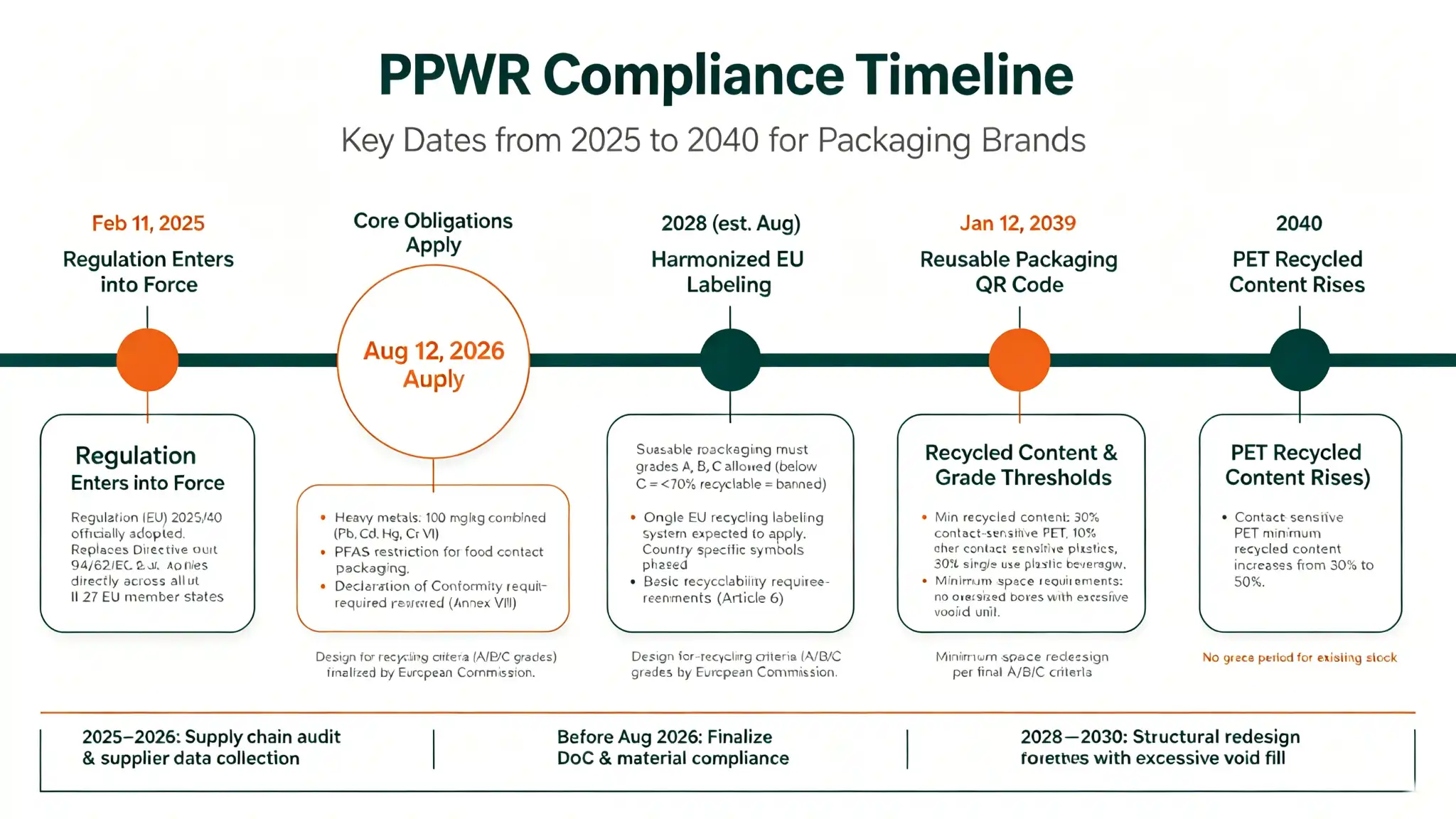
PPWR entered into force on February 11, 2025, but the obligations that matter to most businesses start on August 12, 2026. From that date:
Combined concentration limits for lead, cadmium, mercury, and hexavalent chromium are capped at 100 mg/kg.
Recycled Content and Recyclability Grades Follow in 2030
Not every PPWR obligation lands in 2026. The material-heavy requirements are staged further out, giving supply chains time to adjust — but the lead time is shorter than it looks once you account for redesign and sourcing cycles.
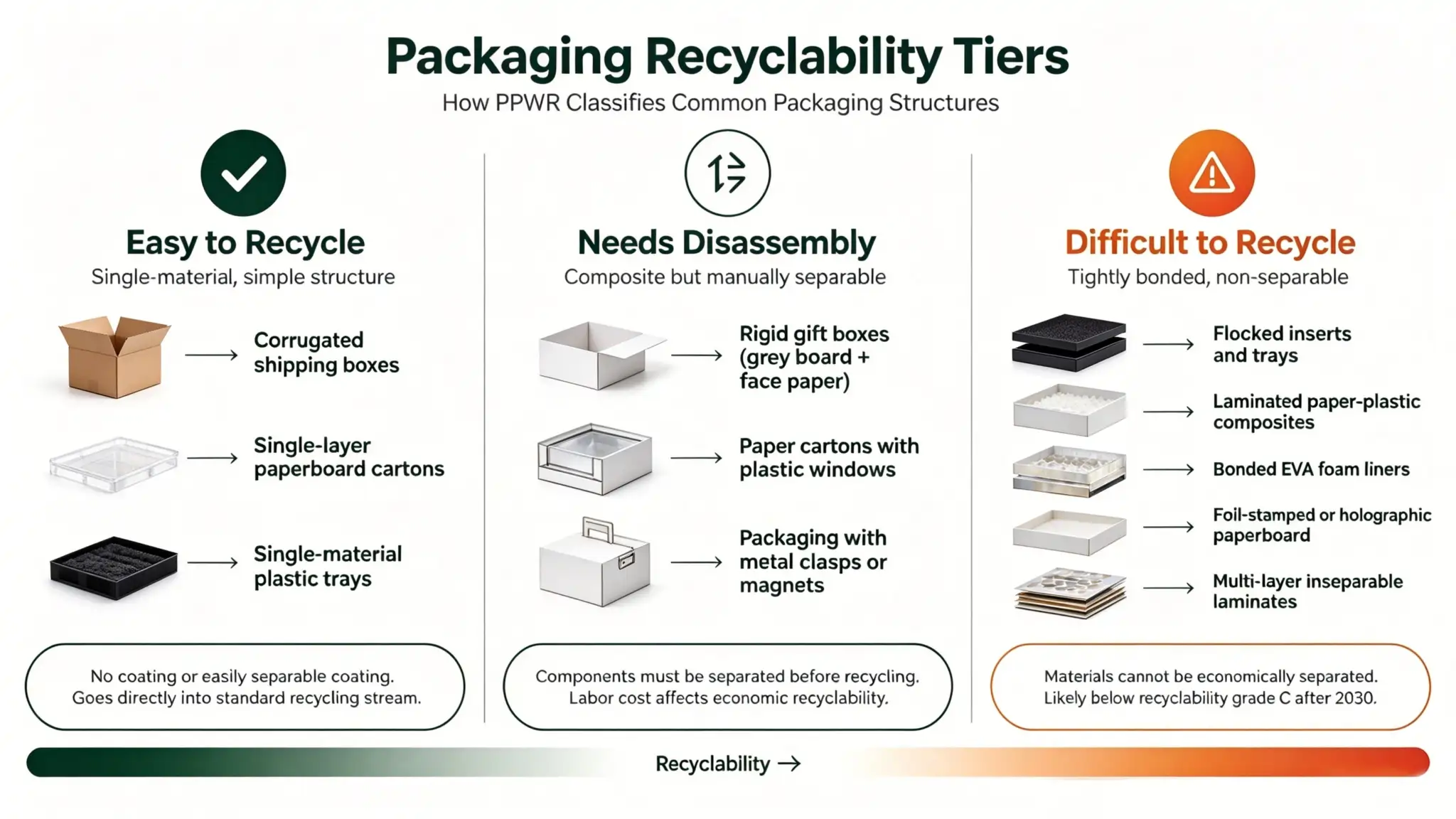
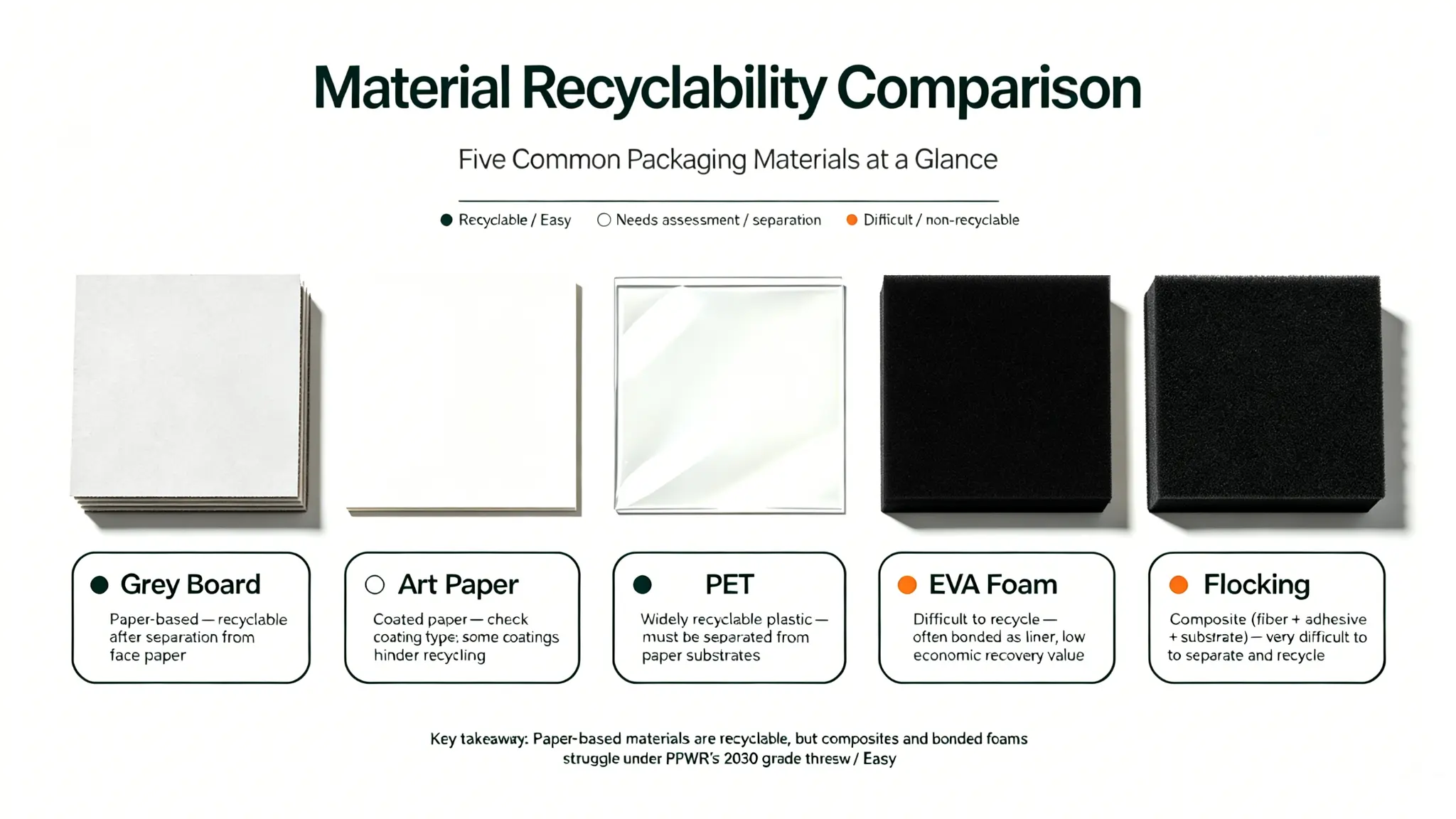
From January 1, 2030: – Only packaging rated recyclability grade A, B, or C can stay on the EU market. Below grade C — meaning less than 70% recyclable by weight — is treated as non-recyclable and barred from sale. – Minimum recycled content kicks in for plastic packaging: 30% for contact-sensitive PET (rising to 50% by 2040), 10% for other contact-sensitive plastics, and 30% for single-use plastic beverage bottles. – Packaging must meet minimum-space requirements — no oversized boxes with excessive void fill.
Separately, reusable packaging will need QR-code labeling from February 12, 2029, carrying environmental and operational data for each unit.
The 2030 deadline looks distant, but the design-for-recycling criteria that determine those A/B/C grades won’t be finalized by the European Commission until 2028, and companies get roughly 24 months from that point to comply. In practice, that leaves less runway than the 2030 date suggests, especially for anyone whose packaging needs a structural redesign rather than a materials swap. Waiting until the criteria are published before starting supplier conversations is likely to mean rushing a redesign in year one of a two-year window.
Further reading:PPWR compliance timelines guide · Avery Dennison on PPWR recycled content rules
A Common Misconception: PPWR Isn’t Just About Plastic
Because so much PPWR coverage focuses on recycled plastic content, it’s easy to assume paperboard, rigid boxes, and cardboard packaging are outside the scope. They’re not. PPWR’s definition of packaging in Article 3 covers any article used to contain, protect, handle, deliver, or present a product, regardless of material. Rigid gift boxes, cosmetic cartons, and printed paperboard packaging all fall under the same recyclability, labeling, and documentation rules as plastic packaging — they’re simply less likely to hit the plastic-specific recycled-content thresholds. A rigid box brand that assumes PPWR is “a plastics regulation” and skips the documentation conversation with its supplier is making the same mistake as a plastics brand that ignores it entirely.
Your Role Under PPWR Decides Who’s on the Hook
This is the part most explainer articles skip, and it’s the one that actually determines who does the paperwork. PPWR assigns different legal roles to different links in the supply chain, and the obligations are not shared equally.
The Manufacturer is whoever’s name or brand appears on the packaging. If a UK homeware brand buys rigid boxes from an overseas factory and puts its own logo on them, the brand is the Manufacturer — even though it never touched a production line. Manufacturers carry the heaviest load: technical documentation, conformity assessment, and the Declaration of Conformity.
The Supplier is the company that makes or provides the packaging or packaging materials to be branded by someone else. A supplier generally doesn’t carry direct PPWR compliance liability, but it does need to supply accurate material, recyclability, and recycled-content data so the Manufacturer can meet its own obligations.
Importers and Distributors sit in between, mainly responsible for verifying that documentation exists rather than creating it from scratch.
The same company can hold different roles for different products, and even different roles in different EU countries for the same product, depending on where it’s first placed on the market. This is why compliance can’t be handled at the company level — it has to be assessed SKU by SKU, market by market.
There’s a fourth role worth knowing: the Producer, which carries Extended Producer Responsibility (EPR) — financing the collection and recycling of packaging waste. This registration happens per country, not once for the whole EU. A brand selling into Germany registers with LUCID, into France with CITEO, into Spain with Ecoembes — three separate systems, three separate fee structures, three separate reporting calendars. A brand selling into a dozen EU markets is looking at a dozen separate registrations, which is often the single most underestimated administrative cost in the entire rollout.
Further reading:PPWR roles explained · PPWR supply chain roles guide · Distinguishing manufacturers and producers under PPWR
What This Means If You Buy Rigid Boxes or Gift Packaging
If you’re a brand sourcing rigid gift boxes, cosmetic packaging, or custom cartons for the EU market, you’re most likely the Manufacturer under PPWR — which means the documentation burden sits with you, not your factory. But you can’t produce that documentation without accurate data from the supplier side: material composition, recycled-content percentages with proper chain-of-custody backing, and recyclability information mapped to the design-for-recycling criteria PPWR is still finalizing through 2028.
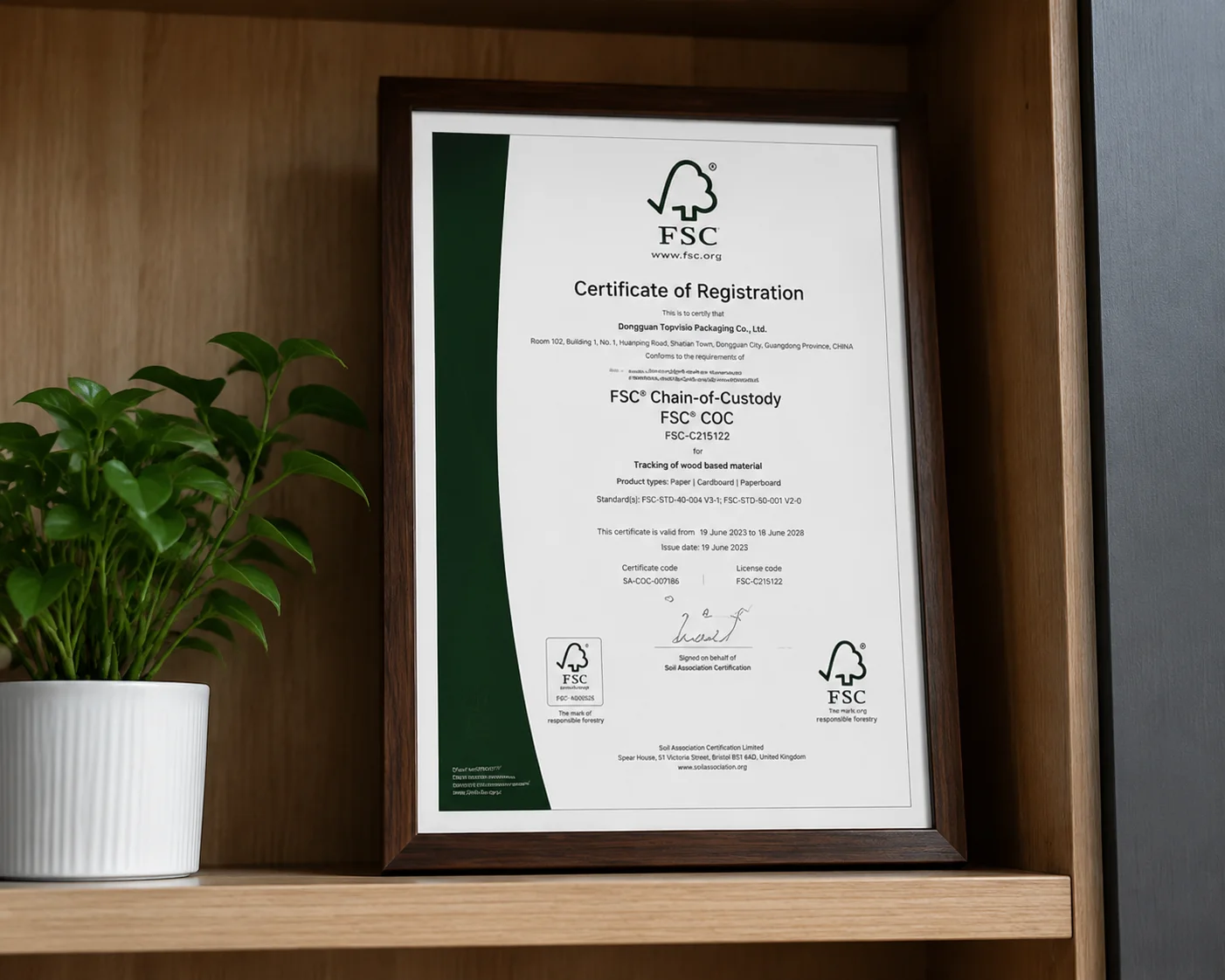
This is where the supplier relationship becomes a compliance relationship, not just a production one. A factory that can hand over a marketing brochure calling its boxes “eco-friendly” is not the same as a factory that can produce material specifications, FSC-chain-of-custody records, and recycled-content data broken down by packaging line.
Topvisio works from that second position. As a rigid gift box manufacturer supplying brands across the US, EU, Middle East, and APAC, Topvisio maintains FSC-linked sourcing documentation and material records as a standard part of production, not something assembled after a customer asks for it. That includes traceable paperboard sourcing, supplier-level certification records, and material specifications organized by product line rather than scattered across old email threads.
That structure doesn’t make Topvisio the party responsible for signing a Declaration of Conformity — under PPWR, that obligation sits with the brand placing packaging on the EU market. What it does mean is that a brand working with Topvisio isn’t starting its documentation process from zero. For brands preparing for August 2026, that’s the practical difference between a packaging supplier and a PPWR-ready one: whether the paperwork exists before you ask for it, or after.
If you want the full deadline breakdown from 2026 through 2030, see our companion article on EU PPWR regulation timelines. And if you’re ready to check whether your current supplier can actually back up its sustainability claims, our guide on what to ask a PPWR packaging supplier walks through the exact questions to raise before your next order.
FAQ
Does this apply to companies outside the EU?
Yes. Any business whose packaging or packaged goods reach an EU consumer is affected, regardless of where the factory or head office is based. Non-compliant shipments can be held or refused at the border after August 12, 2026.
Is PPWR the same as the old Packaging Directive?
No. Regulation (EU) 2025/40 replaces Directive 94/62/EC entirely. The old directive let each country write its own implementing law; the new regulation removes that flexibility and applies one text across all 27 member states.
Do small businesses get an exemption?
Only a narrow one. Micro-enterprises — fewer than 10 employees and under €2 million in turnover — are exempt from certain packaging-design obligations, but they still have to supply compliant packaging when trading with larger partners, and the exemption doesn’t cover every obligation in the regulation.
What happens to packaging already in warehouses on August 12, 2026? It still has to comply. There’s no stock exemption written into the regulation, which is different from how some transition periods have worked in the past. Brands with long production lead times or seasonal stockpiling — gift packaging ordered months ahead of a holiday season is a good example — need to account for this when planning print runs and factory orders for late 2025 and early 2026, not just for shipments placed after the deadline itself.
Send us your product specs and target market — we’ll respond with material recommendations, structural options, and a sample within 7 days.
Related Articles
12:06 pm
What Is Bespoke Packaging? Benefits for Your Brand
8:25 am
How to Design Cosmetic Packaging That Sells
Extended producer responsibility for packaging: who's responsible, which countries have EPR, and what buyers need to know. FSC on request, PPWR compliant.